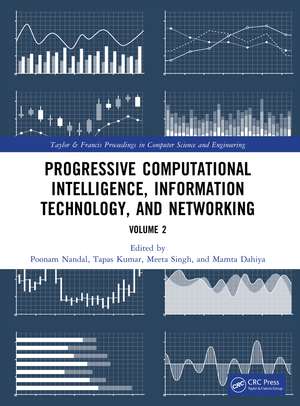
Progressive Computational Intelligence, Information Technology, and Networking: Volume 2: Taylor and Francis Proceedings in Computer Science and Engineering
Editat de Poonam Nandal, Tapas Kumar, Meeta Singh, Mamta Dahiyaen Limba Engleză Paperback – 28 iul 2026
The book covers foundational and advanced topics in computational intelligence, including machine learning algorithms, deep learning architecture, evolutionary computing, and fuzzy systems. It further examines information technology frameworks such as cloud computing, big data analytics, cybersecurity mechanisms, and distributed systems. In the networking domain, it discusses Internet of Things (IoT), network security, and performance optimization techniques. Through case studies and applied research findings, the book highlights how intelligent models enhance automation, predictive analysis, and decision-making across sectors like healthcare, smart cities, finance, and education. Emphasis is placed on scalability, efficiency, and integration of AI-driven solutions with modern networking environments. The main findings demonstrate that the convergence of computational intelligence with IT and networking significantly improves system adaptability, resource management, and real-time data processing capabilities.
This book is intended for postgraduate students, research scholars, academicians, and industry professionals in computer science, information technology, and electronics engineering. It is particularly valuable for those specializing in artificial intelligence, data science, networking, and cybersecurity who seek updated knowledge on emerging intelligent technologies and integrated computing systems.
Din seria Taylor and Francis Proceedings in Computer Science and Engineering
- 20%
 Preț: 441.41 lei
 - 20%
 Preț: 433.51 lei
 - 20%
 Preț: 439.92 lei
 - nou
 Preț: 455.98 lei
 - 20%
 Preț: 438.78 lei
 - 18%
 Preț: 1359.37 lei
 - 20%
 Preț: 393.36 lei
 - 20%
 Preț: 394.16 lei
 - nou
 Preț: 444.47 lei
 - 20%
 Preț: 1370.51 lei
 - 29%
 Preț: 2060.42 lei
 - nou
 Preț: 360.91 lei
 - nou
 Preț: 365.62 lei
 - nou
 Preț: 362.86 lei
 - nou
 Preț: 369.47 lei
 - nou
 Preț: 360.48 lei
 - nou
 Preț: 352.68 lei
 - nou
 Preț: 364.47 lei
 - nou
 Preț: 357.62 lei
Preț: 470.09 lei
Preț vechi: 587.60 lei
-20% Nou
Puncte Express: 705
Carte tipărită la comandă
Livrare economică 07-21 decembrie
Livrare prin curier în România Termenul estimat este afișat lângă disponibilitate.
Transport gratuit pentru acest produs Plată online sau ramburs, în funcție de opțiunile comenzii.
Retur gratuit în 14 zile Comandă securizată și suport în română.
Specificații
ISBN-13: 9781041368120
ISBN-10: 1041368127
Pagini: 750
Dimensiuni: 210 x 280 mm
Greutate: 1.39 kg
Ediția:1
Editura: CRC Press
Colecția CRC Press
Seria Taylor and Francis Proceedings in Computer Science and Engineering
ISBN-10: 1041368127
Pagini: 750
Dimensiuni: 210 x 280 mm
Greutate: 1.39 kg
Ediția:1
Editura: CRC Press
Colecția CRC Press
Seria Taylor and Francis Proceedings in Computer Science and Engineering
Public țintă
Academic and Undergraduate CoreNotă biografică
Poonam Nandal is a professor at Department of Computer Science & Engineering, School of Engineering & Technology, Manav Rachna International Institute of Research and Studies (Deemed to be University), she is an esteemed academic and researcher with an impressive career spanning over 18 years. Her academic journey reached its pinnacle with a Ph.D. in Computer Science & Engineering from YMCA University of Science & Technology in 2017. Complementing this, she holds a master’s degree in computer engineering from Maharishi Dayanand University, Rohtak, showcasing a comprehensive educational background. Dr. Nandal scholarly impact is evidenced by her substantial contributions, including six patents and more than 50 research papers published in esteemed conferences and peer-reviewed journals. These publications are indexed in renowned databases such as Scopus, WoS, EBSCO, and UGC Care, underscoring her dedication to advancing knowledge in her field. Beyond her research, she actively participates in advisory and editorial capacities for respected peer-reviewed journals.
Tapas Kumar is an accomplished academic and researcher with a passion for advancing the field of computer science and engineering. His journey began with a Ph.D. from the Birla Institute of Technology, Mesra, where he focused on the innovative application of Cellular Automata in Image Processing. He holds a master’s degree in Computer Science from Guru Jambeshwar University and a B.E. from Amravati University. With over a decade of experience, he has supervised ten M.Tech thesis and guided more than 200 B.E./B. Tech students in their research and application-based projects. His commitment to mentorship has also led to the successful guidance of six Ph.D. scholars, with two current research scholars having submitted their thesis and four under his supervision making satisfactory progress. He has published 72 research articles, with 51 in refereed international journals and 15 presented at various conferences. His work has garnered 696 citations and an h-index of 11, reflecting my contributions to the academic community. He is passionate about fostering innovation and collaboration in research, and always eager to connect with like-minded professionals and explore new opportunities in the realm of computer science and engineering.
Meeta Singh is a Professor at the Department of Computer Science & Engineering, School of Engineering & Technology, Manav Rachna International Institute of Research and Studies (Deemed to be University), she is a distinguished academician and researcher with over 22 years of experience in the field of Computer Science & Engineering. She earned her Ph.D. in Computer Science & Engineering from Bhagwant University, Ajmer, in 2015. Her academic portfolio also includes an M.Tech in Information Technology from Guru Gobind Singh Indraprastha University, New Delhi (2007), and an M.Sc in Electronics from Banasthali Vidyapeeth, Rajasthan (1999), demonstrating a robust and multidisciplinary educational foundation. Dr. Singh has made significant contributions to her field, holding six patents and publishing more than 40 research papers in esteemed conferences and peer-reviewed journals. Many of these works are indexed in Scopus, WoS, EBSCO, and UGC Care, underscoring her commitment to advancing research and innovation. She also serves in advisory and editorial capacities for prominent academic journals.
Mamta Dahiya has over 23 years of experience in academia, industry, and research. She was closely associated with research and development in the field of spatial data analytics, retrieval, Pattern Recognition, Data Science, Machine Learning, and Information Security, focusing on multiple aspects of societal problems. She has completed her Doctorate in Computer Science and Engineering from Deenbandhu Chotu Ram University of Science and Technology, Murthal. She has a Masters in Technology in Computer Science & Engineering with a Gold Medal. She has almost 85 research publications in various international and national journals of repute and conferences. She has 20 Indian and international patents granted and published. She has authored and edited multiple books with international publishers. She holds professional memberships in societies like IEEE, LMCSI, IJHEPS, and LMSGSD. She has completed eight research projects funded by national and international funding agencies. She has recently completed the Consultancy on “Asian Metropolis” services to carry out the full process of research, analysis, and elaboration of the contents of the publication “Asian Metropolitan Report” with Metropolis, Barcelona, Spain, and “Technology Implementation for Water Management System in Gurugram” a Department of Science Technology sponsored project. She has held various esteemed positions throughout her career, including Dean of the Faculty of Engineering & Technology, Research Track Professor, Program Director, Board of Studies (BOS)/DRC Member, Research and Development (R&D) Chair, ICC Chairperson, etc. Her unwavering commitment to academic excellence, innovation, and integrity has driven her efforts in each role, impacting the institution, faculty, and students she has served.
Tapas Kumar is an accomplished academic and researcher with a passion for advancing the field of computer science and engineering. His journey began with a Ph.D. from the Birla Institute of Technology, Mesra, where he focused on the innovative application of Cellular Automata in Image Processing. He holds a master’s degree in Computer Science from Guru Jambeshwar University and a B.E. from Amravati University. With over a decade of experience, he has supervised ten M.Tech thesis and guided more than 200 B.E./B. Tech students in their research and application-based projects. His commitment to mentorship has also led to the successful guidance of six Ph.D. scholars, with two current research scholars having submitted their thesis and four under his supervision making satisfactory progress. He has published 72 research articles, with 51 in refereed international journals and 15 presented at various conferences. His work has garnered 696 citations and an h-index of 11, reflecting my contributions to the academic community. He is passionate about fostering innovation and collaboration in research, and always eager to connect with like-minded professionals and explore new opportunities in the realm of computer science and engineering.
Meeta Singh is a Professor at the Department of Computer Science & Engineering, School of Engineering & Technology, Manav Rachna International Institute of Research and Studies (Deemed to be University), she is a distinguished academician and researcher with over 22 years of experience in the field of Computer Science & Engineering. She earned her Ph.D. in Computer Science & Engineering from Bhagwant University, Ajmer, in 2015. Her academic portfolio also includes an M.Tech in Information Technology from Guru Gobind Singh Indraprastha University, New Delhi (2007), and an M.Sc in Electronics from Banasthali Vidyapeeth, Rajasthan (1999), demonstrating a robust and multidisciplinary educational foundation. Dr. Singh has made significant contributions to her field, holding six patents and publishing more than 40 research papers in esteemed conferences and peer-reviewed journals. Many of these works are indexed in Scopus, WoS, EBSCO, and UGC Care, underscoring her commitment to advancing research and innovation. She also serves in advisory and editorial capacities for prominent academic journals.
Mamta Dahiya has over 23 years of experience in academia, industry, and research. She was closely associated with research and development in the field of spatial data analytics, retrieval, Pattern Recognition, Data Science, Machine Learning, and Information Security, focusing on multiple aspects of societal problems. She has completed her Doctorate in Computer Science and Engineering from Deenbandhu Chotu Ram University of Science and Technology, Murthal. She has a Masters in Technology in Computer Science & Engineering with a Gold Medal. She has almost 85 research publications in various international and national journals of repute and conferences. She has 20 Indian and international patents granted and published. She has authored and edited multiple books with international publishers. She holds professional memberships in societies like IEEE, LMCSI, IJHEPS, and LMSGSD. She has completed eight research projects funded by national and international funding agencies. She has recently completed the Consultancy on “Asian Metropolis” services to carry out the full process of research, analysis, and elaboration of the contents of the publication “Asian Metropolitan Report” with Metropolis, Barcelona, Spain, and “Technology Implementation for Water Management System in Gurugram” a Department of Science Technology sponsored project. She has held various esteemed positions throughout her career, including Dean of the Faculty of Engineering & Technology, Research Track Professor, Program Director, Board of Studies (BOS)/DRC Member, Research and Development (R&D) Chair, ICC Chairperson, etc. Her unwavering commitment to academic excellence, innovation, and integrity has driven her efforts in each role, impacting the institution, faculty, and students she has served.
Cuprins
Optimizing Happiness: A Data-Driven Framework Using Psychometric Validation and Computational Modelling; Cutting-Edge Techniques and Latest Trends in Object Detection; Crowdfunding Application in Health Sector Using Blockchain for Transparency; Recent Advances in Multimodal Representation Learning: A Survey; Impact of IoT in Smart Tourism Solutions Based on Medical Applications; Advanced Techniques and Innovations in Deepfake Detection: A Comprehensive Research Perspective; Early Prediction of Heart Diseases Using Generative Artificial Intelligence and Machine Learning; Easyshare: A Modern Approach to Secure and Efficient File Sharing Using React, Next.js, and Firebase; Evalution of Recommendations Utilizing Multi-Context and Multi-Criteria Decision Systems; AI-Based Real-Time Guidance and Feedback System; Mechanization of DNA Sequencing: Accelerating Progress in the Human Genome Project; Comparative Analysis of ML for Government Initiatives; A Review of Machine Learning Algorithms in Sports Performance Analysis; Modern Application and Future Direction Treatment of Cancer and AIDS; Evaluate and Validate the Performance of the Proposed Prediction Model Using Established Depression Assessment Scales; Leveraging the Mechanism of Internet of Things (IoT) for Disaster Management: Present Trends and Future Prospects; Venture Vista: Your Pathway to Extraordinary Journeys; Internet of Things (IoT) in Smart Tourism: A Literature Review; Provisioning Security Measures to Handle Vulnerable Cloud Using Machine Learning Models; Plant Leaf Disease Prediction Using a Hybrid Deep Learning Model: An Optimized Approach for Early Detection and Classification; A Comprehensive Smart Health Monitoring System to Tracks Patients’ Health Data Efficiently; Implementation of Different Battery in Electric Vehicle; Developing a Machine Learning Algorithm to Detect Biasness in Judicial Decisions; Deep Learning for Apple Leaf Disease Classification: A CNN-Based Approach to Enhance Agricultural Productivity; Analyzing Software Defect Prediction through Machine Learning: A Comprehensive Survey; Neurodegenerative Disease Prediction Using Machine Learning: Parkinson; Towards Non-Invasive and Explainable Parkinson’s Disease Stage Detection: A Succinct Analysis; Blended Learning Insights: Machine Learning-Based Evaluation of E-Learning Effectiveness in Diverse Educational Contexts; AI for Cuffless Blood Pressure Monitoring: A Survey of Methods, Challenges, and Future Perspectives; Efficient Gun and Knife Detection Utilizing the YOLOv5 Model; Methodical Evaluation of Speech to Sign Language Interpretation Technologies; Federated Distillation-Based Spatio-Temporal Framework for Efficient Traffic Prediction; Investigating Racial Inequity in Deep Learning Models for Face Recognition; Conservation and Optimized Utilization of Water in Households: A Case Study; Intelligent Malware Detection System; Semantic Clustering of Verbal Fluency Tasks for Early Schizophrenia Detection: A Preliminary Study; Quantum Attacks: Emerging Threats and Advanced Countermeasures in Cybersecurity; Hybrid LLM and Autoencoder-LSTM Model for Assistive Communication in Speech-Disabled Individuals; Design and Implementation of a Serverless Notification System for the University; Using a Variety of Machine Learning Techniques to Identify Cardiovascular Disease Early; Emotion Aspect Fusion for Context Aware E-Commerce Recommendation; AI-Based Leukaemia Test Code Identification: Challenges, Solutions and Future Directions; Smart Glove: A Model to Detect and Measure Pesticide Residues in Fruits and Vegetables; Improving Face Recognition Performance on Low-Resolution Images Using Interpolation and Feature Extraction Techniques; Cattle Classification System Using Deep Learning; Frustration Detection on Code-Related Platforms Using Machine Learning Models Trained on the GoEmotions Dataset; Machine Learning Approaches for Early Prediction of Depression and Mental Health Disorders; Lung Cancer Detection Using Convolutional Nueral Networks; Benchmarking MedSAM Against CNN and U-Net for Organ-Wise Medical Image Segmentation; Malicious URL Detection Using Machine Learning; Security Enhancement in Audio Steganography: A Detailed Review; A Review of Preprocessing Strategies in ECG-Based Arrhythmia Prediction Using Machine Learning and Deep Learning; Machine Learning Approaches for Predicting Electric Vehicle Charging Behavior: A Comprehensive Review; Multilingual Text-to-Speech System for Programming Languages Using RAG and Neural Speech Synthesis; Explainable Federated Deep Learning with Stacked Ensemble of Dual Pretrained Models and Visual Explanations on Enhanced Images for Privacy-Conscious Skin Lesion Diagnosis in Real-World Clinical Practice; Cross-Institutional Generalization of Skin Cancer Detection Using Pretrained CNNÂ Feature Extraction with Machine Learning and Explainable AI Frameworks; IoT-Based Smart Dustbin for Effective Waste Management; AI-Driven Emergency Detection using ECG and Voice; Identifying High-Risk Subgroups for Depression through Lifestyle and Occupational Factors using Logistic Regression; ConselDesk: A Web-Based Legal Assistant Platform for Automated Legal Query Resolution; 1PEDMO: A Refined Model for the Emotion Detection Via Deep Learning; GRID SHIFT: An AI-Driven Smart Solar Management and Optimization Framework; Discriminative Approaches for Age Invariant Face Recognition: A Review; Automated Multi-Phenomena Tuberculosis Detection in Chest Radiographs Using a Robust CNN; Ensemble with Grad-CAM for Enhanced Visual Explainability and Interpretability; EnrolStack: A Stacking Ensemble with Feature Selection and UI/UX Simulation; Smart Interview Simulator: A Custom-Made and Collaborative Approach to Upgrade Job Readiness; Survey of File Storage on Cloud with Auto-Scaling and Client-Side Encryption; Unsupervised Dehazing Methods: A Review; AI-Powered Mental Health Assessment Using NLP and Machine Learning; A Review on CNN-based Unsupervised Dehazing Methods; Flutter-Controlled Robotic Arm for E-Commerce Logistics Automation with Integrated Vision and PID Controller; Techniques for Fake News Detection: A Theoretical Synthesis and Research Agenda; Beyond the Naked Eye: Leveraging AI and Image Recognition for Early Rice Disease Identification; Secure File Transfer System with End-to-End Encryption; Optimizing Energy-Efficient Cloud Computing for Sustainable Development; Deep Learning Approaches for Age Invariant Face Recognition: A Review; Emotionally Intelligent Chatbots: Leveraging AI for Predictive and Context-Aware Interactions; Smart Control of Utilities: An IoT-Based Adaptive Multi-Utility Management System; Patient Monitoring using Hand Gestures and Activit Recognition with Deep Learning; Machine Learning-Driven Efficient Retrieval of Global Energy Data for Consumption Prediction; Optimized EfficientNet for Robust Thoracic Disease Classification under Class Imbalance; AI-Driven Approaches for Lung Cancer Detection and Classification: A Comprehensive; Review with Prospects for YOLOv8-Based Real-Time Detection; The Integration of AI-Powered Tools in Sub-Junior Badminton Training: A Comprehensive Review; Assistive Technologies for Visually Impaired Using Arduino: A Conceptual Study; Real-Time Hand Gesture Recognition to Aid Mute Individuals; Air Quality Index (AQI)-Aware Navigation: A State-of-the-Art on Pollution-Conscious Route Optimization; Analyzing Factors of Artificial Intelligence Adoption for Sustainable Education in Higher Education; A Novel Behavioural Fraud Ensemble Model for Click Fraud Detection in Online Advertising; Smart Seat Belt Detection: A New Approach for Leveraging Image Recognition for Enhanced Safety; Human Scream Detection and Analysis for Controlling Crime Rate; Toxic Comment Classification using Machine Learning; Next-Gen Waste Management with Ecobinova Using AI, IoT and Sustainable Innovation; Review on Anomaly Detection in Autonomous Electric Vehicles Using Artificial Intelligence Technique; Transformative Role of Artificial Intelligence (AI) In Shaping Consumer Buying Behaviour; Revolutionizing Agriculture by Integrating AI, Block Chain, IOT and Cloud for Precision and Sustainable Farming; AI-Powered Plant Disease Detection and smart Treatment Recommendations through a Web Application; Integrating CNN and LSTM for Natural Language Descriptions of Images; Analysis of Energy Efficient Schemes for Smart Agriculture IoT Network; A Study on YOLOv11-Based Traffic Monitoring Systems; A Proposed Framework to Develop a Hybrid Secure Encrypted Data Cloud Model Using O-SHAECC with Data Deduplication Architecture in Cloud Environment; AI Integration in Learning Management System;
Descriere
This book explores emerging advancements in intelligent computing, modern IT infrastructures, and next-generation networking technologies. It presents contemporary theories, practical implementations, and research trends that integrate AI, data-driven systems, and communication networks to solve real-world challenges in academia & industry.