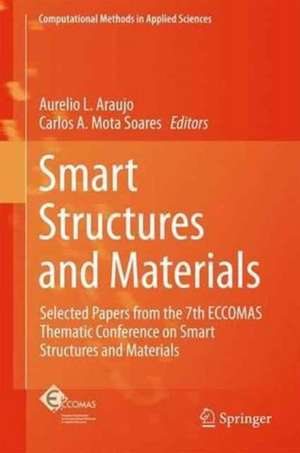
Smart Structures and Materials: Computational Methods in Applied Sciences, cartea 43
Editat de Aurelio L. Araujo, Carlos A. Mota Soaresen Limba Engleză Hardback – 30 dec 2016
Notăm cu interes publicarea acestui volum care marchează o actualizare semnificativă în domeniu, prezentând versiuni extinse și riguros revizuite ale lucrărilor susținute la a 7-a Conferință Tematică ECCOMAS. Față de prezentările inițiale din cadrul evenimentului desfășurat în Azore, această ediție oferă un fundament teoretic consolidat și rezultate experimentale aprofundate, esențiale pentru cercetarea în ingineria mecanică și știința materialelor. Observăm o organizare tematică ce reflectă natura multidisciplinară a sistemelor inteligente. Structura volumului ghidează cititorul de la fundamentele modelării și caracterizării materialelor compozite, până la aplicații industriale de vârf. Cuprinsul indică o progresie de la micro-sisteme, precum actuatorii bazați pe arhitecturi de nanotuburi de carbon, către macro-structuri complexe, exemplificate prin cinematica aripilor de aeronavă de tip „droop nose”. Un accent deosebit este pus pe analiza neliniarității structurale în optimizarea recoltării de energie din vibrații, utilizând materiale electret. Remarcăm faptul că această lucrare completează excelent literatura tehnică existentă. Cititorul care a aplicat ideile fundamentale din Dynamics of Smart Systems and Structures va găsi aici o extensie practică necesară, axată pe metode computaționale avansate și soluții de control activ. În timp ce alte titluri similare, precum cele coordonate de M. Sumesh, oferă o perspectivă generală asupra sustenabilității, volumul de față, editat de Aurelio L. Araujo și Carlos A. Mota Soares, se distinge prin rigoarea analizei numerice și focalizarea pe integritatea structurală a actuatorilor sub sarcină.
Din seria Computational Methods in Applied Sciences
- 15%
 Preț: 675.08 lei
 - 15%
 Preț: 678.41 lei
 - 15%
 Preț: 659.28 lei
 - 18%
 Preț: 1156.95 lei
 - 18%
 Preț: 920.12 lei
 - 18%
 Preț: 1262.67 lei
 - 18%
 Preț: 985.87 lei
 - 18%
 Preț: 978.15 lei
 - 20%
 Preț: 639.94 lei
 - 18%
 Preț: 952.65 lei
 - 15%
 Preț: 617.66 lei
 - 18%
 Preț: 1003.81 lei
 - 20%
 Preț: 632.19 lei
 - 18%
 Preț: 986.53 lei
 - 20%
 Preț: 635.65 lei
 - 18%
 Preț: 1197.60 lei
 - 24%
 Preț: 836.98 lei
 - 18%
 Preț: 920.32 lei
 - 47%
 Preț: 564.35 lei
 - 15%
 Preț: 618.47 lei
 - 18%
 Preț: 926.64 lei
 - 15%
 Preț: 615.62 lei
 - 15%
 Preț: 669.40 lei
 - 18%
 Preț: 977.88 lei
 - 18%
 Preț: 1286.08 lei
 - 15%
 Preț: 663.68 lei
 - 15%
 Preț: 673.77 lei
 - 15%
 Preț: 677.06 lei
 - 15%
 Preț: 667.64 lei
 - 15%
 Preț: 673.99 lei
 - 18%
 Preț: 997.53 lei
 - 15%
 Preț: 680.99 lei
Preț: 643.84 lei
Preț vechi: 785.17 lei
-18%
Carte disponibilă
Livrare economică 09-23 noiembrie
Livrare express 23-29 octombrie pentru 40.21 lei
Specificații
ISBN-10: 3319445057
Pagini: 304
Ilustrații: VIII, 293 p. 193 illus., 187 illus. in color.
Dimensiuni: 160 x 241 x 21 mm
Greutate: 0.63 kg
Ediția:1st edition 2017
Editura: Springer
Colecția Computational Methods in Applied Sciences
Seria Computational Methods in Applied Sciences
Locul publicării:Cham, Switzerland
V-ar putea interesa
-
 Aircraft Structures for Engineering StudentsT. H. G. Megson-30%Preț: 482.03 lei692.90 lei
 -
 Introduction to Coupled Theories in Solid MechanicsLallit Anand-23%Preț: 582.72 lei751.97 lei
 -
 Funicular Structures: The Art of Building EfficientlyDamon BolhassaniPreț: 384.80 leiRecomandat
 -
 -20%Preț: 1371.39 lei1714.24 lei
 -
 Advances in Materials Science and TechnologySrikari Srinivasan-15%Preț: 506.89 lei596.35 lei
 -
 Advanced Computational NanomechanicsNuno Silvestre-23%Preț: 760.29 lei987.39 lei
 -
 Smart Materials Actuators: Recent Advances in Characterization & ApplicationsProfessor Seung-Bok Choi-27%Preț: 1525.14 lei2077.11 lei
 -
 -30%Preț: 97.81 lei139.80 lei
 -
 -18%Preț: 1555.90 lei1897.43 lei
 -
 Smart Morphing and Sensing for Aeronautical ConfigurationsMarianna Braza-18%Preț: 1076.69 lei1313.04 lei
 -
 -18%Preț: 1376.53 lei1678.70 lei
 -
 Biomimetic NanomaterialsZhicheng Zhang-23%Preț: 843.39 lei1095.30 lei
 -
 Piezoelectric ShellsHornsen (Hs) Tzou-18%Preț: 1166.95 lei1423.11 lei
 -
 -18%Preț: 1121.10 lei1367.20 lei
 -
 Advanced Materials and ManufacturingJitendra Kumar Katiyar-18%Preț: 1402.65 lei1710.55 lei
 -
 -18%Preț: 2015.01 lei2457.32 lei
 -
 Recent Developments in Structural Engineering, Volume 4Manmohan Dass Goel-18%Preț: 1357.69 lei1655.71 lei
 -
 Recent Advances in Composites Engineering and ResearchMulakaluri Rama Manohara Babu-18%Preț: 1165.03 lei1420.78 lei
De ce să citești această carte
Această resursă este esențială pentru inginerii și cercetătorii care doresc să treacă de la teoria materialelor inteligente la implementări practice în aeronautică și robotică. Cititorul câștigă acces la metodologii avansate de optimizare pentru compozite și tehnici de modelare a fracturilor, oferind un avantaj competitiv în proiectarea sistemelor adaptive și a dispozitivelor de recoltare a energiei.
Cuprins
Textul de pe ultima copertă
Fundamentals of smart materials and structures; Modeling/formulation and characterization of smart actuators, sensors and smart material systems; Trends and developments in diverse areas such as material science including composite materials, intelligent hydrogels, interfacial phenomena, phase boundaries and boundary layers of phase boundaries, control, micro- and nano-systems, electronics, etc. to be considered for smart systems; Comparative evaluation of different smart actuators and sensors; Analysis of structural concepts and designs in terms of their adaptability to smart technologies; Design and development of smart structures and systems; Biomimetic phenomena and their inspiration in engineering; Fabrication and testing of smart structures and systems; Applications of smart materials, structures and related technology; Smart robots; Morphing wings and smart aircrafts; Artificial muscles and biomedical applications; Smart structures in mechatronics; and Energy harvesting.