Cantitate/Preț
Produs

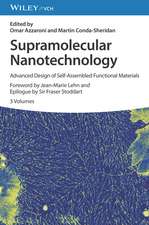
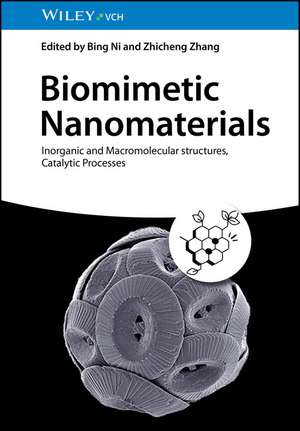
Biomimetic Nanomaterials

Editat de Zhicheng Zhang, Bing Ni
en Limba Engleză Hardback – 24 sep 2025

Subliniem, încă de la început, structura riguroasă a acestui volum coordonat de Zhicheng Zhang și Bing Ni, care este organizat metodologic pentru a servi drept referință în cercetarea nanomaterialelor. Materialul este sistematizat în jurul a doi piloni centrali: morfologia structurilor anorganice și macromoleculare și, respectiv, replicarea funcțiilor catalitice complexe întâlnite în natură. Această abordare binară permite cititorului să navigheze de la fundamentele biomineralizării și arhitecturilor bio-inspirate, precum aerogelurile, până la aplicații avansate în ingineria chimică. Suntem de părere că valoarea adăugată a acestei lucrări rezidă în detalierea proceselor de sinteză pentru materiale cu proprietăți specifice, cum sunt nanoparticulele chirale și nanozimele. Spre deosebire de abordările pur teoretice, editorii pun un accent deosebit pe sistemele catalitice destinate sustenabilității, incluzând capitole dedicate fotosintezei artificiale și fixării azotului. Din punct de vedere stilistic, textul menține un ton tehnic precis, fiind susținut de date experimentale recente care fac legătura între chimia bioanorganică și biotehnologie. În contextul literaturii de specialitate, Biomimetic Nanomaterials completează perspectiva oferită de Bio–Nanomaterials – Designing materials inspired by nature de W Pompe. În timp ce lucrarea lui Pompe se concentrează pe principii generale de procesare și studii de caz biologice, volumul editat de Zhang și Ni adaugă o componentă funcțională extinsă, focalizându-se pe replicarea proceselor catalitice și pe utilizarea nanomaterialelor în conversia energiei, aspecte mai puțin detaliate în textele introductive. Credem că această ediție de la Wiley-VCH GmbH reprezintă un instrument de lucru esențial pentru recalibrarea cercetării de laborator conform modelelor biologice eficiente.

Citește tot Restrânge

Preț: 83251 lei

Preț vechi: 108118 lei
-23%

Puncte Express: 1249

Carte disponibilă

Livrare economică 19-25 septembrie
Livrare express 08-12 septembrie pentru 8155 lei

Livrare prin curier în România Termenul estimat este afișat lângă disponibilitate.
Transport gratuit pentru acest produs Plată online sau ramburs, în funcție de opțiunile comenzii.
Retur gratuit în 14 zile Comandă securizată și suport în română.

Specificații

ISBN-13: 9783527354542
ISBN-10: 3527354549
Pagini: 352
Dimensiuni: 175 x 248 x 22 mm
Greutate: 0.8 kg
Ediția:1
Editura: Wiley-VCH GmbH

De ce să citești această carte

Recomandăm această lucrare specialiștilor în știința materialelor și bioinginerilor care caută soluții aplicate pentru sinteza biomimetică. Cititorul câștigă o înțelegere profundă a modului în care structurile anorganice pot replica funcții biologice complexe, precum cataliza enzimatică. Este un titlu indispensabil pentru cei care lucrează la dezvoltarea tehnologiilor verzi, oferind protocoale concrete pentru fotosinteza artificială și captarea carbonului.


Descriere

An accurate and authoritative discussion of the structure, fabrication, and applications of biomimetic materials In Biomimetic Nanomaterials: Inorganic and Macromolecular Structures, Catalytic Processes, a team of distinguished researchers delivers an up-to-date discussion of select emerging topics in nature-inspired approaches to biomimetic nanomaterials. The authors focus on two core subjects: mimicking biological structures and replicating biological functions. The book begins with an exploration of bio-inorganic structures and biomineralization processes, including biominerals and bio-inspired architectures like aerogels and chiral nanoparticles. It continues on to discuss biomacromolecule-based materials and synthetic mimics, as well as their structural and functional attributes. Finally, it covers bio-inspired functional materials, including nanozymes and catalytic systems for applications, like artificial photosynthesis, CO2 conversion, and N2 fixation. Readers will also find: A thorough introduction to the foundational concepts and the latest developments in biomimetic nanomaterialsComprehensive explorations of the latest applications of biomimetic nanomaterials, including artificial muscles, protective coatings, and catalytic processesPractical discussions of the structures of biomimetic inorganic nanomaterials, like biominerals, biomorphs, artificial plastic materials, and chiral nanoparticlesComplete treatments of particularly remarkable uses of biomimetic materials, including water splitting catalysis nanozymes Perfect for materials scientists, bioinorganic chemists, and biotechnologists, Biomimetic Nanomaterials will also benefit bioengineers, polymer chemists, and biochemists.

Notă biografică

Bing Ni, PhD, is a Full Professor at Beijing Normal University. His research is focused on crystal growth mechanisms and electrocatalysis.

Zhicheng Zhang, PhD, is a Professor at Tianjin University in China. His research is focused on the design and synthesis of functional metal-based nanomaterials and their applications in energy conversion and catalysis.


Cuprins

Biography of Book Editors xi

Preface xiii

1 Introduction 1
Bing Ni

Part 1: Biomimetic Inorganic Nanostructures 4

Part 2: Biomacromolecules and Structural Mimics 4

Part 3: Nanomaterials Mimicking Biocatalytic Processes 5

References 5

2 Biominerals and Biomineralization 7
Jie Wang, Zonghao Yu, Zhaoming Liu

2.1 Typical Biominerals 7

2.2 Unique Structures of Biominerals 12

2.3 A Crystal Growth View on Biomineralization Process 15

2.4 Inspirations from Biomineralization 19

2.4.1 Manufacture of Biomimetic Structures 20

2.4.2 Controllable Arrangement of Ions - A Biomimetic Process 21

2.4.3 Life-Material Hybrids 23

2.5 Conclusion 25

References 25

3 Designing Functional Biomorphs 33
Bing Ni

3.1 Introduction 33

3.2 Overview of the Biomorph Formation Mechanism 35

3.3 Influence and Potential Application of the Biomorphs 41

3.4 Conclusion 44

References 44

4 Biomimetic Materials Inspired by Bone and Tooth 47
Yifan Xu, Yuning Wang, Yanhuizhi Feng

4.1 Introduction 47

4.2 Biomimetic Artificial Bone 48

4.2.1 The Structure and Mineralization of Bone 48

4.2.1.1 The Composition and Structure of Bone 48

4.2.1.2 The Synthesis and Self-assembly of Type I Collagen 48

4.2.1.3 The Mineralization of Bone 50

4.2.2 Artificial Bone 52

4.2.2.1 Acellular Scaffolds 53

4.2.2.2 Electrospinning Technology 54

4.2.2.3 3D Bioprinting Technology 54

4.2.2.4 Freeze-drying Technology 54

4.2.3 Future Directions 56

4.3 Biomimetic Artificial Tooth 56

4.3.1 The Structure and Mineralization of Tooth 56

4.3.1.1 The Structure of Enamel 56

4.3.1.2 The Mineralization of Enamel 57

4.3.1.3 The Structure of Dentin 58

4.3.1.4 The Mineralization of Dentin 58

4.3.2 Biomimetic Tooth 59

4.3.2.1 Biomimetic Enamel 59

4.3.2.2 Biomimetic Dentin 64

4.3.3 Future Directions 65

References 65

5 Biomimetic Chiral Nanomaterials 73
Lili Tan, Peng-peng Wang

5.1 Introduction 73

5.2 Biomolecular Encoding Chiral Inorganic Nanomaterials 74

5.2.1 Biomimetic Inorganic Nanomaterials with Surface Chirality 75

5.2.2 Biomolecularly Programmed Inorganic Assemblies 77

5.2.3 Chiral-shaped Inorganic Nanomaterials 80

5.3 Bioinspired Applications 81

5.3.1 Chiral Sensor 81

5.3.2 Chiral Catalyst 82

5.3.3 Chiral Therapy 85

5.4 Conclusion 86

References 87

6 Biomacromolecular Mimics 93
Nan Wu, Xiao Sang, Xinyu Zhang, and Xinyu Liu

6.1 Introduction 93

6.2 Structure and Function of Biomacromolecules 94

6.2.1 Nucleic Acids 94

6.2.2 Proteins 95

6.2.3 Polysaccharides 97

6.3 Development of Biomacromolecular Mimics 97

6.3.1 Directly Copying the Structures of Biomacromolecules 97

6.3.1.1 Genetic and Protein Engineering 98

6.3.1.2 Folding and Assembly 100

6.3.2 Chemical Modification of Bioproducts 102

6.3.2.1 Covalent Modification 102

6.3.2.2 Noncovalent Modification 104

6.3.2.3 De Novo Organic Synthesis 106

6.3.2.4 Enzyme-catalyzed Modification 109

6.4 Applications of Bio-macromolecular Mimics 110

6.4.1 Application of Nucleic Acid-based Mimics 111

6.4.2 Application of Protein-based Mimics 112

6.4.3 Polysaccharide-based Mimics 113

6.5 Challenges and Future Directions 115

6.6 Conclusion 115

References 116

7 Advanced Wood-based Bionic Materials 125
Yingying li

7.1 Wood Bionic Intelligence Science 125

7.2 Theoretical Basis of Wood Bionics Science 126

7.2.1 Hierarchal Structure of Wood 126

7.2.2 Multi-scale Porous Structure of Wood 127

7.3 Advanced Wood-based Materials 127

7.3.1 Transparent Wood-based Materials 128

7.3.2 Ultra-strong Wood 130

7.3.3 Magnetic-responsive Wood 131

7.3.4 Light-temperature Responsive Wood 133

7.3.5 Energy Storage Wood 134

7.3.6 Superhydrophobic Wood 135

7.4 Conclusion 136

References 137

8 Bio-inspired Multifunctional Nanocellulose Materials 141
Jieming Qiu, Rui Xiong

8.1 Introduction 141

8.2 Classification of Nanocellulose 142

8.2.1 The Main Properties of Nanocellulose 143

8.2.1.1 Excellent Mechanical Properties 143

8.2.1.2 Surface Chemical Tunability 143

8.2.1.3 Biocompatibility and Biodegradability 144

8.3 Multidimensional Structural Design of Nanocellulose 144

8.3.1 1D Nanocellulose Structures 145

8.3.1.1 Individual Fibril Structure 145

8.3.1.2 Aligned Nanofibril Structure 150

8.3.2 2D Hierarchical Structure 151

8.3.2.1 Self-assembly 152

8.3.2.2 LbL Growth 153

8.3.3 3D/4D Hierarchical Architectures 154

8.3.3.1 3D/4D Printing 154

8.3.3.2 Ice-templating Assembly 156

8.3.3.3 Self-assembly of Chiral Nematic Liquid Crystal Structures 157

8.4 Conclusion and Outlook 160

References 161

9 Biomass-based Materials for a Circular Economy 173
Bing Ni

9.1 Introduction 173

9.2 Lignin Extraction and Functionalization 174

9.3 Conversion of Biomass to Biofuels 179

9.4 Biomass Conversion to Functional Carbon Materials 182

9.5 Conclusion 189

References 189

10 Biomimetic Aerogel 197
Hong Ju Jung

10.1 Introduction 197

10.2 Anisotropic Building Blocks 199

10.2.1 2D Material Dispersions 199

10.2.2 1D Material Dispersions 201

10.2.3 Hybrid Material Dispersions 202

10.3 Assembly Techniques 203

10.3.1 Self-assembly 205

10.3.2 Freeze Casting 205

10.3.3 Breath-figure Method 205

10.3.4 Electrochemical Gelation 206

10.4 Applications 206

10.4.1 Thermal Insulation 207

10.4.2 Elastic Sponges 208

10.4.3 Water Transport 208

10.4.4 Bio-scaffolds 209

10.4.5 Energy Storage System 209

10.4.6 Other Applications for Conductive BAs 211

10.5 Discussion 211

10.5.1 Diversity of Shapes 212

10.5.2 Mass Production 212

10.5.3 Structural Analysis 213

10.6 Conclusion 214

References 214

11 Mechanical Materials with Biomimetic Hierarchical Structures 221
Wenbing Wu

11.1 Introduction 221

11.2 Lamellar Organization 222

11.2.1 Layer-by-layer Assembly 222

11.2.2 Freeze-casting 225

11.2.3 Bulk Fabrication Methods 228

11.2.4 Additive Manufacturing 230

11.3 Columnar Organization 232

11.4 Challenges and Perspectives 235

References 238

12 Nanozyme 247
Ying Liu, Ruijie Qin, Run Yang, Huan Guo, Zhe Hao, Zhicheng Zhang, Ruizhong Zhang, Xiyan Li, Libing Zhang

12.1 Introduction of Nanozyme 247

12.2 Classification of Nanozymes 249

12.2.1 Carbon-based Nanomaterials for Nanozyme 249

12.2.2 Metal-based Nanomaterials for Nanozyme 250

12.2.3 Metal Oxide-based Nanomaterials for Nanozymes 251

12.2.4 Single-atomic Nanomaterials for Nanozymes 253

12.3 Applications of Nanozymes in Bioanalysis 254

12.3.1 Detection of Ions 254

12.3.2 Detection of Small Biological Molecules 255

12.3.3 Detection of Biological Macromolecules 256

12.3.4 Detection of Bacteria 257

12.3.5 Detection of Cancer Cells and Extracellular Vesicles 258

12.4 Applications of Nanozymes in Therapy 259

12.4.1 Nanozymes for Prooxidative Therapy 260

12.4.1.1 Antibacterial Applications 260

12.4.1.2 Anti-tumor Applications 260

12.4.2 Nanozymes for Cytoprotection and Antioxidant Therapy 262

12.4.2.1 Cytoprotection Applications 262

12.4.2.2 Antioxidant Applications 262

12.5 Challenges and Perspective 264

Acknowledgment 265

References 265

13 Photosynthesis and Photocatalytic Water Splitting 273
Xiaoke Li, Rui Yang, Zhicheng Zhang

13.1 Introduction 273

13.2 Photosynthesis: A Natural Masterpiece 274

13.3 Artificial Photocatalytic Water Splitting 275

13.3.1 Photocatalysts 276

13.4 Comparison of Natural and Artificial Systems 276

13.4.1 Quantum Efficiency 276

13.4.2 Mechanistic Differences 278

13.4.3 Charge Separation and Recombination 279

13.5 Potential Improvements in Artificial Systems 280

13.5.1 Improved Photocatalysts 280

13.5.2 Nanostructuring 281

13.5.3 Spatial Separation of HER and OER 284

13.6 Conclusion and Outlook 285

Acknowledgment 286

References 286

14 CO2 Conversion 291
Ziru Wang, Peilei He

14.1 Introduction: Basic Principles of Photocatalytic Reduction of CO 2 291

14.2 Nanostructures for Photocatalytic CO 2 Reduction 293

14.2.1 Semiconductor Nanostructures 293

14.2.2 Metal-organic Frameworks 295

14.2.3 CO2 Fixation Enzymes: Biomimetic Approaches 296

14.3 Challenges and Perspectives 297

References 298

15 Artificial N2 Fixation 303
Jinzheng Liu, Mingzhu Li, Mingliang Hu, Ruizhong Zhang, Xiyan Li, Zhicheng Zhang, Libing Zhang

15.1 Introduction 303

15.2 Electrocatalytic Nitrogen Fixation 306

15.2.1 Precious Metal-based Materials for Electrocatalytic Nitrogen Fixation 309

15.2.2 Non-precious Metal-based Materials for Electrocatalytic Nitrogen Fixation 312

15.2.3 Nonmetallic Base Material for Electrocatalytic Nitrogen Fixation 314

15.3 Photocatalytic Nitrogen Fixation 314

15.3.1 Precious Metal-based Materials for Photocatalytic Nitrogen Fixation 317

15.3.2 Non-noble Metal-based Materials for Photocatalytic Nitrogen Fixation 319

15.3.3 Nonmetallic Base Material for Photocatalytic Nitrogen Fixation 321

15.4 Conclusion and Outlook 321

Acknowledgment 321

References 322

Index 329