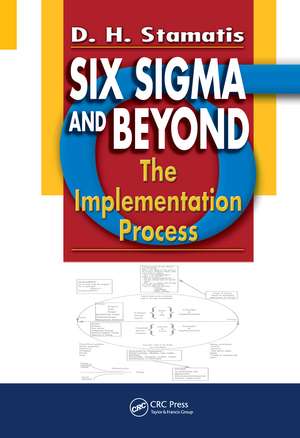
Six Sigma and Beyond: The Implementation Process, Volume VII
Autor D.H. Stamatisen Limba Engleză Hardback – 12 noi 2002
Preț: 2009.82 lei
Preț vechi: 2208.60 lei
-9%
Puncte Express: 3015
Carte disponibilă
Livrare economică 06-20 noiembrie
Livrare express 23-29 octombrie pentru 62.73 lei
Livrare prin curier în România Termenul estimat este afișat lângă disponibilitate.
Transport gratuit pentru acest produs Plată online sau ramburs, în funcție de opțiunile comenzii.
Retur gratuit în 14 zile Comandă securizată și suport în română.
Specificații
ISBN-13: 9781574443165
ISBN-10: 157444316X
Pagini: 666
Ilustrații: 37 tables and 20 equations
Dimensiuni: 156 x 234 x 40 mm
Greutate: 1.22 kg
Ediția:1
Editura: Taylor & Francis
Colecția CRC Press
Locul publicării:Oxford, United Kingdom
ISBN-10: 157444316X
Pagini: 666
Ilustrații: 37 tables and 20 equations
Dimensiuni: 156 x 234 x 40 mm
Greutate: 1.22 kg
Ediția:1
Editura: Taylor & Francis
Colecția CRC Press
Locul publicării:Oxford, United Kingdom
V-ar putea interesa
-
 -18%Preț: 1257.60 lei1533.65 lei
 -
 Analysis of Cosmetic ProductsAmparo Salvador-30%Preț: 1550.91 lei2227.61 lei
 -
 Reliability-Centered MaintenanceJohn Moubray-28%Preț: 386.86 lei540.23 lei
 -
 -23%Preț: 596.04 lei774.07 lei
 -
 Preț: 350.97 lei
 -
 Food Supply Chain Management and LogisticsSamir Dani-11%Preț: 438.74 lei492.96 lei
 -
 -20%Preț: 503.17 lei628.97 lei
 -
 Command Center HandbookAbdul A. JaludiPreț: 152.44 lei
 -
 Preț: 378.43 lei
 -
 -18%Preț: 1342.94 lei1637.74 lei
 -
 The Impact of External Factors on Corporate Governance System of FirmsAdeoye Amuda AfolabiPreț: 305.31 lei
 -
 Customer satisfaction & corporate reputation: A correlation studySteve van OostenbruggePreț: 301.99 lei
 -
 Research Insights & Dynamics: A Quick GlanceAnand BajpaiPreț: 303.31 lei
 -
 Culture Et Performance Des Joint-Ventures Internationales En Tunisie: Mission Impossible?Mohamed Amine Bouraoui-15%Preț: 552.89 lei650.46 lei
 -
 -15%Preț: 475.49 lei559.41 lei
 -
 Impact Socio-Economique de L'Industrie Du Livre Au Rwanda: Tome 1Eugène Nsanzabiga-15%Preț: 510.79 lei600.93 lei
Public țintă
Professional and Professional Practice & DevelopmentCuprins
Introduction. What is Diffusion. Characteristics of Innovations. The Process of the Six Sigma Diffusion in the Organization. References. UNDERSTANDING ADULT TRAINING AND INSTRUCTIONAL DESIGN. Understanding the Learner and Instruction. Front End Analysis. Design of Instruction. Development of the Material and Evaluation. Delivery of Material and Evaluation. Contract Training. TRAINING FOR THE DMAIC MODEL. Six Sigma for Executives. Six Sigma for Champions. Six Sigma for Master Black Belts. Six Sigma for Black Belts. Six sigma General orientation Training. TRAINING FOR THE DCOV MODEL. DFSS Training. 6 Certification. Epilog. Glossary. Selected Bibliography.
Descriere
The final volume of this series presents a synopsis of the curriculum that a typical Six Sigma program should follow. It differs from the preceding six volumes in that it is an implementation volume, therefore the information is geared towards helping readers formalize their own training. The book establishes the minimum requirements for the Six Sigma methodology and provides the body of knowledge needed for a successful and rewarding implementation of the Six Sigma processes.