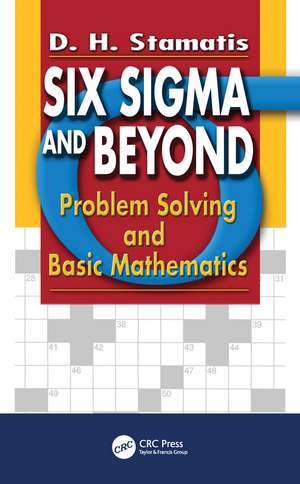
Six Sigma and Beyond: Problem Solving and Basic Mathematics, Volume II
Autor D.H. Stamatisen Limba Engleză Hardback – 30 oct 2001
The Six Sigma methodology demands that problems be resolved in such a way that both the customer and organization benefit. Not a bad expectation. In this book, the author addresses what a problem is and systematically defines the process of resolving it. He stresses the importance of the team - people power - dedicated to solving a specific problem - process power - and how this combination leads to efficiencies that please the customer and enhance the bottom line.
Identifying the problem is only half the task. The next step is to resolve it. This book gives you a detailed rationale and a theoretical explanation of the problem solving process. It focuses on problem solving from a quality perspective and addresses key concepts in team dynamics. It provides an overview of the basic tools of problem solving. In addition, the author introduces the Global Problem Solving (GPS) process.
This strategic program brings the focus of quality programs back to eliminating mistakes, waste, and rework. The book highlights the basic mathematics used in all phases of quality control. It introduces each mathematical concept, gives an example, and proceeds with several exercises that demonstrate the solution. With Six Sigma and Beyond: Problem Solving and Basic Mathematics you get the techniques and statistical tools to go beyond theory to real-world applications and take quality management to the next level.
Preț: 1804.08 lei
Preț vechi: 2200.10 lei
-18%
Puncte Express: 2706
Carte tipărită la comandă
Livrare economică 27 noiembrie-11 decembrie
Livrare express 23-29 octombrie pentru 243.16 lei
Livrare prin curier în România Termenul estimat este afișat lângă disponibilitate.
Transport gratuit pentru acest produs Plată online sau ramburs, în funcție de opțiunile comenzii.
Retur gratuit în 14 zile Comandă securizată și suport în română.
Specificații
ISBN-13: 9781574443103
ISBN-10: 1574443100
Pagini: 388
Ilustrații: 25 b/w images, 10 tables and 222 equations
Dimensiuni: 156 x 234 x 26 mm
Greutate: 0.71 kg
Ediția:1
Editura: Taylor & Francis
Colecția CRC Press
Locul publicării:Oxford, United Kingdom
ISBN-10: 1574443100
Pagini: 388
Ilustrații: 25 b/w images, 10 tables and 222 equations
Dimensiuni: 156 x 234 x 26 mm
Greutate: 0.71 kg
Ediția:1
Editura: Taylor & Francis
Colecția CRC Press
Locul publicării:Oxford, United Kingdom
V-ar putea interesa
-
 -18%Preț: 1257.60 lei1533.65 lei
 -
 Analysis of Cosmetic ProductsAmparo Salvador-30%Preț: 1550.91 lei2227.61 lei
 -
 Reliability-Centered MaintenanceJohn Moubray-28%Preț: 386.86 lei540.23 lei
 -
 -23%Preț: 596.04 lei774.07 lei
 -
 Preț: 350.97 lei
 -
 Food Supply Chain Management and LogisticsSamir Dani-11%Preț: 438.74 lei492.96 lei
 -
 -20%Preț: 503.17 lei628.97 lei
 -
 Command Center HandbookAbdul A. JaludiPreț: 152.44 lei
 -
 Preț: 378.43 lei
 -
 -18%Preț: 1342.94 lei1637.74 lei
 -
 The Impact of External Factors on Corporate Governance System of FirmsAdeoye Amuda AfolabiPreț: 305.31 lei
 -
 Customer satisfaction & corporate reputation: A correlation studySteve van OostenbruggePreț: 301.99 lei
 -
 Research Insights & Dynamics: A Quick GlanceAnand BajpaiPreț: 303.31 lei
 -
 Culture Et Performance Des Joint-Ventures Internationales En Tunisie: Mission Impossible?Mohamed Amine Bouraoui-15%Preț: 552.89 lei650.46 lei
 -
 -15%Preț: 475.49 lei559.41 lei
 -
 Impact Socio-Economique de L'Industrie Du Livre Au Rwanda: Tome 1Eugène Nsanzabiga-15%Preț: 510.79 lei600.93 lei
Public țintă
Professional and Professional Practice & DevelopmentCuprins
INTRODUCTION. Theoretical Aspects of Problem Solving. Overview of Key Elements to Problem Solving. Problem-Solving (PS) and Process Improvement (PI) Cycle. Tools of Quality. The Global Problem Solving (GPS) Process. Six Sigma Approach to Problem Solving. BASIC MATHEMATICS. The Value of Whole Numbers. Addition and Subtraction of Whole Numbers. Multiplication and Division of Whole Numbers. Parts and Types of Fractions. Simple Form and Common Denominators of Fractions. Adding and Subtracting Fractions. Multiplication and Division of Fractions. Ordering, Rounding and Changing Decimals. The Four Operations of Decimals. DIVISION WITH DECIMALS. Squares, Square Roots, Cubes, Cube Roots and Proportions. Scientific Notation and Powers of Ten. Decimals. The Metric System. International System of Units. Conversion of English to Metric. APPENDICES. SELECTED BIBLIOGRAPHY.
Descriere
Focusing on the problem solving methodology fundamental to any Six Sigma or quality initiative, this volume gives a detailed rationale and theoretical explanation of the process. The text focuses on problem solving from a quality perspective and addresses key concepts in the problem-solving cycle and the process improvement cycle. The author introduces the Global Problem Solving process developed successfully in the automotive industry. He covers the concepts and approaches of problem solving unique to Six Sigma and includes a section on the basic math involved in problem solving environments. The author's approach is to introduce the mathematical concept, give an example, and then proceed with several exercises.