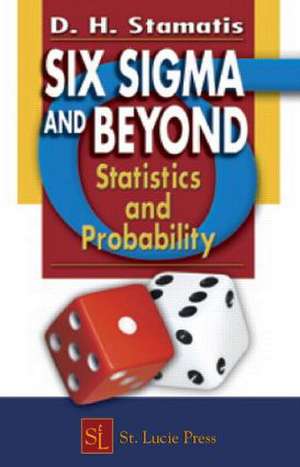
Six Sigma and Beyond: Statistics and Probability, Volume III
Autor D.H. Stamatisen Limba Engleză Hardback – 28 aug 2002
This volume introduces the relationship of statistics, probability, and reliability as they apply to quality in general and to Six Sigma in particular. The author brings the theoretical into the practical by providing statistical techniques, tests, and methods that the reader can use in any organization. He reviews basic parametric and non-parametric statistics, probability concepts and applications, and addresses topics for both measurable and attribute characteristics. He delineates the importance of collecting, analyzing, and interpreting data not from an academic point of view but from a practical perspective.
This is not a textbook but a guide for anyone interested in statistical, probability, and reliability to improve processes and profitability in their organizations. When you begin a study of something, you want to do it well. You want to design a good study, analyze the results properly, and prepare a cogent report that summarizes what you've found. Six Sigma and Beyond: Statistics and Probability shows you how to use statistical tools to improve your processes and give your organization the competitive edge.
Preț: 2004.09 lei
Preț vechi: 2202.30 lei
-9%
Puncte Express: 3006
Carte disponibilă
Livrare economică 06-20 noiembrie
Livrare express 22-28 octombrie pentru 41.81 lei
Livrare prin curier în România Termenul estimat este afișat lângă disponibilitate.
Transport gratuit pentru acest produs Plată online sau ramburs, în funcție de opțiunile comenzii.
Retur gratuit în 14 zile Comandă securizată și suport în română.
Specificații
ISBN-13: 9781574443127
ISBN-10: 1574443127
Pagini: 368
Ilustrații: 139 b/w images, 6 tables and 573 equations
Dimensiuni: 156 x 234 x 25 mm
Greutate: 0.69 kg
Ediția:1
Editura: Taylor & Francis
Colecția CRC Press
Locul publicării:Oxford, United Kingdom
ISBN-10: 1574443127
Pagini: 368
Ilustrații: 139 b/w images, 6 tables and 573 equations
Dimensiuni: 156 x 234 x 25 mm
Greutate: 0.69 kg
Ediția:1
Editura: Taylor & Francis
Colecția CRC Press
Locul publicării:Oxford, United Kingdom
V-ar putea interesa
-
 -18%Preț: 1257.60 lei1533.65 lei
 -
 Analysis of Cosmetic ProductsAmparo Salvador-30%Preț: 1550.91 lei2227.61 lei
 -
 Reliability-Centered MaintenanceJohn Moubray-28%Preț: 386.86 lei540.23 lei
 -
 -23%Preț: 596.04 lei774.07 lei
 -
 Preț: 350.97 lei
 -
 Food Supply Chain Management and LogisticsSamir Dani-11%Preț: 438.74 lei492.96 lei
 -
 -20%Preț: 503.17 lei628.97 lei
 -
 Command Center HandbookAbdul A. JaludiPreț: 152.44 lei
 -
 Preț: 378.43 lei
 -
 -18%Preț: 1342.94 lei1637.74 lei
 -
 The Impact of External Factors on Corporate Governance System of FirmsAdeoye Amuda AfolabiPreț: 305.31 lei
 -
 Customer satisfaction & corporate reputation: A correlation studySteve van OostenbruggePreț: 301.99 lei
 -
 Research Insights & Dynamics: A Quick GlanceAnand BajpaiPreț: 303.31 lei
 -
 Culture Et Performance Des Joint-Ventures Internationales En Tunisie: Mission Impossible?Mohamed Amine Bouraoui-15%Preț: 552.89 lei650.46 lei
 -
 -15%Preț: 475.49 lei559.41 lei
 -
 Impact Socio-Economique de L'Industrie Du Livre Au Rwanda: Tome 1Eugène Nsanzabiga-15%Preț: 510.79 lei600.93 lei
Public țintă
Professional and Professional Practice & DevelopmentCuprins
STATISTICAL CONCEPTS. Designing a Study. Counting Responses for Single Variable. Summarizing Data. Counting Responses for Combinations. Changing the Coding Scheme. Looking at Means. Means from Samples. Working with the Normal Distribution. Testing Hypothesis - Two Independent Means. Testing Hypothesis - Two Dependent Means. Testing Hypothesis about Independence. Comparing Several Means. Plotting Data. Regression. PROBABILITY CHANGES. Set Theory and Venn Diagrams. Probability Concepts. Discrete and Random Variables. Binomial and Poison Distributions. Continuous and Uniform Distributions. Normalizing Binomial and Central Limit Theorem. Functions of Random Variables. Exponential Distribution and Reliability. Poison Process. Chi Square Distribution. T Distribution. Sample Size for Mean Distribution. Sampling Theory. Probability Plots and Percentiles. RELIABILITY CONCEPTS. Failure Rates. Reliability Rate. MTBF. MTBR. ROCOF Plot. Weibull Distribution. Gamma Distribution and Reliability. Hypothesis Testing and OC Curves. Least Squares and Regression Analysis. Taylor Series Expansion.
Descriere
Explaining probability issues as they relate to Six Sigma, this volume introduces the relationship of statistics, probability, and reliability as they apply to quality in general and to Six Sigma in particular. Stamatis turns the theoretical into the practical by providing statistical techniques, tests, and methods that readers can use in any organization. He reviews basic parametric and non-parametric statistics, probability concepts, and applications, and addresses topics for both measurable and attribute characteristics. He delineates the importance of collecting, analyzing, and interpreting data not from an academic point of view, but from a practical perspective.