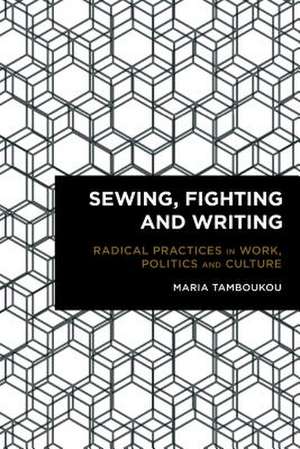
Sewing, Fighting and Writing: Radical Practices in Work, Politics and Culture: Radical Cultural Studies
Autor Maria Tamboukouen Limba Engleză Paperback – 9 noi 2015
Seamstresses were central figures in the socio-political and cultural events of nineteenth and early twentieth century France but their stories and political writings have remained marginalized and obscured. Drawing on a wide range of published and unpublished documents from the industrial revolution, 'Sewing, Fighting and Writing' is a foucauldian genealogy of the Parisian seamstress. Looking at the assemblage of radical practices in work, politics and culture, it explores the constitution of the self of the seamstress in the era of early industrialization and revolutionary events and considers her contribution to the socio-political and cultural formations in modernity.




Preț: 335.82 lei
Preț vechi: 435.38 lei
-23%
Puncte Express: 504
Carte tipărită la comandă
Livrare economică 05-19 decembrie
Livrare prin curier în România Termenul estimat este afișat lângă disponibilitate.
Transport gratuit de la 400.00 lei Plată online sau ramburs, în funcție de opțiunile comenzii.
Retur gratuit în 14 zile Comandă securizată și suport în română.
Specificații
ISBN-13: 9781783482450
ISBN-10: 1783482451
Pagini: 246
Dimensiuni: 151 x 229 x 18 mm
Greutate: 0.32 kg
Editura: Bloomsbury Publishing
Colecția Rowman & Littlefield
Seria Radical Cultural Studies
Locul publicării:New York, United States
ISBN-10: 1783482451
Pagini: 246
Dimensiuni: 151 x 229 x 18 mm
Greutate: 0.32 kg
Editura: Bloomsbury Publishing
Colecția Rowman & Littlefield
Seria Radical Cultural Studies
Locul publicării:New York, United States
V-ar putea interesa
-
 Eve Was FramedHelena Kennedy-31%Preț: 64.55 lei93.14 lei
 -
 Autobiography Of A GeishaSayo MasudaPreț: 114.55 lei
 -
 The Beauty MythNaomi Wolf-19%Preț: 70.13 lei86.26 lei
 -
 English Feminism, 1780-1980Barbara Caine-27%Preț: 419.81 lei576.48 lei
 -
 -31%Preț: 555.78 lei801.92 lei
 -
 Woman Defamed and Woman Defended: An Anthology of Medieval TextsAlcuin Blamires-27%Preț: 412.09 lei566.48 lei
 -
 Half the SkyNicholas D. KristofPreț: 94.61 lei
 -
 How Women Mean BusinessAvivah Wittenberg-CoxPreț: 149.17 lei
 -
 A Midwife's TaleLaurel Thatcher Ulrich-18%Preț: 100.47 lei122.32 lei
 -
 Can't Buy My LoveJean KilbournePreț: 110.42 lei
 -
 Jo's GirlsChristian McewenPreț: 202.73 lei
 -
 Stories of Illness and HealingDasguptaPreț: 209.88 lei
 -
 A Girl's Best FriendJan Fook-8%Preț: 145.02 lei157.29 lei
 -
 Making Sex Work: A Failed Experiment with Legalised ProstitutionMary Lucille Sullivan-9%Preț: 140.66 lei154.72 lei
 -
 A Suitable Job for a WomanVal McDermidPreț: 94.52 lei
 -
 Women and PunishmentPat CarlenPreț: 410.44 lei
Cuprins
Introduction - Charting lines of light: the Parisian seamstress / Chapter 1 - Adventures in a culture of thought: genealogies, narratives, process / Chapter 2 - Mapping the archive: mnemonic and imaginary technologies of the self / Chapter 3 - 'From my work you will know my name': materialising utopias / Chapter 4 - Feeling the world: love, gender and agonistic politics / Chapter 5 - Living, writing and imagining the revolution / Chapter 6 - Creativity as process: writing the self, rewriting history / Conclusion - Reassembling radical practices / Bibliography
Recenzii
Concerned with women who were materially poor, Parisian seamstresses, what riches lie within Maria Tamboukou's wonderful Sewing, Writing and Fighting. She provides an analytically outstanding feminist genealogy of the submerged histories of some fascinating women, who were socialist revolutionaries, unionised workers, militant feminists, thinkers and writers as well as seamstresses, and in a way that is both engaging and thought-provoking.
This highly original, richly theorised account draws us into the storyworlds of revolutionary seamstresses who struggled for recognition of the importance of women's work. Maria Tamboukou's meticulous scholarship brings a sense of personal connection, respect and reverence to her philosophical reflections on gendered power relations and the importance of association.
The meticulous and detailed approach to exploring women's lives that we have come to expect from Maria Tamboukou is turned in this book to the voices of Parisian seamstresses during the July Monarchy (1830-1850) . So often our research into women's lives yields an enormous amount of apparently disconnected and potentially irrelevant information that we reluctantly return to the depths of an archive box. Tamboukou's careful theoretical framing provides an excellent example of why, and how, the minutiae of women's lives can be brought together to make sense of both the past and the present.
This highly original, richly theorised account draws us into the storyworlds of revolutionary seamstresses who struggled for recognition of the importance of women's work. Maria Tamboukou's meticulous scholarship brings a sense of personal connection, respect and reverence to her philosophical reflections on gendered power relations and the importance of association.
The meticulous and detailed approach to exploring women's lives that we have come to expect from Maria Tamboukou is turned in this book to the voices of Parisian seamstresses during the July Monarchy (1830-1850) . So often our research into women's lives yields an enormous amount of apparently disconnected and potentially irrelevant information that we reluctantly return to the depths of an archive box. Tamboukou's careful theoretical framing provides an excellent example of why, and how, the minutiae of women's lives can be brought together to make sense of both the past and the present.