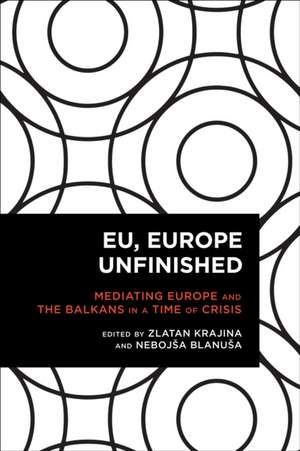
EU, Europe Unfinished: Mediating Europe and the Balkans in a Time of Crisis: Radical Cultural Studies
Editat de Zlatan Krajina, Nebojša Blanušaen Limba Engleză Paperback – 23 sep 2016
EU, Europe Unfinished brings together established and emerging media and cultural scholars to explore colliding visions of space and identity within a declining continent. Whereas Europe imagines the Balkans to be the source of its nearest trouble, the region envisions Europe as a refuge from ongoing post-socialist transition. The book adopts a variety of critical perspectives - from media and policy analysis to anthropology, art history and autobiography - to investigate where Europe is headed with the Balkans in its skein, 25 years after the fall of the Iron Curtain.


Preț: 314.49 lei
Preț vechi: 413.57 lei
-24%
Puncte Express: 472
Carte tipărită la comandă
Livrare economică 08-22 iunie
Specificații
ISBN-13: 9781783489794
ISBN-10: 1783489790
Pagini: 256
Ilustrații: 2 b/w illustrations
Dimensiuni: 150 x 228 x 18 mm
Greutate: 0.38 kg
Editura: Bloomsbury Publishing
Colecția Rowman & Littlefield
Seria Radical Cultural Studies
Locul publicării:New York, United States
ISBN-10: 1783489790
Pagini: 256
Ilustrații: 2 b/w illustrations
Dimensiuni: 150 x 228 x 18 mm
Greutate: 0.38 kg
Editura: Bloomsbury Publishing
Colecția Rowman & Littlefield
Seria Radical Cultural Studies
Locul publicării:New York, United States
Cuprins
Acknowledgements / Introduction: Why the Balkans, Why Now, Who Cares, Zlatan Krajina / Part I: Europeanising / 1. Re-assembling and Disciplining Social Europe: Turbulent Moments and Fragile F(r)ictions, Noémi Lendvai and Paul Stubbs / 2. European Media Policy Limitations in the Balkans: Observations on TV Pink BH, Monika Metykova / Part II: Renaming / 3. The Renaming Machine in the Balkans as a Strategy of "Accumulation by Dispossession", Suzana Milevska/ 4. Balkan Mimesis: Kitsch as a Geographic Concept, Ivaylo Ditchev / Part III: Representing / 5. 'Europe Unfinished' in Bosnia and Herzegovina: The 2014 Protests in the International Media, Eunice Castro Seixas / 6. The Balkans Go Global: Mikhail Veshim's The English Neighbour and the post-socialist variations on "the Balkan" theme, Milena Marinkova / 7. EUrientation Anxieties: Islamic Sexualities and the Construction of Europeanness, Piro Rexhepi / Part IV: Accessing / 8. Transnational Aesthetics: Apprehending Time Between the Balkans and Europe in Contemporary Art Practices, Uros Cvoro / 9. How we Survived Europe (and Never Laughed): The Role of Liberal-Humanitarian Utopia in Croatia's Accession to the EU, Orlanda Obad / 10. The Foreigners, Claudia Ciobanu / Part V: Conclusion / 11. Can Western Europe be at Home in the Balkans?, Slavenka Drakulic, David Morley, Zlatan Krajina and Nebojsa Blanusa/ Index / Notes on Contributors
Recenzii
Tired of endless discussions of "transition" and "Europeanisation" that never tell you what these terms mean? Consider this: these are words about identity, and identity is fraught with conflict, contradiction and confusion over how people perceive themselves and others. These dilemmas are at the heart of political and social disputes involving Europe and the Balkans, and this collection offers a fascinating and challenging ride through them.
EU, Europe Unfinished is an important twist to the conversation on the Europe-Balkan relationship, exploring what it means for "Europe to find a home" in the Balkans. This rich, multi-disciplinary volume provides thought-provoking analyses of how the EU's eastward expansion is remaking-and being remade by-the societies of the Balkans.
[.] a volume concerned with questions related to the Balkans and EU/Europe, about change or even lack of change, about self and difference, that merits being read with patience and using the pen, not only to understand the opinions of the authors, but also to reflect on some questions that the different texts could reveal in our mind, or some answers to our own questions.
EU, Europe Unfinished is an important twist to the conversation on the Europe-Balkan relationship, exploring what it means for "Europe to find a home" in the Balkans. This rich, multi-disciplinary volume provides thought-provoking analyses of how the EU's eastward expansion is remaking-and being remade by-the societies of the Balkans.
[.] a volume concerned with questions related to the Balkans and EU/Europe, about change or even lack of change, about self and difference, that merits being read with patience and using the pen, not only to understand the opinions of the authors, but also to reflect on some questions that the different texts could reveal in our mind, or some answers to our own questions.