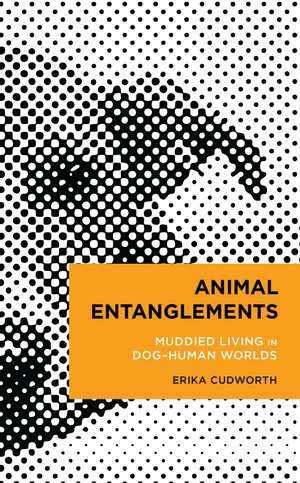
Animal Entanglements: Muddied Living in Dog–Human Worlds: Radical Cultural Studies
Autor Erika Cudworthen Limba Engleză Hardback – 5 apr 2024
Through an innovative theoretical contribution, Cudworth conceptualizes human relations with companion dogs in terms of complex social relations that involve both systemic forms of domination as well as nonhuman agency in shaping social relations and social forms.


Preț: 552.10 lei
Preț vechi: 816.93 lei
-32%
Puncte Express: 828
Carte tipărită la comandă
Livrare economică 21 noiembrie-05 decembrie
Livrare prin curier în România Termenul estimat este afișat lângă disponibilitate.
Transport gratuit pentru acest produs Plată online sau ramburs, în funcție de opțiunile comenzii.
Retur gratuit în 14 zile Comandă securizată și suport în română.
Specificații
ISBN-13: 9781538180198
ISBN-10: 1538180197
Pagini: 254
Ilustrații: 9 BW Photos
Dimensiuni: 152 x 232 x 20 mm
Greutate: 0.54 kg
Editura: Bloomsbury Publishing
Colecția Rowman & Littlefield
Seria Radical Cultural Studies
Locul publicării:New York, United States
ISBN-10: 1538180197
Pagini: 254
Ilustrații: 9 BW Photos
Dimensiuni: 152 x 232 x 20 mm
Greutate: 0.54 kg
Editura: Bloomsbury Publishing
Colecția Rowman & Littlefield
Seria Radical Cultural Studies
Locul publicării:New York, United States
Cuprins
Acknowledgments
List of Figures
Introduction: Domination and Affection in Dogland
Chapter One: Research Pack
Chapter Two: Walking Edgelands
Chapter Three: Sharing Home
Chapter Four: Eating Animals
Chapter Five: Making Oddkin
Chapter Six: Working and Caring
Conclusion: Muddied Living
Bibliography
Index
About the Author
List of Figures
Introduction: Domination and Affection in Dogland
Chapter One: Research Pack
Chapter Two: Walking Edgelands
Chapter Three: Sharing Home
Chapter Four: Eating Animals
Chapter Five: Making Oddkin
Chapter Six: Working and Caring
Conclusion: Muddied Living
Bibliography
Index
About the Author
Recenzii
Animal Entanglements adds to and complements two earlier booksby Cudworth: Developing Ecofeminist Theory (2005) and Social Lives with Other Animals (2011). In the volume under reviewCudworth addresses how nonhuman animals, particularly dogs, raise interesting questions about what it means to be human and what the boundaries are of their and our entangled social worlds. Her starting point is the concept of anthroparchy, namely, the dominant social organization that privileges the human and subordinates the nonhuman living world. Cudworth's sociological method is ethnographic. In vivid and messy detail she describes the negotiated complexities of human-canine encounters in the parks and streets of the River Lee (or Lea) and the Walthamstow and Leyton marsh areas of East London and elsewhere, and in multispecies home spaces such as bedrooms and kitchens. There is insight aplenty in this book on how humans should interact justly and responsibly with their animal companions, including the absolute necessity of dog walking and the need for care with what humans should and should not feed "our" dogs. Recommended. Advanced undergraduates through faculty.
Animal Entanglements nicely shows how difficult it can be for dogs to adapt to, and have high quality lives in, a human-dominated world. Erika Cudworth makes the clear case that dogs are not our best friends, nor are they unconditional lovers-two highly overused and misleading characterizations that often appear in academic and popular media. This well-written and most important book deserves a global audience because when we value the lives of every single individual dog, we also are helping ourselves come to the realization that it is a panoply of shared emotions that function as social glue that draws them to us and us to them.
Animal Entanglements takes us into the messy relationalities between humans and their companion dogs and the everyday constitution of more-than-human life. From a situated embodied perspective and based on multispecies research methods, Cudworth closely follows the practices of multispecies families in the domestic and public space, exploring the ambiguities of their intimacy, and the porous boundaries between power and care of the human-dog bonds.
Animal Entanglements will be a valuable asset for researchers exploring human-canine connections and will bring joy to anyone with a fondness for dogs. Its valuable insights hold potential for making the world a better place for dogs and the people dedicated to their well-being.
With innovative research methods and an infectious sociological imagination, Erika Cudworth elegantly analyses humans' multifaceted and muddied relationships with dogs by connecting everyday experiences to fundamental problems in social theory-the relationships between actor and structure, social reproduction and resistance, and nature and culture.
What is it like to live with a dog? How muddied are you, your house, and your physical and emotional boundaries going to get? How will your food choices, your personal relationships, your work life, be challenged? Who is it that cares for whom? In this warm-hearted and generous book, Erika Cudworth uses multispecies ethnography to explore in detail how the lives of co-habiting dogs and humans are shaped by the environments in which they walk, the spaces in which they live, and the carnism of the pet food industry. It also, critically, asks what kinds of relations dogs and humans can forge together, and what kin and care really mean in practice. Muddied living, Animal Entanglements illustrates, is a complex and ambiguous space that embodies both tension and possibility. This is an important and compelling book that addresses previously unresearched areas of the lives of dogs and the people who live with dogs. In the process, it offers an insightful account of contemporary social life, and an adroit engagement with the theories we use to explain it.
Animal Entanglements nicely shows how difficult it can be for dogs to adapt to, and have high quality lives in, a human-dominated world. Erika Cudworth makes the clear case that dogs are not our best friends, nor are they unconditional lovers-two highly overused and misleading characterizations that often appear in academic and popular media. This well-written and most important book deserves a global audience because when we value the lives of every single individual dog, we also are helping ourselves come to the realization that it is a panoply of shared emotions that function as social glue that draws them to us and us to them.
Animal Entanglements takes us into the messy relationalities between humans and their companion dogs and the everyday constitution of more-than-human life. From a situated embodied perspective and based on multispecies research methods, Cudworth closely follows the practices of multispecies families in the domestic and public space, exploring the ambiguities of their intimacy, and the porous boundaries between power and care of the human-dog bonds.
Animal Entanglements will be a valuable asset for researchers exploring human-canine connections and will bring joy to anyone with a fondness for dogs. Its valuable insights hold potential for making the world a better place for dogs and the people dedicated to their well-being.
With innovative research methods and an infectious sociological imagination, Erika Cudworth elegantly analyses humans' multifaceted and muddied relationships with dogs by connecting everyday experiences to fundamental problems in social theory-the relationships between actor and structure, social reproduction and resistance, and nature and culture.
What is it like to live with a dog? How muddied are you, your house, and your physical and emotional boundaries going to get? How will your food choices, your personal relationships, your work life, be challenged? Who is it that cares for whom? In this warm-hearted and generous book, Erika Cudworth uses multispecies ethnography to explore in detail how the lives of co-habiting dogs and humans are shaped by the environments in which they walk, the spaces in which they live, and the carnism of the pet food industry. It also, critically, asks what kinds of relations dogs and humans can forge together, and what kin and care really mean in practice. Muddied living, Animal Entanglements illustrates, is a complex and ambiguous space that embodies both tension and possibility. This is an important and compelling book that addresses previously unresearched areas of the lives of dogs and the people who live with dogs. In the process, it offers an insightful account of contemporary social life, and an adroit engagement with the theories we use to explain it.