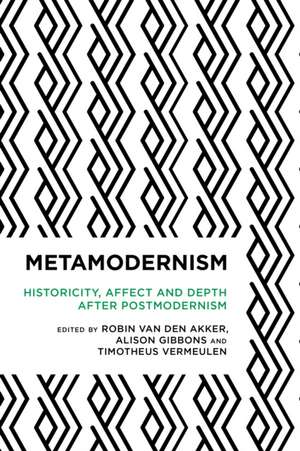
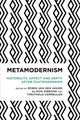
Metamodernism: Historicity, Affect, and Depth after Postmodernism: Radical Cultural Studies
Editat de Robin van den Akker, Alison Gibbons, Timotheus Vermeulenen Limba Engleză Hardback – 14 dec 2017

Preț: 820.80 lei
Preț vechi: 1205.50 lei
-32%
Puncte Express: 1231
Carte tipărită la comandă
Livrare economică 18 noiembrie-02 decembrie
Livrare prin curier în România Termenul estimat este afișat lângă disponibilitate.
Transport gratuit pentru acest produs Plată online sau ramburs, în funcție de opțiunile comenzii.
Retur gratuit în 14 zile Comandă securizată și suport în română.
Specificații
ISBN-13: 9781783489602
ISBN-10: 178348960X
Pagini: 304
Dimensiuni: 158 x 232 x 22 mm
Greutate: 0.61 kg
Editura: Bloomsbury Publishing
Colecția Rowman & Littlefield
Seria Radical Cultural Studies
Locul publicării:New York, United States
ISBN-10: 178348960X
Pagini: 304
Dimensiuni: 158 x 232 x 22 mm
Greutate: 0.61 kg
Editura: Bloomsbury Publishing
Colecția Rowman & Littlefield
Seria Radical Cultural Studies
Locul publicării:New York, United States
Cuprins
Acknowledgements
1. Periodising the 2000s, or, the emergence of metamodernism, Robin van den Akker and Timotheus Vermeulen
Section I: Historicity
2. Metamodern Historicity, Robin van den Akker
3. The metamodern, the quirky, and the challenge of categorization, James MacDowell
4. Toni Morrison's Beloved and the Rise of Historioplastic Metafiction, Josh Toth
5. Super-hybridity: Non-simultaneity, political power, and multipolar conflict, Jorg Heiser
6. The Cosmic Artisan: Mannerist Virtuosity and Contemporary Crafts, Sjoerd van Tuinen
Section II: Affect
7. Metamodern Affect, Alison Gibbons
8. Four Faces of Post-Irony, Lee Konstantinou
9. Radical Defenselessness: A new sense of self in the work of David Foster Wallace, Nicoline Timmer
10. Contemporary Autofiction and Affect, Alison Gibbons
11. The Joke that Wasn't funny anymore: Empathy in Contemporary Sitcoms, Gry Rustad and Kai Schwind
Section III: Depth
12. Metamodern Depth or 'Depthiness', Timotheus Vermeulen
13. Reconstructing Depth: Authentic Fiction and Responsibility, Irmtraud Huber and Wolfgang Funk
14. Between truth, sincerity and satire: Post-truth politics and the rhetoric of authenticity, Sam Browse
15. Notes on Performatist Photography: Experiencing beauty and transcendence after postmodernism, Raoul Eshelman
Epilogue
16. Thoughts on writing about art after postmodernism, James Elkins
References
Index
Contributor Information
1. Periodising the 2000s, or, the emergence of metamodernism, Robin van den Akker and Timotheus Vermeulen
Section I: Historicity
2. Metamodern Historicity, Robin van den Akker
3. The metamodern, the quirky, and the challenge of categorization, James MacDowell
4. Toni Morrison's Beloved and the Rise of Historioplastic Metafiction, Josh Toth
5. Super-hybridity: Non-simultaneity, political power, and multipolar conflict, Jorg Heiser
6. The Cosmic Artisan: Mannerist Virtuosity and Contemporary Crafts, Sjoerd van Tuinen
Section II: Affect
7. Metamodern Affect, Alison Gibbons
8. Four Faces of Post-Irony, Lee Konstantinou
9. Radical Defenselessness: A new sense of self in the work of David Foster Wallace, Nicoline Timmer
10. Contemporary Autofiction and Affect, Alison Gibbons
11. The Joke that Wasn't funny anymore: Empathy in Contemporary Sitcoms, Gry Rustad and Kai Schwind
Section III: Depth
12. Metamodern Depth or 'Depthiness', Timotheus Vermeulen
13. Reconstructing Depth: Authentic Fiction and Responsibility, Irmtraud Huber and Wolfgang Funk
14. Between truth, sincerity and satire: Post-truth politics and the rhetoric of authenticity, Sam Browse
15. Notes on Performatist Photography: Experiencing beauty and transcendence after postmodernism, Raoul Eshelman
Epilogue
16. Thoughts on writing about art after postmodernism, James Elkins
References
Index
Contributor Information
Recenzii
If you're in the market for a slick, shiny new aesthetic of the post-post or the meta-, you won't find it here - but you won't find it anywhere else, either, because it doesn't exist. If, however, you genuinely want to understand the "sticky mess" (in Jörg Heiser's phrase) that the new cultural practices are in the very process of emerging from, then you owe it to yourself to give this volume your fullest attention.
Metamodernism is the best collection of essays on our time's most notable cultural development: the turning of postmodernism into something else. The project's heart is van den Akker and Vermeulen's 2008 milestone essay "Notes on Metamodernism," which beats across a volume bringing together Alison Gibbons, Lee Konstantinou, Josh Toth, James MacDowell, Raoul Eshelman, and other distinguished critics of the contemporary.
In 2002, Linda Hutcheon famously announced the end of postmodernism. What has been happening in the areas of arts, culture, aesthetics, and politics ever since? Metamodernism: Historicity, Affect, and Depth after Postmodernism provides an answer to this question. The book is truly impressive in terms of both its theoretical scope and the discussion of representative examples of metamodernism.
I hope this book becomes required reading for scholars and think tanks, or any students studying postmodernism and beyond, so we could at least adopt a common 'language' (as they describe it) to reduce the excessive redundancy and conict in academia and contemporary social thought. This is what the 'principle of abstraction' from computer science does, and is much needed in our cultural programming.
Metamodernism is the best collection of essays on our time's most notable cultural development: the turning of postmodernism into something else. The project's heart is van den Akker and Vermeulen's 2008 milestone essay "Notes on Metamodernism," which beats across a volume bringing together Alison Gibbons, Lee Konstantinou, Josh Toth, James MacDowell, Raoul Eshelman, and other distinguished critics of the contemporary.
In 2002, Linda Hutcheon famously announced the end of postmodernism. What has been happening in the areas of arts, culture, aesthetics, and politics ever since? Metamodernism: Historicity, Affect, and Depth after Postmodernism provides an answer to this question. The book is truly impressive in terms of both its theoretical scope and the discussion of representative examples of metamodernism.
I hope this book becomes required reading for scholars and think tanks, or any students studying postmodernism and beyond, so we could at least adopt a common 'language' (as they describe it) to reduce the excessive redundancy and conict in academia and contemporary social thought. This is what the 'principle of abstraction' from computer science does, and is much needed in our cultural programming.