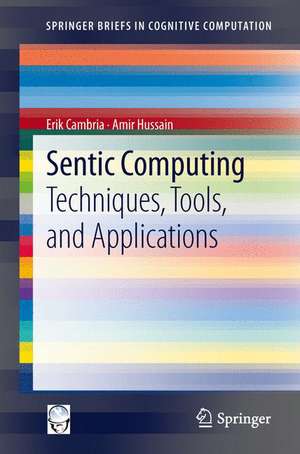
Sentic Computing: SpringerBriefs in Cognitive Computation, cartea 2
Autor Erik Cambria, Amir Hussainen Limba Engleză Paperback – 28 iul 2012
Preț: 352.61 lei
Preț vechi: 371.17 lei
-5%
Puncte Express: 529
Carte tipărită la comandă
Livrare economică 25 noiembrie-09 decembrie
Livrare prin curier în România Termenul estimat este afișat lângă disponibilitate.
Transport gratuit de la 400.00 lei Plată online sau ramburs, în funcție de opțiunile comenzii.
Retur gratuit în 14 zile Comandă securizată și suport în română.
Specificații
ISBN-13: 9789400750692
ISBN-10: 9400750692
Pagini: 172
Ilustrații: XVIII, 153 p. 39 illus., 35 illus. in color.
Dimensiuni: 155 x 235 x 10 mm
Greutate: 0.27 kg
Ediția:2012
Editura: Springer
Colecția SpringerBriefs in Cognitive Computation
Seria SpringerBriefs in Cognitive Computation
Locul publicării:Dordrecht, Netherlands
ISBN-10: 9400750692
Pagini: 172
Ilustrații: XVIII, 153 p. 39 illus., 35 illus. in color.
Dimensiuni: 155 x 235 x 10 mm
Greutate: 0.27 kg
Ediția:2012
Editura: Springer
Colecția SpringerBriefs in Cognitive Computation
Seria SpringerBriefs in Cognitive Computation
Locul publicării:Dordrecht, Netherlands
V-ar putea interesa
-
 The Frailty ModelLuc Duchateau-15%Preț: 671.62 lei790.14 lei
 -
 Bioconductor Case StudiesFlorian Hahne-15%Preț: 702.45 lei826.42 lei
 -
 -5%Preț: 520.08 lei547.45 lei
 -
 Design and Analysis Healthvan Belle-8%Preț: 425.01 lei461.97 lei
 -
 Strategic Pricing for Medical Technologies: A Practical Guide to Pricing Medical Devices & DiagnosticsMR Christopher D. Provines-5%Preț: 307.69 lei323.89 lei
 -
 Research Skills for Medical StudentsAnn K. Allen-5%Preț: 580.33 lei610.88 lei
 -
 Bone-Implant Interface in Orthopedic SurgeryTheofilos Karachalios-5%Preț: 1151.17 lei1211.75 lei
 -
 Preț: 361.70 lei
 -
 Asia Pacific Life Sciences CompendiumBandit Chumworathayi-27%Preț: 1253.05 lei1704.87 lei
 -
 Hematopoietic Stem Cells: New ResearchWesley G. Montgomery-23%Preț: 1303.79 lei1702.14 lei
 -
 Medicine Research Summaries: Volume 2Zhongwen Liáng-23%Preț: 1310.31 lei1706.26 lei
 -
 Medicine Research Summaries: Volume 3Zhongwen Liáng-23%Preț: 1311.00 lei1706.69 lei
 -
 Testing TreatmentsHazel Thornton-16%Preț: 60.88 lei72.31 lei
 -
 Pharmacological Basis of Acute CareYoo Kuen Chan-5%Preț: 813.09 lei855.88 lei
 -
 -5%Preț: 848.73 lei893.39 lei
 -
 Radiation ProteomicsDariusz Leszczynski-5%Preț: 742.12 lei781.18 lei
 -
 -5%Preț: 1146.56 lei1206.90 lei
Public țintă
ResearchCuprins
1. Introduction. - 2. Background. - 3. Techniques. - 4. Tools. - 5. Applications. - 6. Concluding Remarks.
Textul de pe ultima copertă
In this book common sense computing techniques are further developed and applied to bridge the semantic gap between word-level natural language data and the concept-level opinions conveyed by these. In particular, the ensemble application of graph mining and multi-dimensionality reduction techniques is exploited on two common sense knowledge bases to develop a novel intelligent engine for open-domain opinion mining and sentiment analysis. The proposed approach, termed sentic computing, performs a clause-level semantic analysis of text, which allows the inference of both the conceptual and emotional information associated with natural language opinions and, hence, a more efficient passage from (unstructured) textual information to (structured) machine-processable data.
Caracteristici
Represents the first comprehensive review of Sentic Computing, state-of-the-art approach to opinion mining and sentiment analysis (see http://en.wikipedia.org/wiki/Sentiment_analysis) A special chapter on cognitive and affective modeling for natural language understanding Includes tips on different strategies (techniques, online resources, datasets, etc.) to opinion mining and sentiment analysis Includes supplementary material: sn.pub/extras Includes supplementary material: sn.pub/extras
Notă biografică
Mr. Ranjan Satapathy is currently pursuing Ph.D., at the School of Computer Science and Engg., NTU Singapore under the supervision of Dr. Erik Cambria. His major research interests are deep learning, sentiment analysis and natural language processing.
He completed his Bachelor's degree in Computer Science and Engg., from IIIT-Bhubaneswar, India in 2013. He further recieved a M.Tech degree from University of Hyderabad, India in 2016, with majors in Computer Science. During his pursuits of Master's degree, he joined Dr. Cambria's research group SenticNet as an intern, where he worked on bio-medical sentiment analysis. This exposure and a keen-to-learn attitude motivated him to apply for Ph.D under Dr. Cambria.