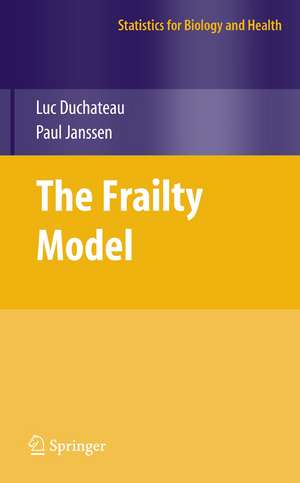
The Frailty Model: Statistics for Biology and Health
Autor Luc Duchateau, Paul Janssenen Limba Engleză Hardback – 7 dec 2007
În cadrul programelor avansate de statistică aplicată în medicină, epidemiologie și demografie, analiza datelor de supraviețuire grupate reprezintă o provocare metodologică majoră. The Frailty Model, publicat de Luc Duchateau și Paul Janssen în prestigioasa serie Statistics for Biology and Health, se poziționează ca o resursă fundamentală pentru cercetătorii care trebuie să gestioneze eterogenitatea neobservată în seturile de date complexe. Recomandăm acest volum pentru rigoarea cu care tratează tranziția de la analiza clasică a supraviețuirii către modelele de fragilitate, oferind o bază teoretică solidă acolo unde literatura existentă este adesea fragmentată. Subliniem abordarea aplicată a autorilor: deși fundamentul matematic este dens, textul integrează numeroase exemple din viața reală. Această ediție acoperă aceeași arie tematică precum Modeling Survival Data Using Frailty Models de David D. Hanagal, însă The Frailty Model se distinge prin accentul pus pe implementarea practică, oferind cod sursă pentru pachetele R și Winbugs. Structura cărții facilitează o progresie logică, începând cu modelele de riscuri proporționale parametrice cu fragilitate gamma, trecând prin distribuții alternative și modele semiparametrice, până la extensii avansate pentru date ierarhice și multinivel. Credem că acest parcurs, care include tehnici variate de fitare precum algoritmul EM sau metodele Bayesiene, transformă volumul într-un instrument de lucru indispensabil pentru statisticienii care depășesc nivelul introductiv al modelării Cox.
Din seria Statistics for Biology and Health
- 18%
 Preț: 1225.33 lei
 - 5%
 Preț: 853.45 lei
 - 5%
 Preț: 851.64 lei
 - 15%
 Preț: 561.48 lei
 - 5%
 Preț: 742.43 lei
 - 5%
 Preț: 749.66 lei
 - 5%
 Preț: 848.25 lei
 - 15%
 Preț: 675.76 lei
 - 15%
 Preț: 598.55 lei
 - 5%
 Preț: 979.54 lei
 - 23%
 Preț: 1074.46 lei
 - 5%
 Preț: 846.51 lei
 - 5%
 Preț: 381.37 lei
 - 20%
 Preț: 1035.54 lei
 - 5%
 Preț: 710.77 lei
 - 18%
 Preț: 940.29 lei
 - 15%
 Preț: 710.70 lei
 - 5%
 Preț: 1152.76 lei
 - 5%
 Preț: 723.65 lei
 - 5%
 Preț: 875.56 lei
 - 18%
 Preț: 1441.16 lei
 - 18%
 Preț: 1271.59 lei
 - 5%
 Preț: 1040.91 lei
 - 5%
 Preț: 759.20 lei
 - 5%
 Preț: 880.86 lei
 - 18%
 Preț: 2184.27 lei
 - 18%
 Preț: 908.65 lei
 - 18%
 Preț: 1398.92 lei
 -
 Preț: 399.93 lei
 - 5%
 Preț: 828.32 lei
 - 18%
 Preț: 1442.69 lei
 - 18%
 Preț: 1056.55 lei
 - 5%
 Preț: 756.96 lei
 - 18%
 Preț: 993.92 lei
 - 18%
 Preț: 1443.17 lei
 - 5%
 Preț: 764.59 lei
 - 5%
 Preț: 1152.77 lei
Preț: 671.62 lei
Preț vechi: 790.14 lei
-15%
Carte tipărită la comandă
Livrare economică 27 noiembrie-11 decembrie
Specificații
ISBN-10: 0387728341
Pagini: 336
Ilustrații: XVII, 316 p.
Dimensiuni: 160 x 241 x 24 mm
Greutate: 0.62 kg
Ediția:2008
Editura: Springer
Colecția Statistics for Biology and Health
Seria Statistics for Biology and Health
Locul publicării:New York, NY, United States
V-ar putea interesa
-
 DrugsNg-23%Preț: 607.87 lei789.44 lei
 -
 -5%Preț: 1021.28 lei1075.02 lei
 -
 -5%Preț: 294.23 lei309.71 lei
 -
 Ovulation Stimulation with GonadotropinsJean-Claude Emperaire-5%Preț: 739.26 lei778.17 lei
 -
 -5%Preț: 334.39 lei351.98 lei
 -
 Die Idee der PhänomenologieEdmund HusserlPreț: 116.36 lei
Public țintă
Professional/practitionerDe ce să citești această carte
Această lucrare este esențială pentru statisticienii și doctoranzii din domeniul sănătății care lucrează cu date grupate. Spre deosebire de alte texte teoretice, volumul oferă soluții software concrete în R și Winbugs, permițând cititorului să aplice imediat modelele de fragilitate în propriile cercetări. Câștigați astfel o înțelegere profundă a eterogenității datelor și instrumentele necesare pentru a interpreta corect rezultatele în context clinic sau biologic.
Cuprins
Recenzii
"The book by Duchateau and Jansen is generally easy to follow. The book starts with introduction to the most popular parametric and semiparametric survival models. … this book can be recommended also for undergraduate students in statistics. … the book contains several further extensions of frailty models such as multifrailty and multilevel models with references. Therefore it is valuable also for researchers in survival analysis." (Tommi Härkänen, International Statistical Review, Vol. 76 (3), 2008)
"This book focuses on frailty models and provides an in-depth discussion of the basics of frailty model methodology using numerous real data sets. … The book is well structured and covers very nicely the material for frailty models. … The book is directed towards statistical practitioners and graduate students but it may be useful to a broad interdisciplinary readership of researchers and practitioners in applied statistics, biomedicine and biostatistics. … a reference book for a one-semester applied course in survival analysis focusing on frailties." (Filia Vonta, Journal of Applied Statistics, Vol. 36 (6), August, 2009)
"This book studies so-called frailty models intended for time-to-event data with a cluster structure. … provide a thorough presentation of the most current techniques used in this area of time-to-event analysis with emphasis on analysis of real data sets. The book is intended for students and applied statisticians. … this book gives a good description of frailty models. It is well written and its many real applications and the availability of computer code make it a valuable resource for the applied statistician … ." (Torben Martinussen, Biometrical Journal, Vol. 51 (3), 2009)
Textul de pe ultima copertă
It is demanding for statistical practitioners and graduate students to grasp a good knowledge on frailty models from the existing literature. This book provides an in-depth discussion and explanation of the basics of frailty model methodology for such readers. The discussion includes parametric and semiparametric frailty models and accelerated failure time models. Common techniques to fit frailty models include the EM-algorithm, penalised likelihood techniques, Laplacian integration and Bayesian techniques. More advanced frailty models for hierarchical data are also included.
Real-lifeexamples are used to demonstrate how particular frailty models can be fitted and how the results should be interpreted. The programs to fit all the worked-out examples in the book are available from the Springer website with most of the programs developed in the freeware packages R and Winbugs. The book starts with a brief overview of some basic concepts in classical survival analysis, collecting what is needed for the reading on the more complex frailty models.
Luc Duchateau is Associate Professor of Statistics at the Faculty of Veterinary Medicine of the Ghent University, Belgium. He is board member of the Quetelet Society (Belgian Region of the International Biometric Society) and of the International Biometric Society Channel Network. He has collaborated extensively with physicians in oncology and allergy, public health workers and veterinarians, and is an author of numerous papers in statistical, medical and veterinarian journals.
Paul Janssen is Professor of Statistics at the Centre for Statistics of the Hasselt University, Diepenbeek, Belgium. He is an elected member of the International Statistical Institute. He spent research visits at the Johns Hopkins University (Baltimore, USA) and the University of Washington (Seattle, USA). His research interests include survival analysis, nonparametric estimation, resampling techniques and asymptotic theory.