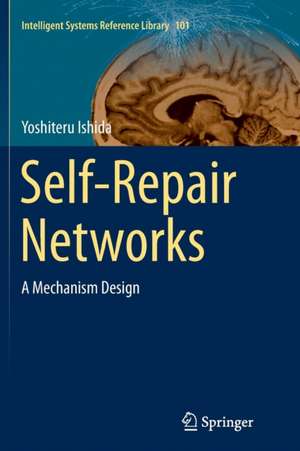
Self-Repair Networks: A Mechanism Design: Intelligent Systems Reference Library, cartea 101
Autor Yoshiteru Ishidaen Limba Engleză Paperback – 30 mar 2018
The book contains interdisciplinaryresearch encompassing game theory, complex systems, reliability theory andparticle physics. All devoted to its central theme: what happens ifsystems self-repair themselves?
| Toate formatele și edițiile | Preț | Express |
|---|---|---|
| Paperback (1) | 615.00 lei 43-57 zile | |
| Springer International Publishing – 30 mar 2018 | 615.00 lei 43-57 zile | |
| Hardback (1) | 621.01 lei 43-57 zile | |
| Springer International Publishing – 6 ian 2016 | 621.01 lei 43-57 zile |
Din seria Intelligent Systems Reference Library
- 20%
 Preț: 1112.56 lei
 - 20%
 Preț: 623.39 lei
 - 20%
 Preț: 624.95 lei
 - 20%
 Preț: 966.57 lei
 - 20%
 Preț: 1011.75 lei
 - 20%
 Preț: 1125.88 lei
 - 20%
 Preț: 1119.52 lei
 - 20%
 Preț: 1006.20 lei
 - 20%
 Preț: 1022.07 lei
 - 20%
 Preț: 1002.07 lei
 - 20%
 Preț: 314.86 lei
 - 20%
 Preț: 1126.65 lei
 - 20%
 Preț: 352.25 lei
 - 20%
 Preț: 1126.86 lei
 - 20%
 Preț: 1845.06 lei
 - 20%
 Preț: 952.14 lei
 - 20%
 Preț: 626.38 lei
 - 20%
 Preț: 621.01 lei
 - 20%
 Preț: 634.64 lei
 - 20%
 Preț: 622.12 lei
 - 20%
 Preț: 628.77 lei
 - 20%
 Preț: 624.82 lei
 - 20%
 Preț: 623.07 lei
 - 20%
 Preț: 632.58 lei
 - 20%
 Preț: 631.46 lei
 - 20%
 Preț: 1560.69 lei
 - 20%
 Preț: 618.14 lei
 - 20%
 Preț: 624.51 lei
 - 20%
 Preț: 626.07 lei
 - 20%
 Preț: 627.83 lei
 - 20%
 Preț: 964.01 lei
 - 20%
 Preț: 620.20 lei
 - 20%
 Preț: 626.71 lei
 - 20%
 Preț: 620.07 lei
 - 20%
 Preț: 621.64 lei
Preț: 615.00 lei
Preț vechi: 768.74 lei
-20%
Puncte Express: 923
Preț estimativ în valută:
108.74€ • 128.32$ • 95.23£
108.74€ • 128.32$ • 95.23£
Carte tipărită la comandă
Livrare economică 13-27 aprilie
Specificații
ISBN-13: 9783319799551
ISBN-10: 331979955X
Pagini: 157
Ilustrații: XXII, 157 p. 50 illus., 12 illus. in color.
Dimensiuni: 155 x 235 mm
Greutate: 0.26 kg
Ediția:Softcover reprint of the original 1st ed. 2015
Editura: Springer International Publishing
Colecția Springer
Seria Intelligent Systems Reference Library
Locul publicării:Cham, Switzerland
ISBN-10: 331979955X
Pagini: 157
Ilustrații: XXII, 157 p. 50 illus., 12 illus. in color.
Dimensiuni: 155 x 235 mm
Greutate: 0.26 kg
Ediția:Softcover reprint of the original 1st ed. 2015
Editura: Springer International Publishing
Colecția Springer
Seria Intelligent Systems Reference Library
Locul publicării:Cham, Switzerland
V-ar putea interesa
-
 -21%Preț: 83.28 lei105.26 lei
 -
 Argumentation in Artificial IntelligenceIyad Rahwan-20%Preț: 963.19 lei1203.99 lei
 -
 Computer Vision: Models, Learning, and InferenceSimon J. D. Prince-20%Preț: 528.19 lei660.24 lei
 -
 -20%Preț: 349.72 lei437.15 lei
 -
 -20%Preț: 623.61 lei779.51 lei
 -
 Wavelet Neural NetworksAntonios K Alexandridis-20%Preț: 586.36 lei732.94 lei
 -
 A Practical Introduction to Computer Vision with OpenCV3K Dawson–Howe-23%Preț: 433.80 lei563.37 lei
 -
 Numerical Methods for Nonlinear Engineering ModelsJohn R. Hauser-20%Preț: 1601.40 lei2001.75 lei
 -
 Machine Learning: An Algorithmic Perspective, Second EditionStephen Marsland-20%Preț: 595.25 lei744.07 lei
 -
 -9%Preț: 945.32 lei1038.82 lei
 -
 Immunity-Based Systems: A Design PerspectiveYoshiteru Ishida-20%Preț: 621.81 lei777.27 lei
 -
 -20%Preț: 324.19 lei405.23 lei
 -
 -20%Preț: 340.78 lei425.97 lei
 -
 -20%Preț: 322.61 lei403.26 lei
 -
 Recent Advances in ConstraintsFrancisco Azevedo-20%Preț: 315.87 lei394.84 lei
 -
 Modeling and Using ContextBoicho Kokinov-20%Preț: 636.86 lei796.08 lei
 -
 Argumentation in Multi-Agent SystemsIyad Rahwan-20%Preț: 318.51 lei398.15 lei
 -
 Believable Bots: Can Computers Play Like People?Philip Hingston-20%Preț: 628.32 lei785.39 lei
Cuprins
Introduction: Self-Action Models.- Incentives for Repair in Self-Repair Networks.- A Phase Transition in Self-Repair Networks: Problems and Definitions.- Controlling RepairingStrategy: A Spatial Game Approach.- Adaptive Capability in Spaceand Time.- Protection of CooperativeClusters by Membrane.- Duality in Logics ofSelf-Repair.- Asymmetry between Repair andInfection in Self-Repair Networks.- Dynamics of Self-RepairNetworks of Several Types.- Self-Repair Networks as anEpidemic Model.- Self-Repair Networks and theSelf-Recognition Model.- Conclusion.
Textul de pe ultima copertă
Thisbook describes the struggle to introduce a mechanism that enablesnext-generation information systems to maintain themselves. Our generationobserved the birth and growth of information systems, and the Internet inparticular. Surprisingly information systems are quite different fromconventional (energy, material-intensive) artificial systems, and ratherresemble biological systems (information-intensive systems). Many artificialsystems are designed based on (Newtonian) physics assuming that every elementobeys simple and static rules; however, the experience of the Internet suggestsa different way of designing where growth cannot be controlled butself-organized with autonomous and selfish agents. This book suggests using gametheory, a mechanism design inparticular, for designing next-generation information systems which will beself-organized by collective acts with autonomous components. The challenge of mapping a probability to time appears repeatedly in many forms throughoutthis book.
The book contains interdisciplinaryresearch encompassing game theory, complex systems, reliability theory andparticle physics. All devoted to its central theme: what happens ifsystems self-repair themselves?
The book contains interdisciplinaryresearch encompassing game theory, complex systems, reliability theory andparticle physics. All devoted to its central theme: what happens ifsystems self-repair themselves?
Caracteristici
Focuses on self-repair networks which originated as an extension of Immunity-based Systems Presents a game theoretic approach to networks with special focus on mechanism design by selfish agents Presents logics, dynamics and applications of Self-Repair Networks Includes supplementary material: sn.pub/extras