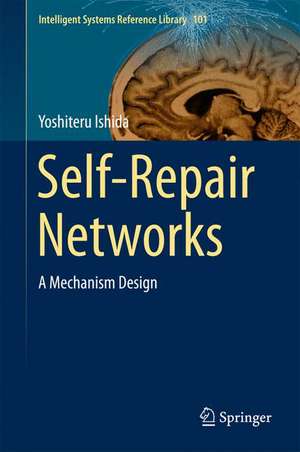
Self-Repair Networks: Intelligent Systems Reference Library, cartea 101
Autor Yoshiteru Ishidaen Limba Engleză Hardback – 6 ian 2016
The book contains interdisciplinaryresearch encompassing game theory, complex systems, reliability theory andparticle physics. All devoted to its central theme: what happens ifsystems self-repair themselves?
Din seria Intelligent Systems Reference Library
- 20%
 Preț: 1199.62 lei
 - 20%
 Preț: 672.22 lei
 - 20%
 Preț: 674.97 lei
 - 20%
 Preț: 1043.12 lei
 - 20%
 Preț: 1090.74 lei
 - 20%
 Preț: 1213.04 lei
 - 20%
 Preț: 1207.79 lei
 - 20%
 Preț: 1083.76 lei
 - 20%
 Preț: 1101.63 lei
 - 20%
 Preț: 1080.01 lei
 - 20%
 Preț: 1322.83 lei
 - 20%
 Preț: 1207.79 lei
 - 20%
 Preț: 1928.55 lei
 - 20%
 Preț: 952.14 lei
 - 20%
 Preț: 674.70 lei
 - 20%
 Preț: 684.20 lei
 - 20%
 Preț: 669.84 lei
 - 20%
 Preț: 677.34 lei
 - 20%
 Preț: 672.70 lei
 - 20%
 Preț: 670.94 lei
 - 20%
 Preț: 681.75 lei
 - 20%
 Preț: 680.43 lei
 - 20%
 Preț: 1686.68 lei
 - 20%
 Preț: 638.62 lei
 - 20%
 Preț: 672.48 lei
 - 20%
 Preț: 674.25 lei
 - 20%
 Preț: 676.25 lei
 - 20%
 Preț: 1039.77 lei
 - 20%
 Preț: 620.20 lei
 - 20%
 Preț: 682.21 lei
 - 20%
 Preț: 667.38 lei
 - 20%
 Preț: 669.16 lei
Preț: 668.51 lei
Preț vechi: 835.64 lei
-20%
Puncte Express: 1003
Carte tipărită la comandă
Livrare economică 08-22 decembrie
Livrare prin curier în România Termenul estimat este afișat lângă disponibilitate.
Transport gratuit pentru acest produs Plată online sau ramburs, în funcție de opțiunile comenzii.
Retur gratuit în 14 zile Comandă securizată și suport în română.
Specificații
ISBN-13: 9783319264455
ISBN-10: 3319264451
Pagini: 180
Ilustrații: XXII, 157 p. 50 illus., 12 illus. in color.
Dimensiuni: 160 x 241 x 16 mm
Greutate: 0.39 kg
Ediția:1st edition 2015
Editura: Springer
Colecția Intelligent Systems Reference Library
Seria Intelligent Systems Reference Library
Locul publicării:Cham, Switzerland
ISBN-10: 3319264451
Pagini: 180
Ilustrații: XXII, 157 p. 50 illus., 12 illus. in color.
Dimensiuni: 160 x 241 x 16 mm
Greutate: 0.39 kg
Ediția:1st edition 2015
Editura: Springer
Colecția Intelligent Systems Reference Library
Seria Intelligent Systems Reference Library
Locul publicării:Cham, Switzerland
V-ar putea interesa
-
 -19%Preț: 92.35 lei114.22 lei
 -
 Argumentation in Artificial IntelligenceIyad Rahwan-20%Preț: 1041.96 lei1302.44 lei
 -
 Computer VisionSimon J. D. Prince-20%Preț: 582.72 lei728.39 lei
 -
 Machine LearningPeter Flach-20%Preț: 386.84 lei483.55 lei
 -
 Multi-Agent Machine LearningH M Schwartz-20%Preț: 675.81 lei844.77 lei
 -
 Wavelet Neural NetworksAntonios K Alexandridis-20%Preț: 634.18 lei792.72 lei
 -
 Practical Introduction to CompDawson-Howe-20%Preț: 518.21 lei647.76 lei
 -
 Numerical Methods for Nonlinear Engineering ModelsJohn R. Hauser-20%Preț: 1719.07 lei2148.84 lei
 -
 Machine Learning: An Algorithmic Perspective, Second EditionStephen Marsland-20%Preț: 625.22 lei781.53 lei
 -
 Natural Language Processing and Computational LinguisticsMohamed Zakaria Kurdi-9%Preț: 1021.06 lei1122.04 lei
 -
 Immunity-Based Systems: A Design PerspectiveYoshiteru Ishida-20%Preț: 621.81 lei777.27 lei
 -
 -20%Preț: 324.19 lei405.23 lei
 -
 -20%Preț: 340.78 lei425.97 lei
 -
 Learning Classifier SystemsPier L. Lanzi-20%Preț: 325.44 lei406.80 lei
 -
 Recent Advances in ConstraintsFrancisco Azevedo-20%Preț: 329.48 lei411.85 lei
 -
 Modeling and Using ContextBoicho Kokinov-20%Preț: 664.52 lei830.66 lei
 -
 Argumentation in Multi-Agent SystemsIyad Rahwan-20%Preț: 319.49 lei399.37 lei
 -
 Believable BotsPhilip Hingston-20%Preț: 676.70 lei845.88 lei
Public țintă
ResearchCuprins
Introduction: Self-Action Models.- Incentives for Repair in Self-Repair Networks.- A Phase Transition in Self-Repair Networks: Problems and Definitions.- Controlling RepairingStrategy: A Spatial Game Approach.- Adaptive Capability in Spaceand Time.- Protection of CooperativeClusters by Membrane.- Duality in Logics ofSelf-Repair.- Asymmetry between Repair andInfection in Self-Repair Networks.- Dynamics of Self-RepairNetworks of Several Types.- Self-Repair Networks as anEpidemic Model.- Self-Repair Networks and theSelf-Recognition Model.- Conclusion.
Textul de pe ultima copertă
Thisbook describes the struggle to introduce a mechanism that enablesnext-generation information systems to maintain themselves. Our generationobserved the birth and growth of information systems, and the Internet inparticular. Surprisingly information systems are quite different fromconventional (energy, material-intensive) artificial systems, and ratherresemble biological systems (information-intensive systems). Many artificialsystems are designed based on (Newtonian) physics assuming that every elementobeys simple and static rules; however, the experience of the Internet suggestsa different way of designing where growth cannot be controlled butself-organized with autonomous and selfish agents. This book suggests using gametheory, a mechanism design inparticular, for designing next-generation information systems which will beself-organized by collective acts with autonomous components. The challenge of mapping a probability to time appears repeatedly in many forms throughoutthis book.
The book contains interdisciplinaryresearch encompassing game theory, complex systems, reliability theory andparticle physics. All devoted to its central theme: what happens ifsystems self-repair themselves?
The book contains interdisciplinaryresearch encompassing game theory, complex systems, reliability theory andparticle physics. All devoted to its central theme: what happens ifsystems self-repair themselves?
Caracteristici
Focuses on self-repair networks which originated as an extension of Immunity-based Systems Presents a game theoretic approach to networks with special focus on mechanism design by selfish agents Presents logics, dynamics and applications of Self-Repair Networks Includes supplementary material: sn.pub/extras