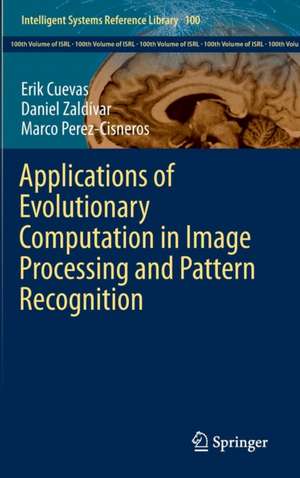
Applications of Evolutionary Computation in Image Processing and Pattern Recognition: Intelligent Systems Reference Library, cartea 100
Autor Erik Cuevas, Daniel Zaldívar, Marco Perez-Cisnerosen Limba Engleză Hardback – 17 noi 2015
Din seria Intelligent Systems Reference Library
- 20%
 Preț: 1199.62 lei
 - 20%
 Preț: 672.22 lei
 - 20%
 Preț: 674.97 lei
 - 20%
 Preț: 1043.12 lei
 - 20%
 Preț: 1090.74 lei
 - 20%
 Preț: 1213.04 lei
 - 20%
 Preț: 1207.79 lei
 - 20%
 Preț: 1083.76 lei
 - 20%
 Preț: 1101.63 lei
 - 20%
 Preț: 1080.01 lei
 - 20%
 Preț: 1322.83 lei
 - 20%
 Preț: 1207.79 lei
 - 20%
 Preț: 1928.55 lei
 - 20%
 Preț: 952.14 lei
 - 20%
 Preț: 668.51 lei
 - 20%
 Preț: 684.20 lei
 - 20%
 Preț: 669.84 lei
 - 20%
 Preț: 677.34 lei
 - 20%
 Preț: 672.70 lei
 - 20%
 Preț: 670.94 lei
 - 20%
 Preț: 681.75 lei
 - 20%
 Preț: 680.43 lei
 - 20%
 Preț: 1686.68 lei
 - 20%
 Preț: 638.62 lei
 - 20%
 Preț: 672.48 lei
 - 20%
 Preț: 674.25 lei
 - 20%
 Preț: 676.25 lei
 - 20%
 Preț: 1039.77 lei
 - 20%
 Preț: 620.20 lei
 - 20%
 Preț: 682.21 lei
 - 20%
 Preț: 667.38 lei
 - 20%
 Preț: 669.16 lei
Preț: 674.70 lei
Preț vechi: 843.38 lei
-20%
Puncte Express: 1012
Carte tipărită la comandă
Livrare economică 07-21 decembrie
Livrare prin curier în România Termenul estimat este afișat lângă disponibilitate.
Transport gratuit pentru acest produs Plată online sau ramburs, în funcție de opțiunile comenzii.
Retur gratuit în 14 zile Comandă securizată și suport în română.
Specificații
ISBN-13: 9783319264608
ISBN-10: 3319264605
Pagini: 292
Ilustrații: XV, 274 p. 111 illus., 55 illus. in color.
Dimensiuni: 160 x 241 x 22 mm
Greutate: 0.55 kg
Ediția:1st edition 2016
Editura: Springer
Colecția Intelligent Systems Reference Library
Seria Intelligent Systems Reference Library
Locul publicării:Cham, Switzerland
ISBN-10: 3319264605
Pagini: 292
Ilustrații: XV, 274 p. 111 illus., 55 illus. in color.
Dimensiuni: 160 x 241 x 22 mm
Greutate: 0.55 kg
Ediția:1st edition 2016
Editura: Springer
Colecția Intelligent Systems Reference Library
Seria Intelligent Systems Reference Library
Locul publicării:Cham, Switzerland
V-ar putea interesa
-
 Lattice Methods for Multiple IntegrationI. H. Sloan-32%Preț: 782.97 lei1144.70 lei
 -
 -27%Preț: 807.23 lei1105.78 lei
 -
 Calculus and AnalysisHorst R Beyer-9%Preț: 1080.19 lei1187.02 lei
 -
 User and Task Analysis for Interface DesignJoann T Hackos-20%Preț: 538.53 lei673.16 lei
 -
 Calculus of Variations and Optimal Control TheoryDaniel Liberzon-19%Preț: 601.35 lei742.41 lei
 -
 DistributionsJ J Duistermaat-15%Preț: 673.59 lei792.46 lei
 -
 Optimization with PDE ConstraintsMichael Hinze-18%Preț: 924.87 lei1127.89 lei
 -
 Convex Analysis and Nonlinear OptimizationJonathan Borwein-15%Preț: 446.81 lei525.65 lei
 -
 Mathematical Control TheoryEduardo D. Sontag-15%Preț: 515.66 lei606.66 lei
 -
 Foundations of OptimizationOsman Güler-40%Preț: 239.42 lei399.03 lei
 -
 Geometric Optimal ControlHeinz Schättler-15%Preț: 606.28 lei713.27 lei
 -
 Optimal InvestmentL. C. G. Rogers-15%Preț: 467.08 lei549.51 lei
 -
 Nonlinear Solid MechanicsAdnan IbrahimbegovicPreț: 427.88 lei
Public țintă
ResearchCuprins
Introduction.- ImageSegmentation Based on Differential Evolution Optimization.-Motion EstimationBased on Artificial Bee Colony (ABC).- Ellipse Detection on ImagesInspired by the Collective Animal Behavior.- Template Matching by Usingthe States of Matter Algorithm.- Estimation of Multiple View RelationsConsidering Evolutionary Approaches.- Circle Detection on Images Based onan Evolutionary Algorithm that Reduces theNumber of Function Evaluations.- Otsu and Kapur Segmentation Basedon Harmony Search Optimization.- Leukocyte Detection by UsingElectromagnetism-Like Optimization.- Automatic Segmentation by Using an AlgorithmBased on the Behavior of Locust Swarms.
Textul de pe ultima copertă
This book presents the use of efficientEvolutionary Computation (EC) algorithms for solving diverse real-world imageprocessing and pattern recognition problems. It provides an overview of thedifferent aspects of evolutionary methods in order to enable the reader inreaching a global understanding of the field and, in conducting studies onspecific evolutionary techniques that are related to applications in imageprocessing and pattern recognition. It explains the basic ideas of the proposedapplications in a way that can also be understood by readers outside of thefield. Image processing and pattern recognition practitioners who are notevolutionary computation researchers will appreciate the discussed techniquesbeyond simple theoretical tools since they have been adapted to solvesignificant problems that commonly arise on such areas. On the other hand,members of the evolutionary computation community can learn the way in whichimage processing and pattern recognition problems can be translated into anoptimization task. The book has been structured so that each chapter can beread independently from the others. It can serve as reference book for studentsand researchers with basic knowledge in image processing and EC methods.
Caracteristici
Provides an overview of the different aspects of evolutionary methods Enables the reader to reach a global understanding of the field Structured so that each chapter can be read independently Includes supplementary material: sn.pub/extras
Notă biografică
Dr. Erik Cuevas received his B.S. degree with distinction in Electronics and Communications Engineering from the University of Guadalajara, Mexico, in 1995, the M.Sc. degree in Industrial Electronics from ITESO, Mexico, in 2000, and the Ph.D. degree from Freie Universität Berlin, Germany in 2006. Since 2006 he has been with the University of Guadalajara, where he is currently a full-time Professor in the Department of Computer Science. Since 2008, he is a member of the Mexican National Research System (SNI III). He is the author of several books and articles. His current research interest includes Meta-heuristics, computer vision, and mathematical methods. He serves as an editor in Expert System with Applications, ISA Transactions, and Applied Soft Computing, Applied Mathematical Modeling and Mathematics and Computers in Simulation. Daniel Zaldivar graduated from the University of Guadalajara, Mexico in 1995 with a B.S. degree in Electronics and Communications Engineering. Later, in 2000, he earned his M.Sc. degree in Industrial Electronics from ITESO, Mexico, and in 2006 he received his Ph.D. degree from Freie Universität Berlin, Germany. Since then, he has been employed as a full-time Professor in the Department of Computer Science at the University of Guadalajara, where he currently holds his position. Ernesto Ayala, originally from León, Guanajuato was born in 1982. He received the title of Electrical Mechanical Engineer in 2017 and in 2019 the master's degree in Applied Computing at the University of Guadalajara. He is currently a PhD candidate in Electronics and Computing Sciences. Since 2018, he has been teaching curricular courses in Robotics Engineering and Electronic Engineering in the Division of Technologies for Cyber-human Integration of the University Center for Exact Sciences and Engineering. His area of expertise is computer vision and evolutionary computing. Mr. Ayala collaborates with a research group atthe University of Guadalajara focused on the development of ecological and autonomous driving vehicles. Oscar González received his B.S. with distinction in Electronic Engineering and Communications from the University of Guadalajara, Mexico, in 2022. During the COVID-19 pandemic, he was a member of the advisory committee for the COVID-19 pandemic of the University of Guadalajara. For his contributions and studies on COVID-19, he has been awarded the Irene Robledo García Award, the highest distinction of the University of Guadalajara for social service in 2022. Fernando Vega received the title of technical career in electricity by C.B.E.T.I.S. in 2014. Obtained a B.S. degree in Mechatronics from the National Technologist of Mexico, campus Culiacan, Mexico, in 2019. He is part of the University of Guadalajara, a full-time student M.S. in the Electronics and Computer Science program. His current research interests include motors design, electric vehicle design, Metaheuristics.