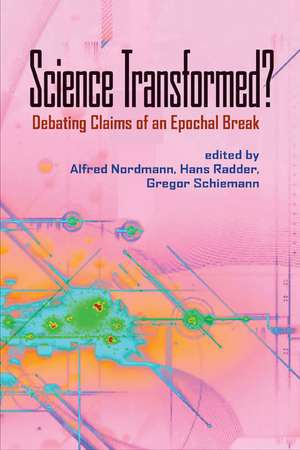
Science Transformed?: Debating Claims of an Epochal Break
Editat de Alfred Nordmann, Hans Radder, Gregor Schiemannen Limba Engleză Paperback – 11 noi 2011
În prima ediție a volumului Science Transformed?, explorăm o întrebare fundamentală pentru structura cunoașterii contemporane: asistăm oare la o „ruptură epocală” în istoria științei? Această lucrare colectivă, coordonată de Alfred Nordmann, Hans Radder și Gregor Schiemann, investighează modul în care instrumentația avansată, robotica și modelarea prin simulare au transformat știința dintr-o întreprindere pur epistemologică într-una condusă de tehnologie. Suntem de părere că volumul reușește să evite concluziile pripite, oferind un spațiu de dezbatere riguros între susținătorii ideii de discontinuitate istorică și cei care văd o continuitate a practicilor anterioare.
Textul extinde cadrul propus de The Role of Technology in Science: Philosophical Perspectives de Sven Ove Hansson, aducând date noi despre modul în care digitalizarea condiționează comportamentele cercetătorilor și alterează obiectul investigației. În timp ce lucrarea lui Hansson se concentrează pe aplicațiile tehnologice, Science Transformed? plonjează în sociologia instituțională, analizând declinul cercetătorului individual în favoarea comunităților vaste și impactul comercializării științei universitare. De asemenea, volumul completează perspectivele din Science in the Context of Application de Martin Carrier, mutând accentul de pe rezolvarea problemelor complexe de mediu spre mecanismele interne prin care predictibilitatea oferită de computer înlocuiește, uneori periculos, explicația teoretică.
Apreciem în mod deosebit analiza tranziției de la laborator la experimentele „in vivo” în lumea reală, o schimbare care ridică serioase semne de întrebare asupra calității științifice. Volumul nu se limitează la teorie, ci examinează studii de caz concrete, de la semnificația culturală a roboților umanoizi până la modul în care algoritmii de calcul redefinesc rigoarea experimentală. Este o resursă esențială pentru înțelegerea noii ordini în care știința și tehnologia au devenit inseparabile.
Preț: 388.81 lei
Carte disponibilă
Livrare economică 13-27 noiembrie
Specificații
ISBN-10: 0822961636
Pagini: 232
Ilustrații: 12 b&w
Dimensiuni: 152 x 229 x 18 mm
Greutate: 0.37 kg
Ediția:1
Editura: University of Pittsburgh Press
Colecția University of Pittsburgh Press
V-ar putea interesa
-
 Physical Theory: Method and InterpretationLawrence Sklar-30%Preț: 614.57 lei878.03 lei
-
 -10%Preț: 374.64 lei414.50 lei
-
 -15%Preț: 338.33 lei399.73 lei
-
 -28%Preț: 518.47 lei719.17 lei
-
 The Theoretical Practices of Physics: Philosophical EssaysR. I. G. Hughes-11%Preț: 313.55 lei353.30 lei
-
 -21%Preț: 66.37 lei83.83 lei
-
 Persistence and SpacetimeYuri Balashov-11%Preț: 312.07 lei352.52 lei
-
 Geometric PossibilityGordon Belot-12%Preț: 302.36 lei342.89 lei
-
 Interpreting Quantum TheoriesLaura Ruetsche-10%Preț: 365.82 lei405.29 lei
-
 How Big is Big and How Small is Small: The Sizes of Everything and WhyTimothy Paul Smith-11%Preț: 353.40 lei398.00 lei
-
 Scientists as Prophets: A Rhetorical GenealogyLynda Walsh-10%Preț: 387.02 lei430.19 lei
-
 Systematicity: The Nature of SciencePaul Hoyningen-Huene-31%Preț: 695.38 lei1001.48 lei
-
 -34%Preț: 583.64 lei879.06 lei
-
 The Philosophy of PhysicsDean RicklesPreț: 232.40 lei
-
 What Makes a Good Experiment?: Reasons and Roles in ScienceAllan FranklinPreț: 451.35 lei
-
 Preț: 388.79 lei
-
 The Philosophy Of Scientific ExperimentationHans RadderPreț: 425.94 lei
-
 Preț: 385.36 lei
-
 Four Decades of Scientific ExplanationWesley C. SalmonPreț: 387.66 lei
-
 Preț: 390.18 lei
-
 The Physics of TheismJeffrey KoperskiPreț: 261.06 lei
-
 Technikphilosophie zur EinführungAlfred NordmannPreț: 107.79 lei
De ce să citești această carte
Recomandăm această carte cercetătorilor și studenților la filosofie sau istoria științei care doresc să înțeleagă dacă transformările digitale actuale reprezintă o evoluție sau o criză de paradigmă. Cititorul va câștiga o perspectivă critică asupra modului în care influența industriei și dependența de simulări pe calculator modifică standardele de obiectivitate și rigoare în cercetarea modernă.
Despre autor
Alfred Nordmann este profesor de filosofie la Universitatea Tehnică din Darmstadt și o figură centrală în studiul filosofiei tehnicii. Expertiza sa este vastă, fiind recunoscut pentru editarea și traducerea lucrărilor lui Ludwig Wittgenstein, experiență reflectată în volumul Philosophical Occasions: 1912-1951. Această preocupare pentru rigoarea limbajului și structura gândirii se regăsește și în abordarea sa editorială din Science Transformed?. Nordmann explorează, de asemenea, dimensiunea istorică a iluziei tehnologice în lucrări precum Täuschung und Illusion, unde analizează tehnica ca o istorie a progresului prin decepție, un unghi de vedere critic ce fundamentează dezbaterea despre „ruptura epocală” în știință.
Descriere scurtă
This edited volume presents an in-depth examination of these issues from philosophical, historical, social, and cultural perspectives. It offers arguments both for and against the epochal break thesis in light of historical antecedents. Contributors discuss topics such as: science as a continuing epistemological enterprise; the decline of the individual scientist and the rise of communities; the intertwining of scientific and technological needs; links to prior practices and ways of thinking; the alleged divide between mode-1 and mode-2 research methods; the commodification of university science; and the shift from the scientific to a technological enterprise. Additionally, they examine the epochal break thesis using specific examples, including the transition from laboratory to real world experiments; the increased reliance on computer imaging; how analog and digital technologies condition behaviors that shape the object and beholder; the cultural significance of humanoid robots; the erosion of scientific quality in experimentation; and the effect of computers on prediction at the expense of explanation.
Whether these events represent a historic break in scientific theory, practice, and methodology is disputed. What they do offer is an important occasion for philosophical analysis of the epistemic, institutional and moral questions affecting current and future scientific pursuits.
Recenzii
—Silvan Schweber, Brandeis University
—Peter Weingart, Bielefeld University
—International Studies in the Philosophy of Science
Notă biografică
Hans Radder is professor of philosophy of science and technology at Vrije Universiteit Amsterdam. He is the author of The World Observed/The World Conceived, In and About the World: Philosophical Studies of Science and Technology, and The Material Realization of Science. Radder is also the editor of The Philosophy of Scientific Experimentation and The Commodification of Academic Research: Science and the Modern University.
Gregor Schiemann is professor of philosophy and history of science at Bergische Universität in Wuppertal. He is the author of Hermann von Helmholtz’ Mechanism: The Loss of Certainty and Werner Heisenberg, and coeditor of The Significance of the Hypothetical in the Natural Sciences.