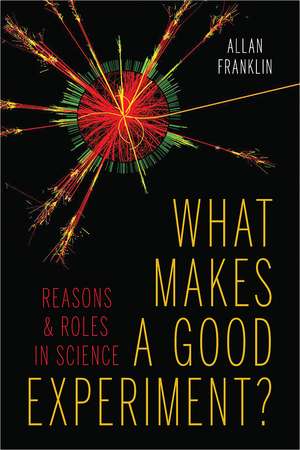
What Makes a Good Experiment?: Reasons and Roles in Science
Autor Allan Franklinen Limba Engleză Hardback – 3 mai 2016
Nivelul de studiu vizat pentru această lucrare este cel de doctorat și referință profesională în filozofia științei. În volumul What Makes a Good Experiment?, Allan Franklin sintetizează decenii de cercetare pentru a demonta mitul conform căruia singurul scop al experimentului este validarea sau infirmarea unei teorii. Remarcăm argumentul central al autorului: nu există un algoritm universal pentru evaluarea calității unui experiment, deoarece succesul acestuia poate fi de natură conceptuală, metodologică sau pur tehnică.
Ne-a atras atenția abordarea nuanțată a eșecului științific. Franklin susține că un experiment poate fi valoros chiar și atunci când produce rezultate eronate, cu condiția ca acesta să ofere temeiuri solide pentru credința în datele obținute la momentul respectiv. Structura cărții se bazează pe studii de caz detaliate din fizică și biologie, susținute de aproape o sută de ilustrații, oferind o perspectivă aplicată asupra modului în care experimentele pot articula teorii existente sau pot investiga domenii unde teoria încă lipsește.
Cititorii familiarizați cu The Uses of Experiment de David Gooding vor aprecia modul în care Franklin aprofundează mecanismele de justificare a rezultatelor, trecând dincolo de simpla descriere a practicii de laborator. Această lucrare reprezintă o continuare firească a temelor explorate în Selectivity and Discord și Shifting Standards, unde Allan Franklin a analizat riguros criteriile de selecție a datelor și rezolvarea rezultatelor discordante în fizica particulelor. Dacă în lucrările anterioare accentul cădea pe epistemologia dovezilor, volumul de față extinde cadrul de analiză către o ontologie a rolurilor experimentale în știința modernă.
Preț: 436.54 lei
Carte disponibilă
Livrare economică 05-19 noiembrie
Specificații
ISBN-10: 0822944413
Pagini: 384
Ilustrații: 97 b&w illustrations
Dimensiuni: 152 x 229 x 33 mm
Greutate: 0.74 kg
Ediția:1
Editura: University of Pittsburgh Press
Colecția University of Pittsburgh Press
V-ar putea interesa
-
 Physical Theory: Method and InterpretationLawrence Sklar-31%Preț: 594.56 lei862.79 lei
 -
 -11%Preț: 362.53 lei407.34 lei
 -
 -15%Preț: 338.33 lei399.73 lei
 -
 -28%Preț: 518.47 lei719.17 lei
 -
 The Theoretical Practices of Physics: Philosophical EssaysR. I. G. Hughes-13%Preț: 303.26 lei347.22 lei
 -
 -21%Preț: 66.37 lei83.83 lei
 -
 Persistence and SpacetimeYuri Balashov-13%Preț: 301.82 lei346.46 lei
 -
 Geometric PossibilityGordon Belot-13%Preț: 298.50 lei342.89 lei
 -
 Interpreting Quantum TheoriesLaura Ruetsche-11%Preț: 354.01 lei399.05 lei
 -
 How Big is Big and How Small is Small: The Sizes of Everything and WhyTimothy Paul Smith-11%Preț: 353.40 lei398.00 lei
 -
 Scientists as Prophets: A Rhetorical GenealogyLynda Walsh-11%Preț: 374.49 lei422.77 lei
 -
 Systematicity: The Nature of SciencePaul Hoyningen-Huene-31%Preț: 694.28 lei1001.48 lei
 -
 -35%Preț: 564.63 lei863.80 lei
 -
 Experiment, Right or WrongAllan FranklinPreț: 337.13 lei
 -
 The Neglect of ExperimentAllan Franklin-11%Preț: 449.38 lei504.93 lei
 -
 The Philosophy of PhysicsDean RicklesPreț: 232.40 lei
 -
 Are There Really Neutrinos?: An Evidential HistoryAllan Franklin-60%Preț: 166.59 lei419.44 lei
 -
 Preț: 434.03 lei
 -
 The Philosophy Of Scientific ExperimentationHans RadderPreț: 425.94 lei
 -
 Preț: 385.36 lei
 -
 No Easy Answers: Science and the Pursuit of KnowledgeAllan FranklinPreț: 387.43 lei
 -
 Science Transformed?: Debating Claims of an Epochal BreakAlfred NordmannPreț: 388.81 lei
 -
 The Physics of TheismJeffrey KoperskiPreț: 261.06 lei
 -
 The Rise and Fall of the Fifth ForceAllan FranklinPreț: 406.90 lei
De ce să citești această carte
Această carte se adresează cercetătorilor, istoricilor și filozofilor științei care doresc să înțeleagă complexitatea practicii experimentale dincolo de manualele standard. Cititorul câștigă o perspectivă critică asupra modului în care se construiește autoritatea științifică, învățând să evalueze un experiment nu doar prin prisma rezultatului final, ci prin rigoarea procesului și impactul său pedagogic sau metodologic asupra disciplinei.
Despre autor
Allan Franklin este profesor emerit în cadrul Departamentului de Fizică al Universității din Colorado. Este recunoscut la nivel internațional ca unul dintre cei mai importanți istorici și filozofi ai experimentului științific. Opera sa vastă, care include titluri precum No Easy Answers și Selectivity and Discord, se concentrează pe analiza epistemologică a dovezilor experimentale. Prin pregătirea sa de fizician, Franklin aduce o rigoare tehnică rară în studiile umaniste, fiind capabil să disece experimente complexe din istoria fizicii moderne pentru a extrage concluzii filozofice fundamentale despre natura cunoașterii umane.
Descriere scurtă
Recenzii
—Metascience
—Philosophy of Science
—Choice
—Kent Staley, Saint Louis University
—Slobodan Perovic, University of Belgrade