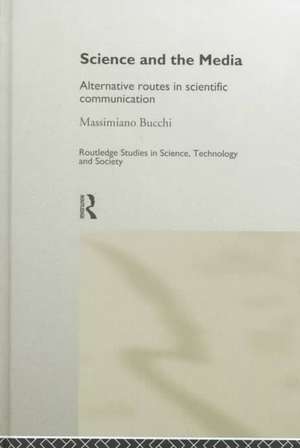
Science and the Media: Alternative Routes to Scientific Communications: Routledge Studies in Science, Technology and Society
Autor Massimiano Bucchien Limba Engleză Hardback – 6 aug 1998
| Toate formatele și edițiile | Preț | Express |
|---|---|---|
| Paperback (1) | 387.57 lei 6-8 săpt. | |
| Taylor & Francis – 21 mar 2014 | 387.57 lei 6-8 săpt. | |
| Hardback (1) | 1197.48 lei 6-8 săpt. | |
| Taylor & Francis – 6 aug 1998 | 1197.48 lei 6-8 săpt. |
Din seria Routledge Studies in Science, Technology and Society
-
 Preț: 452.67 lei
 -
 Preț: 418.16 lei
 -
 Preț: 290.75 lei
 - 15%
 Preț: 450.29 lei
 -
 Preț: 396.46 lei
 -
 Preț: 368.59 lei
 - 18%
 Preț: 1197.62 lei
 - 20%
 Preț: 409.17 lei
 - 18%
 Preț: 1194.62 lei
 - 15%
 Preț: 436.64 lei
 - 5%
 Preț: 350.89 lei
 - 18%
 Preț: 1196.88 lei
 -
 Preț: 363.41 lei
 - 15%
 Preț: 441.36 lei
 -
 Preț: 409.58 lei
 -
 Preț: 445.62 lei
 - 18%
 Preț: 1197.62 lei
 - 20%
 Preț: 1119.57 lei
 - 15%
 Preț: 437.27 lei
 -
 Preț: 453.93 lei
 - 18%
 Preț: 1195.34 lei
 -
 Preț: 387.57 lei
 -
 Preț: 236.21 lei
 - 18%
 Preț: 1197.62 lei
 - 18%
 Preț: 1196.88 lei
 -
 Preț: 234.90 lei
 -
 Preț: 420.40 lei
 - 15%
 Preț: 445.10 lei
 -
 Preț: 407.71 lei
 -
 Preț: 431.49 lei
 - 18%
 Preț: 1069.56 lei
 - 18%
 Preț: 1199.16 lei
 - 18%
 Preț: 1060.76 lei
 - 18%
 Preț: 728.28 lei
Preț: 1197.48 lei
Preț vechi: 1460.34 lei
-18%
Puncte Express: 1796
Preț estimativ în valută:
211.70€ • 246.30$ • 184.15£
211.70€ • 246.30$ • 184.15£
Carte tipărită la comandă
Livrare economică 17 aprilie-01 mai
Specificații
ISBN-13: 9780415189521
ISBN-10: 0415189527
Pagini: 208
Dimensiuni: 156 x 234 x 18 mm
Greutate: 0.47 kg
Ediția:1Adnotată
Editura: Taylor & Francis
Colecția Routledge
Seria Routledge Studies in Science, Technology and Society
Locul publicării:Oxford, United Kingdom
ISBN-10: 0415189527
Pagini: 208
Dimensiuni: 156 x 234 x 18 mm
Greutate: 0.47 kg
Ediția:1Adnotată
Editura: Taylor & Francis
Colecția Routledge
Seria Routledge Studies in Science, Technology and Society
Locul publicării:Oxford, United Kingdom
V-ar putea interesa
-
 The Varieties of Scientific ExperienceCarl SaganPreț: 131.44 lei
 -
 Studies in the Philosophy of the Scottish EnlightenmentM. A. Stewart-15%Preț: 365.16 lei427.09 lei
 -
 The Scenes of Inquiry: On the Reality of Questions in the SciencesNicholas Jardine-24%Preț: 386.07 lei509.71 lei
 -
 Philosophy of Science TodayPeter Clark-15%Preț: 264.54 lei312.79 lei
 -
 Preț: 54.43 lei
 -
 Billions & BillionsCarl SaganPreț: 103.70 lei
 -
 Preț: 403.71 lei
 -
 Understanding Philosophy of ScienceJames LadymanPreț: 345.41 lei
 -
 Inference to the Best ExplanationPeter LiptonPreț: 352.43 lei
 -
 Preț: 207.16 lei
 -
 Science In Society: An Introduction to Social Studies of ScienceMassimiano BucchiPreț: 397.19 lei
 -
 Science and PoetryMary MidgleyPreț: 190.28 lei
 -
 Science, Order and CreativityDavid BohmPreț: 152.17 lei
 -
 Philosophy of Science: A Contemporary IntroductionAlex RosenbergPreț: 450.25 lei
 -
 Problems of Empiricism: Volume 2: Philosophical PapersPaul K. FeyerabendPreț: 238.48 lei
 -
 Realism, Rationalism and Scientific Method: Volume 1: Philosophical PapersPaul K. FeyerabendPreț: 205.86 lei
 -
 Science and Ultimate RealityJohn. D. Barrow-9%Preț: 717.20 lei788.13 lei
Public țintă
PostgraduateCuprins
1. Introduction 1.1 The canonical account 1.2 The social representation of scientific theories 1.3 A communication continuum 1.4 Cognitive trajectories and their obstacles 1.5 The popular stage and its implications 2. When Scientists turn to the public 2.1 When scientists turn to the public 2.2 Metaphors, paradoxes and boundary objects in public communication of science 2.3 Metaphors in science 2.4 Constitutive and popular metaphors 2.5 Metaphors and paradoxes 2.6 Paradox in science 2.7 Boundary objects 3. Case studies 3.0 Preliminary remarks 3.1 Making and unmaking science in public: The Cold Fusion case 3.1.1 Not just 'hyped' science 3.1.2 Signs of (con) fusion 3.1.3 Cold fusion and public communication 3.1.4 Cold fusion and the Italian daily press 3.1.5 In and out of the public level 3.1.6 The ways of deconstruction Appendix A Appendix B Illustrations 3.2 A public explosion: Big Bang Theory in the UK daily press 3.2.1 A public explosion 3.2.2 A brief history of the universe 3.2.3 COBE takes off 3.2.4 More than a Big Bang 3.2.5 Big Bang and the public 3.2.6 Crisis, what crisis? 3.2.7 Big Bang as a boundary object 3.3 The public science of Louis Pasteur: The public experiment on anthrax in the popular press of the time 3.3.1 Prologue: A short story of the Pouilly-le-Fort trial 3.3.2 A celebrated experiment 3.3.3 The law of similars 3.3.4 On animals, for animals 3.3.5 The medical congress 3.3.6 Homeopathy and vivesection 3.3.7 The vaccination debate 3.3.8 The uses of a public experiment 4. Lines and tensions 4.1 Deviation as an exposure of the backstage 4.2 Public communication and boundary configurations 4.3 Mapping deviation 4.4 The second axis References
Recenzii
'...an interesting contribution to the continuing attempts to offer a model of science-media relations...' - Public Understanding of Science
Descriere
This book provides a theoretical framework which allows us to understand why and how scientists address the general public. Bucchi's theories on scientific communication in the media make a valuable contribution to the current debate.