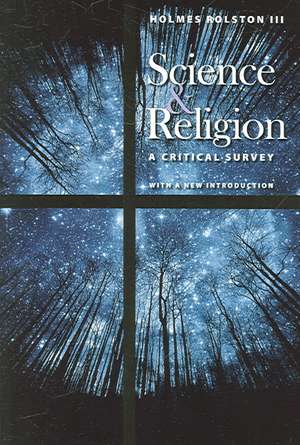
Science and Religion: A Critical Survey
Autor Holmes Rolston, IIIen Limba Engleză Paperback – aug 2006
Recomandăm această ediție a lucrării Science and Religion ca pe un reper metodologic esențial, readus în circuitul academic cu o introducere semnată de Holmes Rolston, III care actualizează dezbaterea pentru noul mileniu. Lucrarea se distinge prin rigoarea cu care aplică metodele de investigație științifică pentru a distila întrebări fundamentale pe care știința singură nu le poate epuiza, integrând viziunile despre lume ale disciplinelor empirice cu cele religioase.
Considerăm că structura volumului este una dintre cele mai coerente din literatura de specialitate. Autorul pornește de la fundamentul fizic al universului — explorând mecanica cuantică și relativitatea — și urcă treptat spre complexitatea biologică, psihologică și, în final, spre istoria spiritului. Această progresie logică permite cititorului să înțeleagă cum conceptele de „materie”, „energie” și „informație” se transformă atunci când sunt privite prin prisma unicității umane și a conștiinței. Remarcăm faptul că Holmes Rolston, III păstrează echilibrul între obiectivitate și implicare, analizând critic modelele și paradigmele ambelor domenii.
Comparabil cu Religion and Science de Philip Clayton în ceea ce privește claritatea expunerii conflictelor clasice, volumul de față se diferențiază prin profunzimea analizei asupra naturii „cruciforme” și a modului în care viața persistă în procesul de perisabilitate. În contextul operei sale, această carte pune bazele teoretice pentru argumentele dezvoltate ulterior în Genes, Genesis, and God, unde autorul contestă ortodoxia sociobiologică, susținând că natura nu este lipsită de valori, ci este purtătoarea unui sens care transcende procesele genetice oarbe.
Preț: 204.63 lei
Carte disponibilă
Livrare economică 18 mai-01 iunie
Specificații
ISBN-10: 1599470993
Pagini: 408
Dimensiuni: 152 x 229 x 30 mm
Greutate: 0.63 kg
Ediția:1
Editura: Templeton Press
Colecția Templeton Press
V-ar putea interesa
-
 The Infinite BookJohn D. Barrow-20%Preț: 71.01 lei89.17 lei
 -
 Studies in the Philosophy of the Scottish EnlightenmentM. A. Stewart-15%Preț: 365.16 lei427.09 lei
 -
 The Scenes of Inquiry: On the Reality of Questions in the SciencesNicholas Jardine-24%Preț: 386.07 lei509.71 lei
 -
 -17%Preț: 119.33 lei143.47 lei
 -
 Visual Cultures in Science and Technology: A Comparative HistoryKlaus Hentschel-33%Preț: 753.18 lei1121.41 lei
 -
 Philosophy of Science TodayPeter Clark-15%Preț: 264.54 lei312.79 lei
 -
 Billions & BillionsCarl SaganPreț: 104.35 lei
 -
 Does Santa Exist?Eric Kaplan-28%Preț: 63.37 lei88.37 lei
 -
 Understanding Philosophy of ScienceJames LadymanPreț: 345.61 lei
 -
 Problems of Empiricism: Volume 2: Philosophical PapersPaul K. FeyerabendPreț: 238.48 lei
 -
 Realism, Rationalism and Scientific Method: Volume 1: Philosophical PapersPaul K. FeyerabendPreț: 205.86 lei
 -
 Kant: Metaphysical Foundations of Natural ScienceImmanuel KantPreț: 319.68 lei
 -
 Rationality and ScienceTriggPreț: 383.79 lei
 -
 Re-Thinking ScienceHelga NowotnyPreț: 249.24 lei
 -
 Science in a Free SocietyPaul FeyerabendPreț: 108.18 lei
 -
 -17%Preț: 186.55 lei225.85 lei
 -
 Philosophical Chemistry: Genealogy of a Scientific FieldProfessor Manuel DeLanda-27%Preț: 356.41 lei491.46 lei
 -
 A Realist Theory of ScienceRoy BhaskarPreț: 166.81 lei
 -
 World of Our GrandchildrenBert Koene-12%Preț: 121.46 lei138.34 lei
De ce să citești această carte
Această lucrare este indispensabilă pentru cercetătorii și studenții care caută o bază metodologică solidă în dialogul dintre știință și religie. Cititorul câștigă o perspectivă interdisciplinară rară, învățând să navigheze între rigoarea fizicii sau biologiei și profunzimea întrebărilor existențiale. Este o resursă atemporală care demonstrează că interacțiunea dintre aceste două domenii poate fi fertilă și reciproc avantajoasă, oferind un cadru critic pentru înțelegerea locului omului în univers.
Despre autor
Holmes Rolston, III este un filosof american de renume, adesea considerat „tatăl eticii mediului”. Profesor de filosofie la Colorado State University, el a fost distins cu Premiul Templeton pentru progres în cercetarea realităților spirituale. Opera sa este marcată de o încercare constantă de a reconcilia biologia evoluționistă cu teologia, susținând ideea unei naturi intrinsec valoroase. Prin lucrări precum Genes, Genesis, and God, Rolston a influențat decisiv modul în care mediul academic raportează etica și religia la descoperirile științifice contemporane.
Descriere scurtă
Notă biografică
Cuprins
Introduction to the 2006 Edition. Human Uniqueness and Human Responsibility: Science and Religion in a New Millennium / xi
An Open Future / xii
Matter, Energy, Information / xiv
Genetics: Past, Present, and Future / xviii
Human Uniqueness: Brain, Mind, Culture / xxiv
Mind Knowing Nature: Realism and Social Construction / xxxi
Science and Conscience / xxxv
Historical and Cruciform Nature: Life Persisting in Perishing / xxxix
Chapter 1. Methods in Scientific and Religious Inquiry / 1
Theories, Creeds, and Experience / 1
Models, Patterns, Paradigms / 8
Objectivity and Involvement / 16
Scientific and Religious Logic / 22
Chapter 2. Matter: Religion and the Physical Sciences / 33
Newtonian Mechanism / 34
Quantum Mechanics and Indeterminacy / 41
Relativity and Matter-Energy / 54
Microphysical and Astrophysical Nature / 65
Chapter 3. Life: Religion and the Biological Sciences / 81
Biochemistry and the Secret of Life / 82
Evolution and the Secret of Life / 90
The Cybernetics of Life / 124
The Life Struggle / 133
Chapter 4. Mind: Religion and the Psychological Sciences / 151
The Possibility of a Human Science / 151
Religion and Freudian Psychoanalysis / 159
Religion and Behavioral Science 170
Religion and Humanistic Psychologies / 183
Chapter 5. Culture: Religion and the Social Sciences / 198
Society and the Individual: Models, Laws, Causes / 200
Interpretive Social Science / 210
Religion as a Social Projection / 219
Values in Social Science / 226
Chapter 6. Nature and History / 238
Nature after Science / 238
Hard Naturalism / 247
Soft Naturalism / 253
Eastern Perspectives / 258
The Dimension of History / 269
Suffering / 286
Chapter 7. Nature, History, and God / 297
Nature and Supernature / 298
Scientific-Existentialist Theism / 306
Process Theism / 315
Transscientific Theism / 322
Insight in Science and Religion: Doing the Truth / 335
Index / 349