
Rule-Based Evolutionary Online Learning Systems: Studies in Fuzziness and Soft Computing, cartea 191
Autor Martin V. Butzen Limba Engleză Hardback – 24 noi 2005
Din seria Studies in Fuzziness and Soft Computing
- 20%
 Preț: 1039.08 lei
 - 20%
 Preț: 674.21 lei
 - 20%
 Preț: 672.50 lei
 - 20%
 Preț: 1023.23 lei
 - 20%
 Preț: 1089.22 lei
 - 20%
 Preț: 1086.50 lei
 - 20%
 Preț: 1201.20 lei
 - 18%
 Preț: 1040.70 lei
 - 18%
 Preț: 1042.58 lei
 - 20%
 Preț: 1038.66 lei
 - 20%
 Preț: 1033.79 lei
 - 18%
 Preț: 983.83 lei
 - 20%
 Preț: 319.49 lei
 - 20%
 Preț: 335.46 lei
 - 18%
 Preț: 984.26 lei
 -
 Preț: 402.25 lei
 - 20%
 Preț: 666.88 lei
 - 20%
 Preț: 1017.95 lei
 - 18%
 Preț: 988.46 lei
 - 20%
 Preț: 1028.07 lei
 - 20%
 Preț: 1031.83 lei
 - 15%
 Preț: 665.77 lei
 - 20%
 Preț: 671.27 lei
 - 20%
 Preț: 959.13 lei
 - 15%
 Preț: 659.90 lei
 - 20%
 Preț: 1039.78 lei
 - 20%
 Preț: 1024.11 lei
 -
 Preț: 401.51 lei
 - 18%
 Preț: 1261.42 lei
 - 20%
 Preț: 674.29 lei
Preț: 671.93 lei
Preț vechi: 839.90 lei
-20%
Puncte Express: 1008
Carte tipărită la comandă
Livrare economică 03-17 decembrie
Livrare prin curier în România Termenul estimat este afișat lângă disponibilitate.
Transport gratuit pentru acest produs Plată online sau ramburs, în funcție de opțiunile comenzii.
Retur gratuit în 14 zile Comandă securizată și suport în română.
Specificații
ISBN-13: 9783540253792
ISBN-10: 3540253793
Pagini: 292
Ilustrații: XXI, 259 p.
Dimensiuni: 160 x 241 x 21 mm
Greutate: 0.59 kg
Ediția:2006
Editura: Springer
Colecția Studies in Fuzziness and Soft Computing
Seria Studies in Fuzziness and Soft Computing
Locul publicării:Berlin, Heidelberg, Germany
ISBN-10: 3540253793
Pagini: 292
Ilustrații: XXI, 259 p.
Dimensiuni: 160 x 241 x 21 mm
Greutate: 0.59 kg
Ediția:2006
Editura: Springer
Colecția Studies in Fuzziness and Soft Computing
Seria Studies in Fuzziness and Soft Computing
Locul publicării:Berlin, Heidelberg, Germany
V-ar putea interesa
-
 -27%Preț: 409.93 lei563.24 lei
 -
 Anticipatory Learning Classifier SystemsMartin V. Butz-20%Preț: 666.42 lei833.03 lei
 -
 Computer VisionSimon J. D. Prince-20%Preț: 582.72 lei728.39 lei
 -
 Enterprise Content and Search Management for Building Digital PlatformsShailesh Kumar Shivakumar-20%Preț: 528.34 lei660.43 lei
 -
 Spock: Up and RunningRob Fletcher-20%Preț: 351.55 lei439.44 lei
 -
 Tragic DesignJonathan Shariat-20%Preț: 192.19 lei240.24 lei
 -
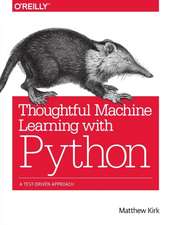 Thoughtful Machine Learning with PythonMatthew Kirk-20%Preț: 258.34 lei322.92 lei
 -
 This is Service Design DoingMarc Stickdorn-20%Preț: 264.28 lei330.35 lei
 -
 Karau, H: High Performance SparkHolden Karau-20%Preț: 242.50 lei303.13 lei
 -
 Practical TableauRyan Sleeper-20%Preț: 319.04 lei398.80 lei
 -
 Course in Mathematical CryptographyGilbert Baumslag-20%Preț: 343.49 lei429.36 lei
 -
 -20%Preț: 622.31 lei777.89 lei
 -
 -20%Preț: 402.90 lei503.62 lei
 -
 GI — 7. Jahrestagung: Nürnberg, 26.– 28. September 1977H. J. Schneider-20%Preț: 618.78 lei773.47 lei
 -
 The Challenge of AnticipationGiovanni Pezzulo-20%Preț: 335.46 lei419.34 lei
 -
 Learning Classifier SystemsJaume Bacardit-20%Preț: 336.09 lei420.10 lei
 -
 -15%Preț: 619.29 lei728.58 lei
 -
 -20%Preț: 316.28 lei395.35 lei
 -
 Quantum InteractionJerome R. Busemeyer-20%Preț: 303.93 lei379.91 lei
 -
 Relational Database Systems: Analysis and ComparisonJoachim W. Schmidt-20%Preț: 640.96 lei801.20 lei
 -
 -20%Preț: 272.03 lei340.04 lei
 -
 Funktionstrennung in ERP-Systemen: Konzepte, Methoden und FallstudienPetra Maria Asprion-34%Preț: 376.50 lei569.82 lei
 -
 ISSE 2012 Securing Electronic Business ProcessesHelmut Reimer-20%Preț: 339.66 lei424.58 lei
Public țintă
ResearchCuprins
Prerequisites.- Simple Learning Classifier Systems.- The XCS Classifier System.- How XCS Works: Ensuring Effective Evolutionary Pressures.- When XCS Works: Towards Computational Complexity.- Effective XCS Search: Building Block Processing.- XCS in Binary Classification Problems.- XCS in Multi-Valued Problems.- XCS in Reinforcement Learning Problems.- Facetwise LCS Design.- Towards Cognitive Learning Classifier Systems.- Summary and Conclusions.
Textul de pe ultima copertă
This book offers a comprehensive introduction to learning classifier systems (LCS) – or more generally, rule-based evolutionary online learning systems. LCSs learn interactively – much like a neural network – but with an increased adaptivity and flexibility. This book provides the necessary background knowledge on problem types, genetic algorithms, and reinforcement learning as well as a principled, modular analysis approach to understand, analyze, and design LCSs. The analysis is exemplarily carried through on the XCS classifier system – the currently most prominent system in LCS research. Several enhancements are introduced to XCS and evaluated. An application suite is provided including classification, reinforcement learning and data-mining problems. Reconsidering John Holland’s original vision, the book finally discusses the current potentials of LCSs for successful applications in cognitive science and related areas.
Caracteristici
Provides a comprehensive introduction to Learning Classifiers Systems Principle approach to understand, analyze, and design Learning Classifier Systems Includes supplementary material: sn.pub/extras