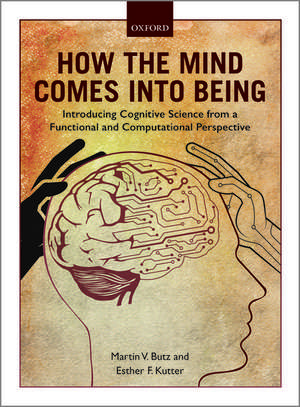
How the Mind Comes into Being: Introducing Cognitive Science from a Functional and Computational Perspective
Autor Martin V. Butz, Esther F. Kutteren Limba Engleză Paperback – 12 ian 2017
Preț: 409.93 lei
Preț vechi: 563.24 lei
-27%
Puncte Express: 615
Carte tipărită la comandă
Livrare economică 10-15 decembrie
Livrare prin curier în România Termenul estimat este afișat lângă disponibilitate.
Transport gratuit pentru acest produs Plată online sau ramburs, în funcție de opțiunile comenzii.
Retur gratuit în 14 zile Comandă securizată și suport în română.
Specificații
ISBN-13: 9780198739692
ISBN-10: 0198739699
Pagini: 416
Dimensiuni: 201 x 267 x 20 mm
Greutate: 0.97 kg
Editura: OUP OXFORD
Colecția OUP Oxford
Locul publicării:Oxford, United Kingdom
ISBN-10: 0198739699
Pagini: 416
Dimensiuni: 201 x 267 x 20 mm
Greutate: 0.97 kg
Editura: OUP OXFORD
Colecția OUP Oxford
Locul publicării:Oxford, United Kingdom
V-ar putea interesa
-
 Orienting of AttentionRichard D. Wright-27%Preț: 387.89 lei530.42 lei
 -
 -31%Preț: 706.17 lei1027.05 lei
 -
 -33%Preț: 663.61 lei983.32 lei
 -
 Symbols and Embodiment: Debates on meaning and cognitionManuel de Vega-28%Preț: 497.66 lei691.62 lei
 -
 The Cognitive Neuroscience of Memory: An IntroductionHoward Eichenbaum-32%Preț: 611.73 lei900.74 lei
 -
 Preț: 129.53 lei
 -
 -15%Preț: 463.38 lei545.15 lei
 -
 -15%Preț: 457.72 lei538.49 lei
 -
 -15%Preț: 452.58 lei532.44 lei
 -
 Anomalistic Psychology: Exploring Paranormal Belief and ExperienceChristopher C. French-24%Preț: 281.62 lei372.84 lei
 -
 Preț: 467.01 lei
 -
 Advances in Cognitive & Behavioral SciencesMiao-Kun Sun Ph.D.-27%Preț: 1220.07 lei1661.21 lei
 -
 Preț: 82.71 lei
 -
 Rule-Based Evolutionary Online Learning SystemsMartin V. Butz-20%Preț: 671.93 lei839.90 lei
 -
 Anticipatory Behavior in Adaptive Learning SystemsMartin V. Butz-20%Preț: 335.91 lei419.88 lei
 -
 The Challenge of AnticipationGiovanni Pezzulo-20%Preț: 335.46 lei419.34 lei
 -
 Learning Classifier SystemsJaume Bacardit-20%Preț: 336.09 lei420.10 lei
 -
 -15%Preț: 619.29 lei728.58 lei
Recenzii
`This is a very timely book. It rises to the challenge of providing a basic introduction to cognitive neuroscience, while being true to the fact that the brain is embodied. This book beautifully articulates intriguing puzzles about how our mind controls the body and how our body shapes the mind. In short, this book is a brilliant and accessible synthesis' Professor Karl J. Friston FMedSci, FRBS, FRS Wellcome Principal Fellow and Honorary Consultant in Neuropsychiatry Scientific Director: Wellcome Trust Centre for Neuroimaging Institute of Neurology, UCL
`The last three decades have seen advancements in the core issues of cognitive science. In 1991, in a talk given at CMU, Allen Newell posed the question, “how can the human mind occur in the physical universe?” This question was taken up by John Anderson as the title of his 2007 book which provided Anderson's answer to Newell's question. Science marches on and now Butz and Kutter provide the novice cognitive scientist an introduction to this set of deep and complex questions in the form of their very accessible and well-organized introductory textbook: How the Mind Comes Into Being. 'Professor Wayne Gray, Departments of Cognitive Science and Computer Science, Rensselaer Polytechnic Institute, USA
`This book is a true adventure for anyone interested in the relation between cognition and human behavior. The key assumption, that cognition can only be understood in relation to real-world experiences, is so convincingly expressed over the different chapters, that even if you want to resist this assumption, you will be thrilled by all the innovative insights about cognition ranging from Evolution, Development, Language to the hard question of Consciousness. A must-read for all students and scholars in the field of cognitive science and related disciplines to advance insights about Cognitive Science at the Brain, Cognitive, Computational, and Behavioral level. 'Prof. Dr. Harold Bekkering, Donders Institute for Brain, Cognition and Behaviour
`The last three decades have seen advancements in the core issues of cognitive science. In 1991, in a talk given at CMU, Allen Newell posed the question, “how can the human mind occur in the physical universe?” This question was taken up by John Anderson as the title of his 2007 book which provided Anderson's answer to Newell's question. Science marches on and now Butz and Kutter provide the novice cognitive scientist an introduction to this set of deep and complex questions in the form of their very accessible and well-organized introductory textbook: How the Mind Comes Into Being. 'Professor Wayne Gray, Departments of Cognitive Science and Computer Science, Rensselaer Polytechnic Institute, USA
`This book is a true adventure for anyone interested in the relation between cognition and human behavior. The key assumption, that cognition can only be understood in relation to real-world experiences, is so convincingly expressed over the different chapters, that even if you want to resist this assumption, you will be thrilled by all the innovative insights about cognition ranging from Evolution, Development, Language to the hard question of Consciousness. A must-read for all students and scholars in the field of cognitive science and related disciplines to advance insights about Cognitive Science at the Brain, Cognitive, Computational, and Behavioral level. 'Prof. Dr. Harold Bekkering, Donders Institute for Brain, Cognition and Behaviour
Notă biografică
With a Diplom with honors in computer science with a minor in psychology (University of Würzburg, Germany, 08/2001) and a PhD in computer science (University of Illinois at Urbana-Champaign, IL, USA, 10/2004), Dr. Butz has been pursuing interdisciplinary, collaborative research in cognitive science for more than fifteen years. He has published more than fifty journal articles in various disciplinary and interdisciplinary journals including, for example, Neural Networks, Evolutionary Computation, Biological Cybernetics, Journal of Vision, Experimental Brain Research, PLoS ONE, and Psychological Review. Since 09/2011 Dr. Butz has been working as a full professor in Cognitive Modeling at the University of Tübingen, Germany.Esther Kutter has graduated with honors with a Master of Science in cognitive science (University of Tübingen, Germany, 09/2015). Her primary research focus lies in understanding how the brain represents the own body and how abstract concepts and categories are established and encoded purposefully for enabling intelligent, goal-directed behavior. She is currently continuing her research as a PhD student in neuroscience at the department of Animal Research at the University of Tübingen.