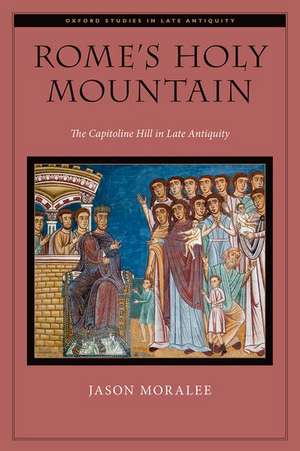
Rome's Holy Mountain: Oxford Studies in Late Antiquity
Autor Jason Moraleeen Limba Engleză Paperback – 20 ian 2021
Din seria Oxford Studies in Late Antiquity
- 33%
 Preț: 662.09 lei
 - 32%
 Preț: 544.93 lei
 - 32%
 Preț: 536.16 lei
 - 23%
 Preț: 764.08 lei
 - 31%
 Preț: 539.38 lei
 - 31%
 Preț: 757.50 lei
 - 28%
 Preț: 463.39 lei
 - 31%
 Preț: 726.02 lei
 - 31%
 Preț: 724.70 lei
 - 31%
 Preț: 661.29 lei
 - 34%
 Preț: 731.03 lei
 - 31%
 Preț: 920.48 lei
 - 31%
 Preț: 747.27 lei
 - 35%
 Preț: 541.32 lei
 - 31%
 Preț: 710.87 lei
 - 31%
 Preț: 716.19 lei
 - 34%
 Preț: 645.95 lei
 - 31%
 Preț: 711.64 lei
 - 12%
 Preț: 600.88 lei
 - 31%
 Preț: 531.40 lei
 - 31%
 Preț: 570.54 lei
 - 30%
 Preț: 526.43 lei
Preț: 267.19 lei
Puncte Express: 401
Carte disponibilă
Livrare economică 05-10 noiembrie
Livrare prin curier în România Termenul estimat este afișat lângă disponibilitate.
Transport gratuit de la 400.00 lei Plată online sau ramburs, în funcție de opțiunile comenzii.
Retur gratuit în 14 zile Comandă securizată și suport în română.
Specificații
ISBN-13: 9780197540718
ISBN-10: 0197540716
Pagini: 304
Ilustrații: 32 (b&w line art and halftones)
Dimensiuni: 236 x 157 x 18 mm
Greutate: 0.45 kg
Editura: Oxford University Press
Colecția OUP USA
Seria Oxford Studies in Late Antiquity
Locul publicării:New York, United States
ISBN-10: 0197540716
Pagini: 304
Ilustrații: 32 (b&w line art and halftones)
Dimensiuni: 236 x 157 x 18 mm
Greutate: 0.45 kg
Editura: Oxford University Press
Colecția OUP USA
Seria Oxford Studies in Late Antiquity
Locul publicării:New York, United States
Recenzii
A clever, tightly researched and well-written exploration of the holy heart of ancient Rome, the Capitoline Hill, but with specific focus on its transition, transformation and adapted tradition in Late Antiquity.
The combination of a wide chronological and narrow geographical focus allows its readers to see change on both the micro and the macro scale. Its methodological insistence that the literary memories of a place are as significant as its historical life is both important and welcome. And it serves to demonstrate how much important work is left to be done on those Christian authors - the apologists in particular - of whom unsophisticated readings abound.
This notable work tackles one of Rome's most symbolically charged places during a period that is usually overlooked. Its examination of the shifting valences of the symbolic significance of the Capitoline hill is an admirable contribution to scholarship.
[A] fine book... The historical and archaeological dimensions of this book seem sound to me but I am especially impressed by the author's reading of a wide array of both familiar and obscure texts. Before reading this book I simply had no idea that the Capitoline figured so prominently in the late antique and early medieval history of Rome and of Rome's place in the European imagination.
Moralee's book expertly and surprisingly charts the history of the hill through transformations of imperial ceremony, state religion, and strategies of social memory between the fourth and seventh centuries to show how the history of a place and the memories of its ancient functions carried forward into the early middle ages. This is an excellent, stimulating read about the history of ideas and how ideas attach to places... Moralee is to be congratulated on an exciting, insightful, and learned contribution to our understanding of how Rome's past gave rise to its future.
This is a highly stimulating book, offering fascinating new insights into the history of Rome from Antiquity to the Early Middle Ages. Moralee gives an innovative interdisciplinary account of the Capitoline Hill, fully exploring its richness as a cultural symbol."
This sophisticated and elegant study of the palimpsest that is the Capitoline Hill exploits a rich trove of archaeological, mythological, and historical sources to bring specific moments in its postclassical reception to life. Jason Moralee has succeeded in producing a work that is instructive, enduring in value, and a sheer delight to read."
Sweeping in its diachronic breadth but tightly focused on a particular locale, Moralee's study of the Capitoline hill offers illuminating historical insights on both the micro and the macro level. The narrative weaves together a delightfully varied array of evidence and agents, encompassing saints, sinners, rulers, travelers, artists, archaeologists, historians, and treasure-seekers, and exposing how each constructed his own Capitoline. A brilliant demonstration of the value of the 'lieu de mémoire' approach, tracing shifts in meaning and memory over time."
The combination of a wide chronological and narrow geographical focus allows its readers to see change on both the micro and the macro scale. Its methodological insistence that the literary memories of a place are as significant as its historical life is both important and welcome. And it serves to demonstrate how much important work is left to be done on those Christian authors - the apologists in particular - of whom unsophisticated readings abound.
This notable work tackles one of Rome's most symbolically charged places during a period that is usually overlooked. Its examination of the shifting valences of the symbolic significance of the Capitoline hill is an admirable contribution to scholarship.
[A] fine book... The historical and archaeological dimensions of this book seem sound to me but I am especially impressed by the author's reading of a wide array of both familiar and obscure texts. Before reading this book I simply had no idea that the Capitoline figured so prominently in the late antique and early medieval history of Rome and of Rome's place in the European imagination.
Moralee's book expertly and surprisingly charts the history of the hill through transformations of imperial ceremony, state religion, and strategies of social memory between the fourth and seventh centuries to show how the history of a place and the memories of its ancient functions carried forward into the early middle ages. This is an excellent, stimulating read about the history of ideas and how ideas attach to places... Moralee is to be congratulated on an exciting, insightful, and learned contribution to our understanding of how Rome's past gave rise to its future.
This is a highly stimulating book, offering fascinating new insights into the history of Rome from Antiquity to the Early Middle Ages. Moralee gives an innovative interdisciplinary account of the Capitoline Hill, fully exploring its richness as a cultural symbol."
This sophisticated and elegant study of the palimpsest that is the Capitoline Hill exploits a rich trove of archaeological, mythological, and historical sources to bring specific moments in its postclassical reception to life. Jason Moralee has succeeded in producing a work that is instructive, enduring in value, and a sheer delight to read."
Sweeping in its diachronic breadth but tightly focused on a particular locale, Moralee's study of the Capitoline hill offers illuminating historical insights on both the micro and the macro level. The narrative weaves together a delightfully varied array of evidence and agents, encompassing saints, sinners, rulers, travelers, artists, archaeologists, historians, and treasure-seekers, and exposing how each constructed his own Capitoline. A brilliant demonstration of the value of the 'lieu de mémoire' approach, tracing shifts in meaning and memory over time."
Notă biografică
Jason Moralee is Associate Professor of History at University of Massachusetts Amherst.
Cuprins
- List of Figures
- Abbreviations
- Acknowledgments
- A Note on Names
- Prologue
- Introduction
- Part I: Lived-In Realities
- Chapter 1: Climbing the Capitoline Hill
- Chapter 2: Living and Working on the Capitoline Hill
- Chapter 3: Christianity, the Capitoline Hill, and the End of Antiquity
- Part II: Dreamed-Of Realities
- Chapter 4: Experiencing and Remembering the Capitoline Hill
- Chapter 5: Learning From the Capitol's Deliverance
- Chapter 6: Learning from the Capitol's Destruction
- Chapter 7: The Capitol and the Legends of the Saints
- Epilogue: The Fall of the Ancient Capitol
- Bibliography
- Index