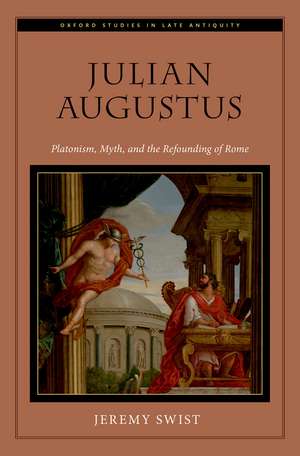
Julian Augustus: Platonism, Myth, and the Refounding of Rome: Oxford Studies in Late Antiquity
Autor Jeremy Swisten Limba Engleză Hardback – 20 oct 2025
Din seria Oxford Studies in Late Antiquity
- 32%
 Preț: 677.84 lei
 - 32%
 Preț: 544.93 lei
 - 32%
 Preț: 536.16 lei
 - 23%
 Preț: 764.30 lei
 - 31%
 Preț: 539.38 lei
 - 31%
 Preț: 757.50 lei
 - 28%
 Preț: 463.39 lei
 - 31%
 Preț: 726.02 lei
 - 31%
 Preț: 724.70 lei
 - 31%
 Preț: 661.29 lei
 - 34%
 Preț: 731.03 lei
 - 31%
 Preț: 920.48 lei
 - 31%
 Preț: 747.27 lei
 -
 Preț: 273.58 lei
 - 35%
 Preț: 541.32 lei
 - 31%
 Preț: 728.23 lei
 - 31%
 Preț: 716.19 lei
 - 34%
 Preț: 645.95 lei
 - 31%
 Preț: 711.64 lei
 - 12%
 Preț: 600.88 lei
 - 31%
 Preț: 531.40 lei
 - 29%
 Preț: 538.95 lei
Preț: 573.61 lei
Preț vechi: 823.73 lei
-30%
Puncte Express: 860
Carte tipărită la comandă
Livrare economică 27 noiembrie-08 decembrie
Livrare prin curier în România Termenul estimat este afișat lângă disponibilitate.
Transport gratuit pentru acest produs Plată online sau ramburs, în funcție de opțiunile comenzii.
Retur gratuit în 14 zile Comandă securizată și suport în română.
Specificații
ISBN-13: 9780197787519
ISBN-10: 0197787517
Pagini: 376
Dimensiuni: 165 x 238 x 34 mm
Greutate: 0.64 kg
Editura: Oxford University Press
Colecția OUP USA
Seria Oxford Studies in Late Antiquity
Locul publicării:New York, United States
ISBN-10: 0197787517
Pagini: 376
Dimensiuni: 165 x 238 x 34 mm
Greutate: 0.64 kg
Editura: Oxford University Press
Colecția OUP USA
Seria Oxford Studies in Late Antiquity
Locul publicării:New York, United States
Recenzii
Swist's monograph is a learned and, at times, strikingly stimulating study that will be of considerable value to scholars of late antique philosophy and imperial ideology. Its detailed engagement with Julian's Neoplatonic context, in particular, represents a significant advancement in our understanding of his theory and practice of leadership.
Swist's prose is clear and engaging and his argumentation is well grounded in the ancient evidence. This is an excellent book... Highly recommended.
Swist's prose is clear and engaging and his argumentation is well grounded in the ancient evidence. This is an excellent book... Highly recommended.
Notă biografică
Jeremy Swist is a native of Boston, Massachusetts. He earned his BA in History and Latin from the University of Maine, and MA and PhD. in Classics from the University of Iowa. He has taught Greek and Roman language and civilization at Miami University, Xavier University, and Brandeis University. He now resides in Grand Rapids, Michigan, working as a Visiting Assistant Professor of Classics at Grand Valley State University. He has published several articles and chapters on pagan prose literature under the later Roman Empire, as well as on the reception of ancient Greece, Rome, and Byzantium in heavy metal music. Jeremy Swist is Visiting Assistant Professor at Grand Valley State University. A native of Boston, Massachusetts, he earned his BA in History and Latin from the University of Maine, and MA and PhD. in Classics from the University of Iowa. He has taught Greek and Roman language and civilization at Miami University, Xavier University, and Brandeis University. He has published severalarticles and chapters on pagan prose literature under the later Roman Empire, as well as on the reception of ancient Greece, Rome, and Byzantium in heavy metal music.