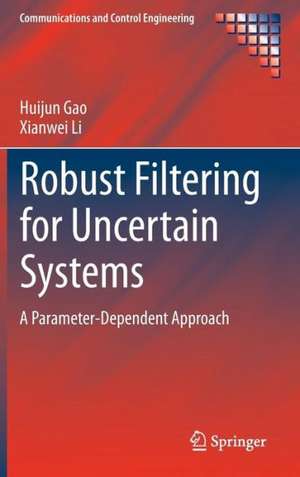
Robust Filtering for Uncertain Systems: Communications and Control Engineering
Autor Huijun Gao, Xianwei Lien Limba Engleză Hardback – 24 apr 2014
· design approaches to robust filters arranged according to varying complexity level and emphasizing robust filtering inthe parameter-dependent framework for the first time;
· guidance on the use of special realistic phenomena or factors to describe problems more accurately and to improve filtering performance;
· a unified linear matrix inequality formulation of design approaches for easy and effective filter design;
· demonstration of the techniques of matrix decoupling technique, the generalized Kalman‒Yakubovich‒Popov lemma, the free weighting matrix technique and the delay modelling approach, in robust filtering;
· numerous easy-to-follow simulation examples, graphical and tabular illustrations to help the reader understand the filter design approaches developed; and
· an account of emerging issues on robust filtering for research to inspire future investigation.
Robust Filtering for Uncertain Systems will be of interest to academic researchers specializing in linear, robust and optimal control and estimation and to practitioners working in tracking and network control or signal filtering, detection and estimation. Graduate students learning control and systems theory, signal processing or applied mathematics will also find the book to be a valuable resource.
Din seria Communications and Control Engineering
- 20%
 Preț: 912.34 lei
 - 18%
 Preț: 992.26 lei
 - 18%
 Preț: 1169.33 lei
 - 18%
 Preț: 1154.10 lei
 - 15%
 Preț: 680.73 lei
 - 18%
 Preț: 929.37 lei
 - 15%
 Preț: 667.91 lei
 - 18%
 Preț: 987.63 lei
 - 18%
 Preț: 1451.74 lei
 - 18%
 Preț: 952.84 lei
 - 18%
 Preț: 983.93 lei
 - 18%
 Preț: 916.16 lei
 - 23%
 Preț: 1004.58 lei
 - 18%
 Preț: 988.90 lei
 - 15%
 Preț: 675.30 lei
 - 18%
 Preț: 991.00 lei
 - 18%
 Preț: 1087.77 lei
 - 18%
 Preț: 925.04 lei
 - 18%
 Preț: 1144.83 lei
 - 18%
 Preț: 1193.65 lei
 - 24%
 Preț: 1061.48 lei
 - 18%
 Preț: 982.79 lei
 - 18%
 Preț: 981.00 lei
 - 18%
 Preț: 1119.01 lei
 - 18%
 Preț: 1431.25 lei
 - 18%
 Preț: 990.53 lei
 - 15%
 Preț: 668.95 lei
 - 18%
 Preț: 980.46 lei
 - 15%
 Preț: 598.26 lei
 - 15%
 Preț: 668.10 lei
 - 20%
 Preț: 1500.71 lei
 - 15%
 Preț: 666.14 lei
 - 18%
 Preț: 1279.56 lei
 - 15%
 Preț: 674.64 lei
 - 18%
 Preț: 821.53 lei
 - 18%
 Preț: 990.77 lei
 - 18%
 Preț: 1079.91 lei
 - 18%
 Preț: 988.26 lei
 - 18%
 Preț: 1270.25 lei
 - 15%
 Preț: 670.23 lei
Preț: 668.28 lei
Preț vechi: 786.20 lei
-15%
Puncte Express: 1002
Carte tipărită la comandă
Livrare economică 25 noiembrie-09 decembrie
Livrare prin curier în România Termenul estimat este afișat lângă disponibilitate.
Transport gratuit pentru acest produs Plată online sau ramburs, în funcție de opțiunile comenzii.
Retur gratuit în 14 zile Comandă securizată și suport în română.
Specificații
ISBN-13: 9783319059020
ISBN-10: 3319059025
Pagini: 272
Ilustrații: XVI, 253 p. 45 illus., 18 illus. in color.
Dimensiuni: 160 x 241 x 21 mm
Greutate: 0.52 kg
Ediția:2014
Editura: Springer
Colecția Communications and Control Engineering
Seria Communications and Control Engineering
Locul publicării:Cham, Switzerland
ISBN-10: 3319059025
Pagini: 272
Ilustrații: XVI, 253 p. 45 illus., 18 illus. in color.
Dimensiuni: 160 x 241 x 21 mm
Greutate: 0.52 kg
Ediția:2014
Editura: Springer
Colecția Communications and Control Engineering
Seria Communications and Control Engineering
Locul publicării:Cham, Switzerland
V-ar putea interesa
-
 CNC RoboticsGeoff WilliamsPreț: 285.65 lei
 -
 Multivariable Feedback ControlSigurd SkogestadPreț: 477.89 lei
 -
 Fanuc CNC Custom MacrosPeter Smid-19%Preț: 512.71 lei632.98 lei
 -
 Drones for DummiesMark LafayPreț: 158.96 lei
 -
 Geometric Methods and ApplicationsJean Gallier-15%Preț: 552.23 lei649.67 lei
 -
 Make: DronesDavid McgriffyPreț: 168.11 lei
 -
 New Autonomous SystemsAlain Cardon-9%Preț: 983.92 lei1081.23 lei
 -
 From Prognosis And Health Systems 1Gouriveau-9%Preț: 1008.09 lei1107.79 lei
 -
 Model Predictive ControlEduardo F. Camacho-15%Preț: 512.40 lei602.82 lei
 -
 Mechatronic SystemsRolf Isermann-15%Preț: 605.64 lei712.51 lei
 -
 Logistik-Wörterbuch. Dictionary of LogisticsVanessa Scott-Sabic-18%Preț: 838.28 lei1022.30 lei
 -
 Automotive Mechatronics: Operational and Practical IssuesB. T. Fijalkowski-18%Preț: 1194.66 lei1456.91 lei
Public țintă
ResearchCuprins
Introduction.- Part I Quadratic and Parameter-Dependent Filter Design.- Quadratic Robust Filter Design.- Parameter-Dependent Robust Filter Design.- Part II Robust Filtering for Time-Delay Systems and 2-D Systems.- Robust Filtering for Continuous-Time Time-Delay Systems.- Robust Filtering for Discrete-Time Time-Delay Systems.- Robust Filtering for Uncertain 2-D Systems.- Part III New Problems in Robust Filtering.- Robust Estimation with Limited Communication Capacity.- Finite-Frequency H-infinity Filtering for Time-Delay Systems.- Conclusion.
Recenzii
“In order to help the reader to get a better understanding of the presented material, in each section there are included numerous algorithms associated to the theorems and tables summarizing the properties which appear in illustrative examples … . references are given at the end of each chapter … . The book is very dense in its content. … The book aims to offer the research engineers and graduate students an excellent tool.” (Dumitru Stanomir, zbMATH 1335.93001, 2016)
Notă biografică
Huihui Pan received a Ph.D. in control science and engineering from the Harbin Institute of Technology, China, in 2017, and a Ph.D. in mechanical engineering from The Hong Kong Polytechnic University, Hong Kong, in 2018. Since December 2017, he has been with the Research Institute of Intelligent Control and Systems, Harbin Institute of Technology, China. His research interests include intelligent vehicles, vehicle dynamic control, and nonlinear control theories with industrial applications. He currently serves as Associate Editor of IEEE Transactions on Intelligent Vehicles, IEEE Transactions on Systems, Man, and Cybernetics: Systems, and Mechatronics.
Jue Wang received a B.S. degree in automation and a M.S. degree in pattern recognition and intelligent systems from Huaqiao University, Xiamen, China, in 2016 and 2019, respectively, and a Ph.D. degree from the Harbin Institute of Technology, Harbin, China, in 2023. Since September 2023, she has beenPostdoctoral Fellow with the University of Science and Technology of China, Hefei, China, and Ningbo Institute of Intelligent Equipment Technology Company Ltd., Ningbo, China. Her current research interests include intelligent vehicles, mechatronics, and adaptive control theories with industrial applications.Xinghu Yu received an M.M. in osteopathic medicine from Jinzhou Medical University, China, and a Ph.D. in control science and engineering from the Harbin Institute of Technology, in 2016 and 2020, respectively. He is currently Chief Executive Officer of the Ningbo Institute of Intelligent Equipment Technology Co., Ltd., China. He has authored over 80 technical papers for conference proceedings and refereed journals, including the IEEE Transactions journals, and has over 20 invention patents. His research interests include vehicle dynamic systems, intelligent control, and image processing.
Weichao Sun received a B.S. degree in automation from Central South University, Changsha, China, in 2007, and the M.S. and Ph.D. degrees in control science and engineering from the Harbin Institute of Technology, Harbin, China, in 2009 and 2013, respectively. He is currently a Professor with the Research Institute of Intelligent Control Systems, Harbin Institute of Technology, China. His research interests include autonomous vehicles, robotics, and high performance motion control. He currently serves as Associate Editor for IEEE Transactions on Systems, Man, and Cybernetics: Systems, Mechatronics, and Journal of Dynamic Systems, Measurement and Control.
Huijun Gao received a Ph.D. in control science and engineering from the Harbin Institute of Technology, China, in 2005. From 2005 to 2007, he was Postdoctoral Researcher with the Department of Electrical and Computer Engineering at the University of Alberta, Canada. Since 2004, he has been with the Harbin Institute of Technology, where he is currently Chair Professor and Director ofthe Research Institute of Intelligent Control and Systems. His research interests include intelligent and robust control, robotics, mechatronics, and their engineering applications. He is Vice President of the IEEE Industrial Electronics Society and a Council Member of IFAC. He currently serves and has held editorial positions with several respected international journals. He is Fellow of the IEEE and Distinguished Lecturer of the IEEE Systems, Man, and Cybernetics Society. He is Member of the Academia Europaea.
Textul de pe ultima copertă
This monograph provides the reader with a systematic treatment of robust filter design, a key issue in systems, control and signal processing, because of the fact that the inevitable presence of uncertainty in system and signal models often degrades the filtering performance and may even cause instability. The methods described are therefore not subject to the rigorous assumptions of traditional Kalman filtering. The monograph is concerned with robust filtering for various dynamical systems with parametric uncertainties, and focuses on parameter-dependent approaches to filter design. Classical filtering schemes, like H2 filtering and H¥ filtering, are addressed, and emerging issues such as robust filtering with constraints on communication channels and signal frequency characteristics are discussed. The text features:
· design approaches to robust filters arranged according to varying complexity level, and emphasizing robust filteringin the parameter-dependent framework for the first time;
· guidance on the use of special realistic phenomena or factors to describe problems more accurately and to improve filtering performance;
· a unified linear matrix inequality formulation of design approaches for easy and effective filter design;
· demonstration of the techniques of matrix decoupling technique, the generalized Kalman‒Yakubovich‒Popov lemma, the free weighting matrix technique, and the delay modelling approach, in robust filtering;
· numerous easy-to-follow simulation examples, graphical and tabular illustrations to help the reader understand the filter design approaches developed; and
· an account of emerging issues on robust filtering for research to inspire future investigation.
Robust Filtering for Uncertain Systems will be of interest to academic researchers specializing in linear, robust and optimal control and estimation and topractitioners working in tracking and network control or signal filtering, detection and estimation. Graduate students learning control and systems theory, signal processing or applied mathematics will also find the book to be a valuable resource.
The Communications and Control Engineering series reports major technological advances which have potential for great impact in the fields of communication and control. It reflects research in industrial and academic institutions around the world so that the readership can exploit new possibilities as they become available.
· design approaches to robust filters arranged according to varying complexity level, and emphasizing robust filteringin the parameter-dependent framework for the first time;
· guidance on the use of special realistic phenomena or factors to describe problems more accurately and to improve filtering performance;
· a unified linear matrix inequality formulation of design approaches for easy and effective filter design;
· demonstration of the techniques of matrix decoupling technique, the generalized Kalman‒Yakubovich‒Popov lemma, the free weighting matrix technique, and the delay modelling approach, in robust filtering;
· numerous easy-to-follow simulation examples, graphical and tabular illustrations to help the reader understand the filter design approaches developed; and
· an account of emerging issues on robust filtering for research to inspire future investigation.
Robust Filtering for Uncertain Systems will be of interest to academic researchers specializing in linear, robust and optimal control and estimation and topractitioners working in tracking and network control or signal filtering, detection and estimation. Graduate students learning control and systems theory, signal processing or applied mathematics will also find the book to be a valuable resource.
The Communications and Control Engineering series reports major technological advances which have potential for great impact in the fields of communication and control. It reflects research in industrial and academic institutions around the world so that the readership can exploit new possibilities as they become available.
Caracteristici
Couches all it’s control design approaches in terms of popular and easy-to-implement linear matrix inequality problems Filter designs presented in increasing complexity allow readers full flexibility in their choice of appropriate method Numerous simulation examples give readers clear and easy-to-follow demonstrations of the filter designs developed Makes problem specification more accurate and improves filter performance by enumerating and dealing with realistic causes of system uncertainty Includes supplementary material: sn.pub/extras