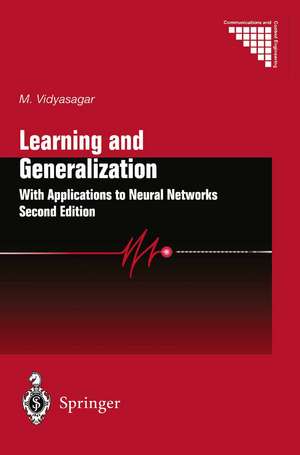
Learning and Generalisation: Communications and Control Engineering
Autor Mathukumalli Vidyasagaren Limba Engleză Paperback – 19 oct 2010
• How does a machine learn a concept on the basis of examples?
• How can a neural network, after training, correctly predict the outcome of a previously unseen input?
• How much training is required to achieve a given level of accuracy in the prediction?
• How can one identify the dynamical behaviour of a nonlinear control system by observing its input-output behaviour over a finite time?
The second edition covers new areas including:
• support vector machines;
• fat-shattering dimensions and applications to neural network learning;
• learning with dependent samples generated by a beta-mixing process;
• connections between system identification and learning theory;
• probabilistic solution of 'intractable problems' in robust control and matrix theory using randomized algorithms.
It also contains solutions to some of the open problems posed in the first edition, while adding new open problems.
Din seria Communications and Control Engineering
- 20%
 Preț: 912.34 lei
 - 18%
 Preț: 992.26 lei
 - 18%
 Preț: 1169.33 lei
 - 18%
 Preț: 1154.10 lei
 - 15%
 Preț: 680.73 lei
 - 18%
 Preț: 929.37 lei
 - 15%
 Preț: 667.91 lei
 - 18%
 Preț: 987.63 lei
 - 18%
 Preț: 1451.74 lei
 - 18%
 Preț: 952.84 lei
 - 18%
 Preț: 983.93 lei
 - 18%
 Preț: 916.16 lei
 - 23%
 Preț: 1004.58 lei
 - 18%
 Preț: 988.90 lei
 - 15%
 Preț: 675.30 lei
 - 18%
 Preț: 991.00 lei
 - 18%
 Preț: 925.04 lei
 - 18%
 Preț: 1144.83 lei
 - 18%
 Preț: 1193.65 lei
 - 24%
 Preț: 1061.48 lei
 - 18%
 Preț: 982.79 lei
 - 18%
 Preț: 981.00 lei
 - 18%
 Preț: 1119.01 lei
 - 18%
 Preț: 1431.25 lei
 - 18%
 Preț: 990.53 lei
 - 15%
 Preț: 668.95 lei
 - 18%
 Preț: 980.46 lei
 - 15%
 Preț: 598.26 lei
 - 15%
 Preț: 668.10 lei
 - 20%
 Preț: 1500.71 lei
 - 15%
 Preț: 666.14 lei
 - 18%
 Preț: 1279.56 lei
 - 15%
 Preț: 674.64 lei
 - 18%
 Preț: 821.53 lei
 - 18%
 Preț: 990.77 lei
 - 18%
 Preț: 1079.91 lei
 - 18%
 Preț: 988.26 lei
 - 18%
 Preț: 1270.25 lei
 - 15%
 Preț: 670.23 lei
Preț: 1087.77 lei
Preț vechi: 1326.54 lei
-18%
Puncte Express: 1632
Carte tipărită la comandă
Livrare economică 26 noiembrie-10 decembrie
Livrare prin curier în România Termenul estimat este afișat lângă disponibilitate.
Transport gratuit pentru acest produs Plată online sau ramburs, în funcție de opțiunile comenzii.
Retur gratuit în 14 zile Comandă securizată și suport în română.
Specificații
ISBN-13: 9781849968676
ISBN-10: 1849968675
Pagini: 516
Ilustrații: XXI, 488 p.
Dimensiuni: 155 x 235 x 28 mm
Greutate: 0.77 kg
Ediția:Second Edition 2003
Editura: Springer
Colecția Communications and Control Engineering
Seria Communications and Control Engineering
Locul publicării:London, United Kingdom
ISBN-10: 1849968675
Pagini: 516
Ilustrații: XXI, 488 p.
Dimensiuni: 155 x 235 x 28 mm
Greutate: 0.77 kg
Ediția:Second Edition 2003
Editura: Springer
Colecția Communications and Control Engineering
Seria Communications and Control Engineering
Locul publicării:London, United Kingdom
V-ar putea interesa
-
 Machine LearningKevin P. Murphy-20%Preț: 731.22 lei918.37 lei
 -
 Foundations of Machine Learning, second editionAfshin Rostamizadeh-26%Preț: 566.34 lei762.74 lei
 -
 Probabilistic Machine LearningKevin P. Murphy-21%Preț: 853.81 lei1080.33 lei
 -
 Understanding Deep LearningSimon J. D. Prince-21%Preț: 687.48 lei867.24 lei
 -
 Gaussian Processes for Machine LearningCarl Edward Rasmussen-26%Preț: 350.95 lei477.34 lei
 -
 -20%Preț: 655.10 lei818.88 lei
 -
 Pattern Recognition and Machine LearningChristopher M Bishop-20%Preț: 646.10 lei807.62 lei
 -
 The Elements of Statistical LearningTrevor Hastie-20%Preț: 546.54 lei683.17 lei
 -
 -39%Preț: 394.79 lei646.62 lei
 -
 -31%Preț: 607.05 lei885.58 lei
 -
 Pattern ClassificationRichard O Duda-23%Preț: 1040.07 lei1350.74 lei
 -
 The Importance of Being EducableLeslie ValiantPreț: 187.73 lei
 -
 Linear Algebra and Learning from DataGilbert Strang-8%Preț: 528.40 lei574.35 lei
 -
 Data-Driven Science and EngineeringSteven L. Brunton-23%Preț: 383.06 lei496.40 lei
 -
 Machine Learning: An Algorithmic Perspective, Second EditionStephen Marsland-20%Preț: 614.34 lei767.93 lei
 -
 -20%Preț: 249.08 lei311.36 lei
 -
 Practical Deep Learning, 2nd Edition: A Python-Based IntroductionRonald T. Kneusel-35%Preț: 333.73 lei515.68 lei
 -
 Deep Learning ArchitecturesOvidiu Calin-15%Preț: 498.66 lei586.66 lei
 -
 Materials Data ScienceStefan Sandfeld-15%Preț: 591.20 lei695.53 lei
 -
 Mathematical Introduction to Data ScienceSven A. Wegner-20%Preț: 526.06 lei657.58 lei
Public țintă
ResearchCuprins
1. Introduction.- 2. Preliminaries.- 3. Problem Formulations.- 4. Vapnik-Chervonenkis, Pseudo- and Fat-Shattering Dimensions.- 5. Uniform Convergence of Empirical Means.- 6. Learning Under a Fixed Probability Measure.- 7. Distribution-Free Learning.- 8. Learning Under an Intermediate Family of Probabilities.- 9. Alternate Models of Learning.- 10. Applications to Neural Networks..- 11. Applications to Control Systems.- 12. Some Open Problems.
Textul de pe ultima copertă
Learning and Generalization provides a formal mathematical theory for addressing intuitive questions such as:
• How does a machine learn a new concept on the basis of examples?
• How can a neural network, after sufficient training, correctly predict the outcome of a previously unseen input?
• How much training is required to achieve a specified level of accuracy in the prediction?
• How can one identify the dynamical behaviour of a nonlinear control system by observing its input-output behaviour over a finite interval of time?
In its successful first edition, A Theory of Learning and Generalization was the first book to treat the problem of machine learning in conjunction with the theory of empirical processes, the latter being a well-established branch of probability theory. The treatment of both topics side-by-side leads to new insights, as well as to new results in both topics.
This second edition extends and improves upon this material, covering new areas including:
• Support vector machines.
• Fat-shattering dimensions and applications to neural network learning.
• Learning with dependent samples generated by a beta-mixing process.
• Connections between system identification and learning theory.
• Probabilistic solution of 'intractable problems' in robust control and matrix theory using randomized algorithm.
Reflecting advancements in the field, solutions to some of the open problems posed in the first edition are presented, while new open problems have been added.
Learning and Generalization (second edition) is essential reading for control and system theorists, neural network researchers, theoretical computer scientists and probabilist.
• How does a machine learn a new concept on the basis of examples?
• How can a neural network, after sufficient training, correctly predict the outcome of a previously unseen input?
• How much training is required to achieve a specified level of accuracy in the prediction?
• How can one identify the dynamical behaviour of a nonlinear control system by observing its input-output behaviour over a finite interval of time?
In its successful first edition, A Theory of Learning and Generalization was the first book to treat the problem of machine learning in conjunction with the theory of empirical processes, the latter being a well-established branch of probability theory. The treatment of both topics side-by-side leads to new insights, as well as to new results in both topics.
This second edition extends and improves upon this material, covering new areas including:
• Support vector machines.
• Fat-shattering dimensions and applications to neural network learning.
• Learning with dependent samples generated by a beta-mixing process.
• Connections between system identification and learning theory.
• Probabilistic solution of 'intractable problems' in robust control and matrix theory using randomized algorithm.
Reflecting advancements in the field, solutions to some of the open problems posed in the first edition are presented, while new open problems have been added.
Learning and Generalization (second edition) is essential reading for control and system theorists, neural network researchers, theoretical computer scientists and probabilist.
Caracteristici
Comprehensive; this book covers all aspects of learning theory and its applications. Other books have a narrower focus It contains applications not only to neural networks but also to control systems The author has recently been selected to receive the Hendrik W. Bode Lecture Prize awarded by the IEEE Control Systems Society Includes supplementary material: sn.pub/extras
Notă biografică
Mathukumalli Vidyasagar was born in Guntur, India on September 29, 1947. He received the B.S., M.S. and Ph.D. degrees in electrical engineering from the University of Wisconsin in Madison, in 1965, 1967 and 1969 respectively. Between 1969 and 1989, he was a Professor of Electrical Engineering at various universities in the USA and Canada. His last overseas job was with the University of Waterloo, Waterloo, ON, Canada, where he served between 1980 and 1989. In 1989 he returned to India as the Director of the newly created Centre for Artificial Intelligence and Robotics (CAIR) in Bangalore, under the Ministry of Defence, Government of India. Between 1989 and 2000, he built up CAIR into a leading research laboratory with about 40 scientists and a total of about 85 persons, working in areas such as flight control, robotics, neural networks, and image processing. In 2000 he moved to the Indian private sector as an Executive Vice President of India's largest software company, Tata Consultancy Services. In the city of Hyderabad, he created the Advanced Technology Center, an industrial R&D laboratory of around 80 engineers, working in areas such as computational biology, quantitative finance, e-security, identity management, and open source software to support Indian languages. In 2009 he retired from TCS at the age of 62, and joined the Erik Jonsson School of Engineering and Computer Science at the University of Texas at Dallas, as a Cecil and Ida Green Chair in Systems Biology Science. In March 2010 he was named as the Founding Head of the newly created Bioengineering Department. His current research interests are in the application of stochastic processes and stochastic modeling to problems in computational biology, control systems and quantitative finance.