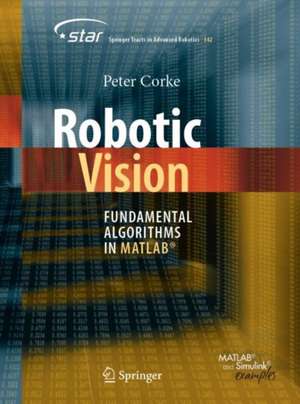
Robotic Vision: Fundamental Algorithms in MATLAB®: Springer Tracts in Advanced Robotics, cartea 142
Autor Peter Corkeen Limba Engleză Paperback – 28 ian 2022
Robotic Vision solicită un nivel de experiență de început spre intermediar, presupunând o familiaritate minimă cu mediul MATLAB și fundamentele matematice ale ingineriei. Ne-a atras atenția modul în care Peter Corke transformă o disciplină densă într-un parcurs didactic accesibil, axat pe rezultate imediate. Suntem de părere că forța acestei lucrări rezidă în utilizarea celor două MATLAB Toolboxes pe care autorul le dezvoltă de peste zece ani, permițând cititorului să testeze algoritmi complecși fără a irosi timp cu depanarea codului de la zero. Abordarea diferă de cea din Computer Vision de Richard Szeliski prin faptul că este mai puțin abstractă și mult mai aplicabilă. În timp ce Szeliski oferă o perspectivă enciclopedică și științifică asupra domeniului, Corke mizează pe eficiența oferită de implementări practice. Structura cărții reflectă o progresie logică: începe cu bazele reprezentării poziției (Partea I), trece prin procesarea de bază a imaginilor, luminii și culorii (Partea II) și culminează cu geometria viziunii multi-vedere și sisteme visual-servo (Partea III). În contextul operei sale, volumul de față rafinează materialul tutorial prezentat în lucrări precum Robotics and Control, integrând viziunea artificială și robotica într-o narațiune coerentă. Autorul demonstrează cum probleme complexe pot fi descompuse și rezolvate în doar câteva linii de cod, oferind o punte esențială între cercetarea teoretică și practica inginerească. Formatul Paperback și stilul informativ fac din acest titlu un instrument de lucru indispensabil pentru cei care doresc să utilizeze viziunea artificială în proiecte de robotică reală.
Din seria Springer Tracts in Advanced Robotics
-
 Preț: 543.02 lei
 - 18%
 Preț: 945.29 lei
 - 18%
 Preț: 924.60 lei
 -
 Preț: 460.34 lei
 - 15%
 Preț: 664.95 lei
 - 18%
 Preț: 812.83 lei
 - 20%
 Preț: 598.05 lei
 - 15%
 Preț: 664.24 lei
 - 20%
 Preț: 1040.60 lei
 - 18%
 Preț: 755.38 lei
 - 18%
 Preț: 1185.81 lei
 - 18%
 Preț: 914.52 lei
 - 15%
 Preț: 615.35 lei
 - 18%
 Preț: 1772.67 lei
 - 18%
 Preț: 856.49 lei
 - 18%
 Preț: 748.16 lei
 - 18%
 Preț: 960.16 lei
 - 20%
 Preț: 1006.30 lei
 - 15%
 Preț: 661.64 lei
 - 18%
 Preț: 946.97 lei
 - 15%
 Preț: 689.78 lei
 - 18%
 Preț: 981.70 lei
 - 15%
 Preț: 663.25 lei
 - 18%
 Preț: 806.73 lei
 - 18%
 Preț: 994.17 lei
 - 15%
 Preț: 683.19 lei
 - 15%
 Preț: 678.81 lei
 - 18%
 Preț: 1010.02 lei
 - 15%
 Preț: 673.55 lei
 - 18%
 Preț: 1018.07 lei
 - 18%
 Preț: 982.36 lei
 - 15%
 Preț: 663.90 lei
 - 15%
 Preț: 677.51 lei
 - 24%
 Preț: 926.35 lei
Preț: 434.53 lei
Carte disponibilă
Livrare economică 16-30 noiembrie
Specificații
ISBN-10: 3030791742
Pagini: 412
Ilustrații: XXV, 412 p. 235 illus., 191 illus. in color.
Dimensiuni: 193 x 260 x 25 mm
Greutate: 1.13 kg
Ediția:2022
Editura: Springer International Publishing
Colecția Springer
Seria Springer Tracts in Advanced Robotics
Locul publicării:Cham, Switzerland
V-ar putea interesa
-
 American GunChris KylePreț: 119.51 lei
 -
 Design for Six SigmaGreg BruePreț: 124.99 lei
 -
 SIPRI Yearbook 2001: Armaments, Disarmament and International SecurityStockholm International Peace Research Institute-31%Preț: 747.30 lei1080.32 lei
 -
 Webley Air PistolsGordon BrucePreț: 378.95 lei
 -
 The Illustrated World Encyclopedia of GunsWilliam FowlerPreț: 169.16 lei
 -
 Designing Small WeaponsJose Herrera-Ramirez-18%Preț: 956.70 lei1166.70 lei
 -
 Adventures in ArduinoBecky StewartPreț: 111.83 lei
 -
 Adventures in PythonCraig Richardson-20%Preț: 106.66 lei133.32 lei
 -
 Practical Gas Airsoft Pistols Upgrade & MaintenanceAirsoftpressPreț: 141.04 lei
 -
 Winchester Lever-Action RiflesMartin Pegler-27%Preț: 84.12 lei114.62 lei
 -
 Walther Pistols: PP, PPK and P 38John Walter-26%Preț: 79.23 lei107.67 lei
 -
 -18%Preț: 1014.04 lei1236.64 lei
 -
 Pistols and Revolvers and Their UseJulian HatcherPreț: 131.81 lei
 -
 Survival - Army FM 21-76 (1957 Historic Edition)US Department of the ArmyPreț: 132.37 lei
 -
 First Aid - FM 4-25.11 US Army Field Manual (2002 Civilian Reference Edition)Navy And Air Force Us ArmyPreț: 110.42 lei
 -
 Preț: 118.23 lei
 -
 Preț: 112.25 lei
 -
 Preț: 152.67 lei
 -
 The Ultimate Shooting Skills ManualChris Christian-7%Preț: 90.98 lei98.17 lei
 -
 Pistols: An Illustrated History of Their ImpactJeff Kinard-44%Preț: 406.89 lei726.28 lei
 -
 Design of Structures to Resist the Effects of Explosions & Atomic Weapons - Vol.1 Strength of Materials & Structural ElementsArmy Engineers U. S. Army EngineersPreț: 218.07 lei
 -
 Preț: 414.22 lei
 -
 -15%Preț: 620.90 lei730.47 lei
De ce să citești această carte
Recomandăm această carte oricărui inginer sau student care dorește să treacă de la teorie la practică în cel mai scurt timp posibil. Câștigul principal este accesul la un ecosistem de cod verificat prin MATLAB Toolboxes, care permite rezolvarea problemelor de viziune artificială fără a rescrie algoritmi de bază. Este un ghid practic care transformă conceptele matematice dificile în soluții funcționale, ideale pentru prototipare rapidă și cercetare aplicată.
Despre autor
Peter Corke este un cercetător și educator recunoscut la nivel internațional în domeniul roboticii, fiind autorul unor resurse fundamentale utilizate la nivel global. Este cunoscut în special pentru crearea și menținerea a două pachete de instrumente open-source pentru MATLAB (Robotics Toolbox și Vision Toolbox), care au devenit standarde de facto în mediul academic pentru predarea și cercetarea în robotică. Lucrările sale, publicate adesea în seria Springer Tracts in Advanced Robotics, se remarcă prin stilul lor didactic și orientarea către implementarea practică, facilitând accesul noilor generații de cercetători la algoritmi complexi.
Descriere scurtă
The practice of robotic vision involves the application of computational algorithms to data. Over the fairly recent history of the fields of robotics and computer vision a very large body of algorithms has been developed. However this body of knowledge is something of a barrier for anybody entering the field, or even looking to see if they want to enter the field — What is the right algorithm for a particular problem?, and importantly: How can I try it out without spending days coding and debugging it from the original research papers?
The author has maintained two open-source MATLAB Toolboxes for more than 10 years: one for robotics and one for vision. The key strength of the Toolboxes provide a set of tools that allow the user to work with real problems, not trivial examples. For the student the book makes the algorithms accessible, the Toolbox codecan be read to gain understanding, and the examples illustrate how it can be used —instant gratification in just a couple of lines of MATLAB code. The code can also be the starting point for new work, for researchers or students, by writing programs based on Toolbox functions, or modifying the Toolbox code itself.
The purpose of this book is to expand on the tutorial material provided with the toolboxes, add many more examples, and to weave this into a narrative that covers robotics and computer vision separately and together. The author shows how complex problems can be decomposed and solved using just a few simple lines of code, and hopefully to inspire up and coming researchers. The topics covered are guided by the real problems observed over many years as a practitioner of both robotics and computer vision. It is written in a light but informative style, it is easy to read and absorb, and includes a lot of Matlab examples and figures. The book is a real walk through the fundamentals light and color, camera modelling, image processing, feature extraction and multi-view geometry, and bring it all together in a visual servo system.
“An authoritative book, reaching across fields, thoughtfully conceived and brilliantly accomplished
Oussama Khatib, Stanford
Cuprins
Notă biografică
Peter Corke has been appointed new Editor of the IEEE Robotics and Automation Magazine.
Textul de pe ultima copertă
The Machine Vision Toolbox for MATLAB is free and open software that enables the reader to easily bring the algorithmic concepts into practice and work with real, non-trivial, problems. For the beginning student the book makes the algorithms accessible, the Toolbox code can be read to gain understanding, and the examples illustrate how it can be used. The code can also be the starting point for new work, for researchers or students, by writing programs based on Toolbox functions, or modifying the Toolbox code itself.