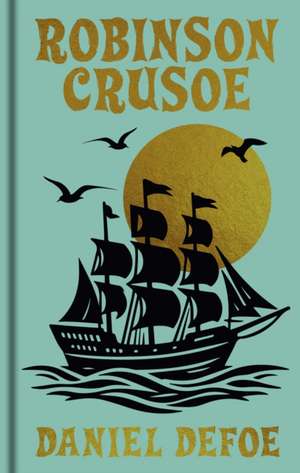
Robinson Crusoe: Arcturus Ornate Classics
Autor Daniel Defoeen Limba Engleză Hardback – 30 sep 2025
Momentul lecturii acestui clasic universal începe adesea cu voce tare, transformând o seară obișnuită într-o expediție imaginară pe o insulă pustie. Notăm cu interes că, deși mulți dintre noi cunoaștem premisa naufragiului, această ediție Collins Classics oferă o experiență mult mai profundă decât o simplă poveste de aventuri. Remarcăm structura atent documentată a volumului, care nu se rezumă doar la textul integral din 1719, ci include o cronologie a vieții lui Daniel De Foe și anexe fascinante despre „narativele naufragiaților” care au precedat romanul. Ca și The Life and Adventures of Robinson Crusoe, lucrarea reușește să educe spiritul practic al tânărului cititor fără a fi didactică, punând accent pe ingeniozitatea umană și pe capacitatea de a reconstrui o lume întreagă din resturile unui naufragiu. Merită menționat că această ediție este special concepută pentru cititorul modern, folosind un font lizibil și un design care evocă valorile tradiționale ale edițiilor de colecție. Progresia narațiunii, de la impulsivitatea tinereții până la maturitatea dobândită în cei 28 de ani de izolare, oferă o perspectivă realistă asupra rezilienței. Spre deosebire de atmosfera sumbră din A Journal of the Plague Year, unde autorul explorează devastarea unei epidemii, în Robinson Crusoe accentul cade pe construcție, pe îmblânzirea naturii și pe dialogul interior în momente de solitudine extremă. Este o lectură care invită la reflecție asupra valorii muncii și a supraviețuirii, fiind fundamentul pe care s-a clădit întreg genul de aventură modern.
Din seria Arcturus Ornate Classics
-
 Preț: 66.07 lei
 -
 Preț: 64.89 lei
 -
 Preț: 65.23 lei
 -
 Preț: 54.83 lei
 -
 Preț: 65.03 lei
 -
 Preț: 65.59 lei
 -
 Preț: 66.57 lei
 -
 Preț: 66.00 lei
 -
 Preț: 65.83 lei
 -
 Preț: 63.67 lei
 -
 Preț: 65.57 lei
 -
 Preț: 65.19 lei
 -
 Preț: 54.52 lei
 -
 Preț: 64.17 lei
 -
 Preț: 65.36 lei
 -
 Preț: 67.00 lei
 -
 Preț: 65.67 lei
 -
 Preț: 65.56 lei
 -
 Preț: 65.39 lei
 -
 Preț: 65.80 lei
 -
 Preț: 64.85 lei
 -
 Preț: 65.60 lei
 -
 Preț: 65.73 lei
 -
 Preț: 65.40 lei
 -
 Preț: 64.87 lei
 -
 Preț: 65.80 lei
 -
 Preț: 65.53 lei
 -
 Preț: 65.65 lei
 -
 Preț: 64.76 lei
 -
 Preț: 65.09 lei
 -
 Preț: 65.26 lei
 -
 Preț: 65.59 lei
 -
 Preț: 66.57 lei
 -
 Preț: 65.63 lei
 -
 Preț: 65.40 lei
 -
 Preț: 65.60 lei
 -
 Preț: 65.02 lei
 -
 Preț: 66.02 lei
 -
 Preț: 64.89 lei
 -
 Preț: 65.47 lei
 - 6%
 Preț: 61.87 lei
 -
 Preț: 64.45 lei
 -
 Preț: 54.47 lei
 -
 Preț: 65.83 lei
 - 6%
 Preț: 61.82 lei
 - 6%
 Preț: 61.70 lei
 -
 Preț: 64.89 lei
 -
 Preț: 65.26 lei
 -
 Preț: 65.02 lei
Preț: 65.82 lei
Carte disponibilă
Livrare economică 14-28 noiembrie
Livrare express 31 octombrie-06 noiembrie pentru 22.35 lei
Specificații
ISBN-10: 1398851094
Pagini: 288
Dimensiuni: 114 x 171 x 22 mm
Greutate: 0.26 kg
Editura: Arcturus Publishing
Colecția Arcturus Ornate Classics
Seria Arcturus Ornate Classics
V-ar putea interesa
-
 Pride and PrejudiceJane AustenPreț: 28.01 lei
 -
 Wuthering HeightsEmily BrontëPreț: 28.01 lei
 -
 The Adventures of Sherlock HolmesArthur Conan DoylePreț: 28.01 lei
 -
 Great ExpectationsCharles DickensPreț: 28.01 lei
 -
 Tess of the D'UrbervillesThomas HardyPreț: 28.01 lei
 -
 Gulliver's TravelsJonathan SwiftPreț: 28.01 lei
 -
 The Adventures Of Huckleberry FinnMark TwainPreț: 28.01 lei
 -
 The Secret GardenFrances Hodgson BurnettPreț: 28.01 lei
 -
 The Prince and the PauperMark TwainPreț: 28.01 lei
 -
 The Adventures of Tom SawyerMark TwainPreț: 28.01 lei
 -
 HamletCollins GcsePreț: 28.01 lei
 -
 The Adventures of Huckleberry FinnMark Twain-26%Preț: 48.77 lei65.63 lei
 -
 -17%Preț: 79.17 lei95.36 lei
 -
 Classic Starts®: Moby-DickArthur Pober-26%Preț: 41.40 lei56.23 lei
 -
 Born Standing UpSteve MartinPreț: 104.11 lei
 -
 BeowolfAnonymousPreț: 51.89 lei
 -
 -5%Preț: 62.70 lei65.83 lei
 -
 Moby DickHerman MelvillePreț: 39.32 lei
 -
 Sense and SensibilityJane AustenPreț: 25.87 lei
 -
 David CopperfieldCharles DickensPreț: 40.48 lei
 -
 Moll FlandersDaniel DefoePreț: 28.01 lei
 -
 Tristram ShandyLaurence SternePreț: 28.01 lei
De ce să citești această carte
Recomandăm această carte părinților care doresc să introducă tinerii cititori (peste 10 ani) în universul marii literaturi prin intermediul unei aventuri captivante. Cititorul câștigă nu doar o lecție de istorie literară, ci și un model de perseverență și ingeniozitate. Este ocazia perfectă de a descoperi de unde a început totul în literatura de supraviețuire, într-o ediție cu o grafică modernă și materiale auxiliare valoroase.
Despre autor
Daniel De Foe (c.1660–1731) a fost o figură polivalentă a Angliei secolului al XVIII-lea, activând ca negustor, pamfletar politic, spion și jurnalist. Considerat unul dintre părinții romanului modern, el a folosit peste 190 de pseudonime de-a lungul carierei sale prolifice de peste 500 de lucrări. Deși a început să scrie ficțiune la o vârstă înaintată, succesul imediat al lui Robinson Crusoe i-a asigurat un loc permanent în canonul literar. Opera sa este marcată de un realism profund, explorând teme economice și sociale în lucrări precum Moll Flanders sau A Journal of the Plague Year, reflectând experiența sa vastă de observator al societății britanice.
Descriere scurtă
After being shipwrecked on a desert island, marina Robinson Crusoe spends over 30 years surviving in complete solitude. Until he spies a footprint on the shore and realises, he is not as alone as he thought...
Robinson Crusoe was first published in 1719 and has been hailed as the classic adventure story. Although the inspiration came from a real-life castaway called Alexander Selkirk, the novel can be enjoyed as a tale of survival, of spiritual awakening, or as a mythic quest.
This beautiful pocket-sized gift edition contains the classic, unabridged text, presented with an embossed cover design, ivory pages, beautifully designed endpapers and gold gilded page edges. Part of the Arcturus Ornate Classics series, this book makes wonderful gift for any lover of classic literature.
ABOUT THE SERIES: Arcturus Ornate Classics are beautiful pocket editions of iconic literary works from across history. Presented with striking foil cover embossing, gilded page edges, and deluxe ivory paper, these editions make the perfect gift for lovers of classic literature.
Descriere
This edition of Robinson Crusoe contains a retold novel, an introduction, notes on the author, notes on the background when the book was written and the book's themes, a glossary, and a free CD (running time 2 hours). The CD is read slowly and clearly to aid comprehension. It is suitable for students, schools, ELT, ESOL. Robinson Crusoe leaves his family for sea adventures but after a shipwreck is stranded on a desert island in the Caribbean for 28 years. Defoe's novel was published in 1719 but was set in the 1680s at the time of naval exploration, and the beginnings of slavery. Crusoe salvages some supplies from the wrecked ship. As the days go by, he builds a fort and a small area for animals. He gathers fruit, grows crops, keeps goats, hunts, and protects his 'castle'. In his diaries he records his progress. He also records how he reads the Bible and becomes religious. After more than 20 years on the island, Crusoe encounters cannibals, which represent the first human contact he's had since being shipwrecked. He finds a footprint, which he runs away from, but then rescues a man he calls Friday from cannibals. Friday becomes his servant. Robinson finally makes an escape when a ship of mutineers arrives on the island. Robinson and his companions help the British captain to take back control of the ship. Robinson arrives home in England to find he is wealthy after an absence of 35 years. The story, told in a journalistic way because of the way he narrates his life and records all the facts, is about how a lonely human can survive alone when hardship comes. It is also a story of how a man can create his own reality out a wilderness on a desert island. Robinson Crusoe is an important figure in literature, and his name is synonymous with a lonely man living alone on a desert island and surviving.
Notă biografică
Recenzii
In addition to an introduction and helpful notes, this Broadview Edition includes a wide range of appendices that situate Defoe’s 1719 novel amidst castaway narratives, economic treatises, reports of cannibalism, explorations of solitude, and Defoe’s own writings on slavery and the African trade. A final appendix presents images of Crusoe’s rescue of Friday from a dozen of the most significant illustrated editions of the novel published between 1719 and 1920.
“Evan R. Davis has done an excellent job of bringing together many of the strands of thought that Defoe put into The Life and Strange Surprizing Adventures of Robinson Crusoe—his interests in travel, economics, religion, and the experience of solitude—and putting them into an attractive format. Professor Davis supplies examples of texts on related topics such as solitude, cannibalism, and castaway narratives, along with a group of wonderful illustrations, including a large number of Crusoe and Friday, showing everything from the sympathetic and helpful Crusoe to Crusoe the colonialist and exploiter. These are well chosen to make points about the ways in which Crusoe fits into the interests of post-colonial criticism. Professor Davis is also very good in his introduction on the ambiguity with which Crusoe treats Friday. Is he a friend, a servant, or a slave? Or all three? This will be a useful and indeed an exciting text for students at all levels.” — Maximillian E. Novak, University of California at Los Angeles
“This edition greatly enriches the reader’s appreciation of Robinson Crusoe both as a classic that transcends its historical origins and as a text that reflects a specific historical context. In each role, the novel can be viewed from many perspectives, ranging from those embodied in other writings by Defoe and his contemporaries to later ideas about psychology, economics, religion, and post-colonialism, and the introduction and appendices give the reader access to an extraordinarily copious array of these perspectives. The introduction, moreover, goes well beyond compiling viewpoints: while elegantly marshaling information, Evan R. Davis also contests received opinion and offers fresh insights. This is an extremely useful edition for students, general readers, and even those already well-acquainted with Defoe.” — Oscar Kenshur, Indiana University
“Evan R. Davis’s fine edition of Robinson Crusoe for Broadview joins an already well-populated field of classroom paperbacks of Defoe’s first novel...The Broadview edition holds its own...and offers much to recommend itself. It provides everything one would want from a text for classroom use (or for reading outside the classroom, for that matter): a reliable text, annotations that are clear and sufficient without being obtrusive, and an intelligent and thoughtful editor’s introduction. Moreover, it provides a rich selection of supplementary materials, including a truly surprising number of illustrations, aimed at provoking classroom discussion or simply thoughtful reflection.” — Benjamin F. Pauley, Eastern Connecticut State University, reviewed in Digital Defoe
Cuprins
Introduction
Daniel Defoe: A Brief Chronology
A Note on the Text
The Life and Strange Surprizing Adventures of Robinson Crusoe
Appendix A: Daniel Defoe, Preface and Publisher’s Introduction to Serious Reflections During the Life and Surprising Adventures of Robinson Crusoe (1720)
Appendix B: From Charles Gildon, The Life and Strange Surprizing Adventures of Mr. D—— De F—(1719)
Appendix C: Castaway Narratives
- From Ibn Ṭufayl, The Improvement of Human Reason, Exhibited in the Life of Hai Ebn Yokdhan (1708)
- Accounts of Alexander Selkirk
- From Woodes Rogers, A Cruising Voyage round the World (1712)
- Richard Steele, The Englishman, no. 26 (1713)
- From Penelope Aubin, The Strange Adventures of the Count de Vinevil and his Family (1721)
- From Leendert Hasenbosch, An Authentick Relation of the Many Hardships and Sufferings of a Dutch Sailor (1728)
- From Richard Baxter, “Of Conversing with God in Solitude” (1664)
- From Mary, Lady Chudleigh, “Of Solitude” (1710)
- From Anne Kingsmill Finch, Countess of Winchilsea, “The Petition for an Absolute Retreat” (1713)
- From Daniel Defoe, “Of Solitude” (1720)
- Alexander Pope, “Ode on Solitude” (1717)
- From Edmund Burke, “Society and Solitude” (1757)
- From Jean-Jacques Rousseau, Emilius and Sophia (1762)
- William Cowper, “Verses Supposed to be Written by Alexander Selkirk” (1782)
- Charlotte Smith, Sonnet XLIV, “Written in the Church-yard at Middleton in Sussex” (1789)
- From Samuel Taylor Coleridge, “The Rime of the Ancyent Marinere” (1798)
- William Wordsworth, “Nutting” (1800)
- William Cowper, “The Castaway” (1803)
- From John Locke, “Of Property,” Two Treatises on Government (1698)
- From Adam Smith, An Inquiry into the Nature and Causes of the Wealth of Nations (1776)
- From Karl Marx, Capital (1867)
- From Max Weber, The Protestant Ethic and the Spirit of Capitalism (1920–21)
- From Reformation of Manners, A Satyr (1702)
- From An Essay upon the Trade to Africa (1711)
- From A Review of the State of the British Nation (1711, 1712)
- From The History and Remarkable Life of the Truly Honourable Col. Jacque, Commonly call’d Col. Jack (1722)
- From A Plan of the English Commerce (1728)
- From Michel de Montaigne, “Of Cannibals” (tr. 1685–86)
- From Charles de Rochefort, The History of the Caribby-Islands (tr. 1666)
- From William Dampier, “Of the Reports about Cannibals” (1703)
- From Daniel Defoe, Serious Reflections During the Life and Surprising Adventures of Robinson Crusoe (1720)
- Anonymous (1720)
- Anonymous (1722)
- Clément Pierre Marillier (1787)
- Charles Ansell (1790)
- Thomas Stothard (1790)
- George Cruikshank (1831)
- J.J. Grandville (1840)
- Phiz (Hablot Knight Browne) (1846)
- Jules Fesquet (1877)
- Otis Turner (1913)