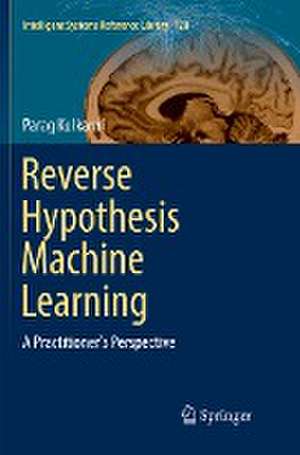
Reverse Hypothesis Machine Learning: A Practitioner's Perspective: Intelligent Systems Reference Library, cartea 128
Autor Parag Kulkarnien Limba Engleză Paperback – 25 iul 2018
Din seria Intelligent Systems Reference Library
- 20%
 Preț: 1199.62 lei
- 20%
 Preț: 672.22 lei
- 20%
 Preț: 674.97 lei
- 20%
 Preț: 1043.12 lei
- 20%
 Preț: 1090.74 lei
- 20%
 Preț: 1213.04 lei
- 20%
 Preț: 1207.79 lei
- 20%
 Preț: 1083.76 lei
- 20%
 Preț: 1101.63 lei
- 20%
 Preț: 1080.01 lei
- 20%
 Preț: 1322.83 lei
- 20%
 Preț: 1207.79 lei
- 20%
 Preț: 1928.55 lei
- 20%
 Preț: 952.14 lei
- 20%
 Preț: 674.70 lei
- 20%
 Preț: 668.51 lei
- 20%
 Preț: 684.20 lei
- 20%
 Preț: 669.84 lei
- 20%
 Preț: 677.34 lei
- 20%
 Preț: 672.70 lei
- 20%
 Preț: 670.94 lei
- 20%
 Preț: 681.75 lei
- 20%
 Preț: 680.43 lei
- 20%
 Preț: 1686.68 lei
- 20%
 Preț: 638.62 lei
- 20%
 Preț: 672.48 lei
- 20%
 Preț: 674.25 lei
- 20%
 Preț: 676.25 lei
- 20%
 Preț: 1039.77 lei
- 20%
 Preț: 620.20 lei
- 20%
 Preț: 682.21 lei
- 20%
 Preț: 667.38 lei
- 20%
 Preț: 669.16 lei
Preț: 723.25 lei
Preț vechi: 904.07 lei
-20%
Carte tipărită la comandă
Livrare economică 07-21 decembrie
Specificații
ISBN-10: 331985626X
Pagini: 138
Ilustrații: XVI, 138 p. 61 illus., 9 illus. in color.
Dimensiuni: 155 x 235 mm
Greutate: 0.23 kg
Ediția:Softcover reprint of the original 1st ed. 2017
Editura: Springer International Publishing
Colecția Springer
Seria Intelligent Systems Reference Library
Locul publicării:Cham, Switzerland
V-ar putea interesa
-
 -19%Preț: 92.35 lei114.22 lei
-
 Reinforcement & Systemic MchinKulkarni-9%Preț: 826.86 lei908.63 lei
-
 Computer VisionSimon J. D. Prince-20%Preț: 582.72 lei728.39 lei
-
 Machine LearningPeter Flach-20%Preț: 386.84 lei483.55 lei
-
 Multi-Agent Machine LearningH M Schwartz-20%Preț: 675.81 lei844.77 lei
-
 Wavelet Neural NetworksAntonios K Alexandridis-20%Preț: 634.18 lei792.72 lei
-
 Practical Introduction to CompDawson-Howe-20%Preț: 518.21 lei647.76 lei
-
 Machine Learning: An Algorithmic Perspective, Second EditionStephen Marsland-20%Preț: 625.22 lei781.53 lei
-
 Natural Language Processing and Computational LinguisticsMohamed Zakaria Kurdi-9%Preț: 1021.06 lei1122.04 lei
-
 Ambient Intelligence - Software and ApplicationsAmr Mohamed-20%Preț: 627.72 lei784.65 lei
-
 -20%Preț: 621.32 lei776.66 lei
-
 Symbolic and Quantitative Approaches to Reasoning with UncertaintySébastien Destercke-20%Preț: 349.32 lei436.65 lei
-
 Handbook of Genetic Programming ApplicationsAmir H. Gandomi-20%Preț: 1046.40 lei1308.00 lei
-
 -20%Preț: 307.50 lei384.38 lei
-
 Industrial Applications of Holonic and Multi-Agent SystemsVladimír Ma¿ík-20%Preț: 318.94 lei398.67 lei
-
 Logic Programming and Nonmonotonic ReasoningFrancesco Calimeri-20%Preț: 350.38 lei437.98 lei
-
 Believable BotsPhilip Hingston-20%Preț: 676.70 lei845.88 lei
-
 New Frontiers in Artificial IntelligenceTsuyoshi Murata-20%Preț: 338.85 lei423.56 lei
Cuprins
Textul de pe ultima copertă
Caracteristici
Notă biografică
Dr. Jay Rajasekera’s specialties are in digital business and computer algorithms. He is currently the vice president and dean of Graduate School of Business and Commerce at Tokyo International University. He started his career at AT&T Bell Laboratories in New Jersey, USA, following his Ph.D. in Operations Research and Computer Science. While at Bell Laboratories he designed and patented the computer algorithm for the construction of the world's first undersea fiber optic cable TAT-8 between USA and Europe; world’s first demonstrations of the Internet too were done using this cable. From 1995 to 2017, he was with the International University of Japan, holding various positions. In 2018, he moved to Tokyo International University and contributed to establish new Digital Business and Innovation (DBI) program. In 2023, he and his team won a global AI competition, which led to applying AI for issuing cyber alerts for one of top global airports. Companies he had offered consulting include IBM, Fujitsu and Hitachi.
Prof. Chaudhuri retired from Indian Statistical Institute, Kolkata, India as INAE Distinguished Professor and J C Bose Fellow in 2018 and acted as Pro VC of Techno India University for five years. Currently, he is a distinguished Emeritus pProfessor at Techno India University and visiting professor of several other Universities. His research areas of interest are AI and machine learning in computer sciences, especially in pattern recognition, computer vision, natural language processing and their applications in various fields. He published more than 450 papers, authored or edited 10 books in these domains. He also authored several patents and acted as chief investigator of externally funded projects like UNDP, Indo-European, Indo-German and Indo-France and many domestic projects. He is a life fellow of IEEE and fellow of IAPR, AAIA, TWAS, INSA, INAE, INASc, IETE, etc.