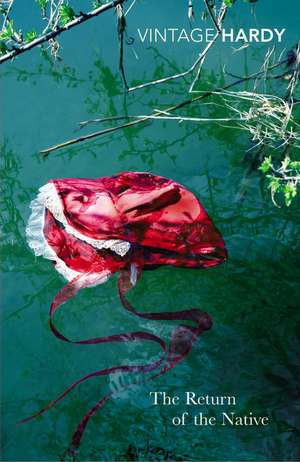
Return of the Native
Autor Thomas Hardyen Limba Engleză Paperback – 3 iun 2010
Subliniem, încă de la primele pagini, o structură narativă riguroasă, în care unitatea de timp și spațiu — un an și o zi pe întinderile pustii din Egdon Heath — conferă romanului o intensitate aproape teatrală. „The Return of the Native” marchează o etapă crucială în evoluția autorului, fiind lucrarea care cristalizează viziunea sa tragică asupra existenței. Spre deosebire de tonul mai optimist din Under the Greenwood Tree, aici notăm cu interes o explorare a conflictului dintre aspirațiile individuale și determinismul mediului social. Forța narativă a lui Thomas Hardy combinată cu sensibilitatea psihologică a unei Anne Brontë în The Tenant of Wildfell Hall oferă o perspectivă unică asupra condiției umane, dar cu un glas propriu, marcat de melancolia peisajului englez. Apreciem modul în care această ediție Wordsworth Classics este organizată, incluzând nu doar textul original din 1878, ci și hărți detaliate ale regiunii Wessex și reacții critice contemporane care plasează opera într-un context istoric viu. Dacă în Far From the Madding Crowd natura părea uneori un aliat, în acest roman Egdon Heath devine un personaj în sine, o forță implacabilă care dictează destinele celor care încearcă să o îmblânzească sau să o părăsească. Este o lucrare de maturitate care pregătește terenul pentru marile tragedii de mai târziu, precum Tess of the D'Urbervilles sau Jude the Obscure.
Preț: 51.20 lei
Preț vechi: 60.13 lei
-15%
Carte disponibilă
Livrare economică 20 noiembrie-01 decembrie
Livrare express 03-07 noiembrie pentru 35.87 lei
Specificații
ISBN-10: 0099518988
Pagini: 512
Dimensiuni: 130 x 196 x 35 mm
Greutate: 0.36 kg
Editura: Vintage Publishing
V-ar putea interesa
-
 Jane EyreCharlotte BrontëPreț: 28.01 lei
 -
 Wuthering HeightsEmily BrontëPreț: 28.01 lei
 -
 Silas MarnerGeorge EliotPreț: 28.01 lei
 -
 Selected Poems of Thomas HardyThomas HardyPreț: 104.61 lei
 -
 The Fiddler of the Reels and Other StoriThomas HardyPreț: 96.18 lei
 -
 Enchanted AprilElizabeth von ArnimPreț: 71.66 lei
 -
 OCR Tess of the d'UrbervillesThomas HardyPreț: 97.21 lei
 -
 The Literary Notebooks of Thomas HardyThomas Hardy-18%Preț: 999.06 lei1218.36 lei
 -
 The Importance of Being Earnest and Other PlaysOscar WildePreț: 35.30 lei
 -
 Major BarbaraGeorge Bernard ShawPreț: 50.12 lei
 -
 Tess of the d'UrbervillesThomas HardyPreț: 43.50 lei
 -
 Normal PeopleSally Rooney-16%Preț: 60.02 lei71.88 lei
 -
 Happy Marriage?!, Vol. 3Maki EnjojiPreț: 56.84 lei
 -
 -19%Preț: 470.21 lei580.51 lei
 -
 The Picture of Dorian GrayOscar WildePreț: 30.66 lei
 -
 Trumpet-MajorThomas HardyPreț: 28.01 lei
 -
 Les Vieux Papiers d'Un Imprimeur: Recueil PoétiqueVingtrinier-APreț: 143.06 lei
 -
 Preț: 150.36 lei
 -
 Preț: 182.67 lei
 -
 Le Retour d'Apollon, Poëme SatiriqueViollet-Le-Duc-EPreț: 82.89 lei
 -
 Nouvel Art Poétique. Poëme En Un ChantViollet-Le-Duc-EPreț: 96.90 lei
 -
 Six mois de la vie d'un jeune homme (1797)Viollet-Le-Duc-EPreț: 150.94 lei
 -
 Flambeaux Éteints: PoèmesVivien-RPreț: 89.59 lei
 -
 Preț: 89.81 lei
 -
 En Guise de Quelques ObservationsVivier-EPreț: 89.59 lei
 -
 La Femme, Ou Les Six Amours. AmitiéVoiart-EPreț: 134.90 lei
De ce să citești această carte
Recomandăm acest roman cititorilor care caută o proză densă, de o frumusețe austeră, unde peisajul este la fel de viu ca personajele. Veți câștiga o înțelegere profundă a tragediei victoriene, explorând teme precum exilul interior și ciocnirea dintre tradiție și modernitate. Este o lectură esențială pentru a înțelege de ce Virginia Woolf l-a numit pe Hardy cel mai mare scriitor tragic al literaturii engleze.
Despre autor
Thomas Hardy (1840–1928) a fost un romancier și poet englez de o importanță fundamentală, reprezentant al realismului victorian influențat de romantism. Deși s-a considerat în primă instanță poet, a atins celebritatea prin romanele sale plasate în regiunea semi-ficțională Wessex, precum The Mayor of Casterbridge și Tess of the D'Urbervilles. Opera sa este adesea critică la adresa societății victoriene, concentrându-se pe declinul comunităților rurale și pe luptele personajelor împotriva pasiunilor proprii și a circumstanțelor sociale rigide. Stilul său combină observația socială metodică cu o viziune filozofică profundă asupra sorții.
Notă biografică
Descriere scurtă
Proud, passionate Eustacia Vye marries Clym Yeobright in the hope that he will help her escape her cramped rural existence. But when their relationship falters and her old lover Damon Wildeve reappears with an unexpected inheritance, Eustacia is faced with a series of decisions upon which multiple lives depend. In a world where misunderstandings can be fatal, Hardy's atmospheric tragedy moves inevitably towards a disastrous climax on the brooding wilds of Egdon Heath.
'Hardy's novels hold a Shakespearean power of creating a unique world' John Bayley
See also: Jude the Obscure
Recenzii
--Daily Telegraph
"Inimitably brooding style."
--The Times
"Besides my complete identification with its heroine, I loved the sheer relentless power of the writing. What other writer would start a novel with six solid pages of description without introducing a single character? Like D H Lawrence, Hardy isn't to everyone's taste: too much blighted love and atheistic pessimism. To me, ensconced in a convent thick with incense, confession and church twice on Sundays, a little atheistic pessimism was a welcome antidote."
--Maeve Haran, Independent
"Throbs with a very Victorian sense of geologies, pre-histories and even astronomy; you can feel the planet moving under the feet" Daily Telegraph "Inimitably brooding style" The Times "Besides my complete identification with its heroine, I loved the sheer relentless power of the writing. What other writer would start a novel with six solid pages of description without introducing a single character? Like D H Lawrence, Hardy isn't to everyone's taste: too much blighted love and atheistic pessimism. To me, ensconced in a convent thick with incense, confession and church twice on Sundays, a little atheistic pessimism was a welcome antidote" -- Maeve Haran, Independent "Splendid" Daily Telegraph "Most of Hardy's novels, and particularly the early ones, have a Shakespearean power of creating a unique world and climate of being ... The Return of the Native is ... thoughtful, valedictory, poetic, tinged with the somberness of an uncertainty which seems to well up from the depths of the author's own subconscious ... Hardy's sense of the tragic life of human beings, mere small fragments of consciousness in a vast uncaring universe, comes directly from his own youthful awareness of the place and circumstances described in the novel" -- John Bayley
Textul de pe ultima copertă
Extras
The heaven being spread with this pallid screen and the earth with the darkest vegetation, their meeting-line at the horizon was clearly marked. In such contrast the heath wore the appearance of an instalment of night which had taken up its place before its astronomical hour was come: darkness had to a great extent arrived hereon, while day stood distinct in the sky. Looking upwards, a furze-cutter would have been inclined to continue work; looking down, he would have decided to finish his faggot and go home. The distant rims of the world and of the firmament seemed to be a division in time no less than a division in matter. The face of the heath by its mere complexion added half an hour to evening; it could in like manner retard the dawn, sadden noon, anticipate the frowning of storms scarcely generated, and intensify the opacity of a moonless midnight to a cause of shaking dread.
In fact, precisely at this transitional point of its nightly roll into darkness the great and particular glory of the Egdon waste began, and nobody could be said to understand the heath who had not been there at such a time. It could best be felt when it could not clearly be seen, its complete effect and explanation lying in this and the succeeding hours before the next dawn: then, and only then, did it tell its true tale. The spot was, indeed, a near relation of night, and when night showed itself an apparent tendency to gravitate together could be perceived in its shades and the scene. The sombre stretch of rounds and hollows seemed to rise and meet the evening gloom in pure sympathy, the heath exhaling darkness as rapidly as the heavens precipitated it. And so the obscurity in the air and the obscurity in the land closed together in a black fraternization towards which each advanced half-way.
The place became full of a watchful intentness now; for when other things sank brooding to sleep the heath appeared slowly to awake and listen. Every night its Titanic form seemed to await something; but it had waited thus, unmoved, during so many centuries, through the crises of so many things, that it could only be imagined to await one last crisis—the final overthrow.
Descriere
The Return of the Native was a radical departure for Thomas Hardy, ushering in his tragic literary vision of the world. Though set in a small space (Egdon Heath in the fictional county of Wessex) and short time (the main action spans a year and a day), the novel addresses the broad social and intellectual upheavals of the Victorian age. Much of this turmoil is embodied in the character of Eustacia Vye, the novel’s wilful female protagonist. A complex, independent young woman, Eustacia is a sympathetic but ultimately tragic figure, the epitome of what the narrator calls the “irrepressible New.”
The appendices to this Broadview edition place the novel in the context of Hardy’s career and the scientific and social ideas of the time. Documents include contemporary reviews, related writings by Hardy, and materials on biology, geology, and the “Woman Question.” Illustrations from the original serialization in Belgravia magazine and Hardy’s performance text of the mummers’ play are also included.
Cuprins
Book One—The Three Women
I. A Face on Which Time Makes but
Little Impression 15
II. Humanity Appears upon the Scene,
Hand in Hand with Trouble 19
III. The Custom of the Country 25
IV. The Halt on the Turnpike Road 46
V. Perplexity among Honest People 51
VI. The Figure against the Sky 63
VII. Queen of Night 77
VIII. Those Who Are Found Where There
Is Said to Be Nobody 84
IX. Love Leads a Shrewd Man into Strategy 90
X. A Desperate Attempt at Persuasion 100
XI. The Dishonesty of an Honest Woman 109
Book Two—The Arrival
I. Tidings of the Comer 121
II. The People at Blooms-End
Make Ready 126
III. How a Little Sound Produced
a Great Dream 131
IV. Eustacia Is Led on to an Adventure 136
V. Through the Moonlight 146
VI. The Two Stand Face to Face 153
VII. A Coalition between Beauty
and Oddness 164
VIII. Firmness Is Discovered in a
Gentle Heart 173
Book Three—The Fascination
I. “My Mind to Me a Kingdom Is” 185
II. The New Course Causes
Disappointment 190
III. The First Act in a Timeworn Drama 199
IV. An Hour of Bliss and Many Hours
of Sadness 213
V. Sharp Words Are Spoken, and a
Crisis Ensues 221
VI. Yeobright Goes, and the Breach
Is Complete 228
VII. The Morning and the Evening of a Day 235
VIII. A New Force Disturbs the Current 249
Book Four—The Closed Door
I. The Rencounter by the Pool 259
II. He Is Set upon by Adversities but
He Sings a Song 266
III. She Goes Out to Battle against
Depression 276
IV. Rough Coercion Is Employed 288
V. The Journey across the Heath 295
VI. A Conjuncture, and Its Result upon
the Pedestrian 300
VII. The Tragic Meeting of Two Old Friends 310
VIII.Eustacia Hears of Good Fortune, and
Beholds Evil 318
Book Five—The Discovery
I.“Wherefore Is Light Given to Him
That Is in Misery” 329
II.A Lurid Light Breaks in upon a
Darkened Understanding 337
III.Eustacia Dresses Herself on a Black
Morning 347
IV.The Ministrations of a
Half-forgotten One 355
V. An Old Move Inadvertently Repeated 360
VI.Thomasin Argues with Her Cousin,
and He Writes a Letter 367
VII. The Night of the Sixth of November 374
VIII. Rain, Darkness, and Anxious Wanderers 382
IX.Sights and Sounds Draw the
Wanderers Together 392
Book Six—Aftercourses
I. The Inevitable Movement Onward 405
II.Thomasin Walks in a Green Place
by the Roman Road 414
III.The Serious Discourse of Clym
with His Cousin 418
IV.Cheerfulness Again Asserts Itself
at Blooms-End, and Clym Finds
His Vocation 423