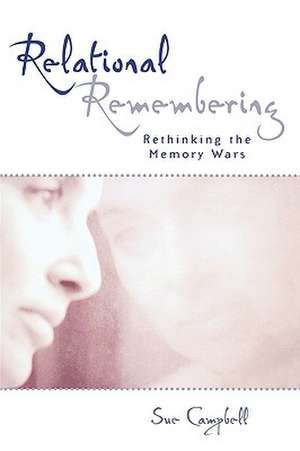
Relational Remembering: Rethinking the Memory Wars: Feminist Constructions
Autor Sue Campbellen Limba Engleză Paperback – 7 oct 2003
The harmful stereotypes of women's passivity and instability that have repopulated discussions of abuse have led many theorists to regard the social dimensions of remembering only negatively, as a threat or contaminant to memory integrity. Such models of memory cannot help us grasp the nature of harms linked to oppression, as these models imply that changed group understandings of the past are incompatible with the integrity of personal memory. Campbell uses the false memory debates to defend a feminist reconceptualization of personal memory as relational, social, and subject to politics. Memory is analyzed as a complex of cognitive abilities and social/narrative activities where one's success or failure as a rememberer is both affected by one's social location and has profound ramifications for one's cultural status as a moral agent.
Din seria Feminist Constructions
- 19%
 Preț: 312.75 lei
 - 19%
 Preț: 321.33 lei
 - 20%
 Preț: 320.17 lei
 - 35%
 Preț: 346.61 lei
 - 19%
 Preț: 317.67 lei
 - 21%
 Preț: 306.46 lei
 - 24%
 Preț: 268.74 lei
 -
 Preț: 358.35 lei
 - 22%
 Preț: 317.88 lei
 - 23%
 Preț: 321.01 lei
 - 35%
 Preț: 562.80 lei
 - 24%
 Preț: 351.71 lei
 - 19%
 Preț: 313.80 lei
 - 23%
 Preț: 322.99 lei
 - 21%
 Preț: 370.80 lei
 - 20%
 Preț: 314.50 lei
 - 52%
 Preț: 532.03 lei
Preț: 322.16 lei
Preț vechi: 416.97 lei
-23%
Puncte Express: 483
Carte tipărită la comandă
Livrare economică 07-21 decembrie
Livrare prin curier în România Termenul estimat este afișat lângă disponibilitate.
Transport gratuit de la 400.00 lei Plată online sau ramburs, în funcție de opțiunile comenzii.
Retur gratuit în 14 zile Comandă securizată și suport în română.
Specificații
ISBN-13: 9780742532816
ISBN-10: 074253281X
Pagini: 238
Dimensiuni: 152 x 227 x 20 mm
Greutate: 0.36 kg
Ediția:New.
Editura: Bloomsbury Publishing
Colecția Rowman & Littlefield
Seria Feminist Constructions
Locul publicării:New York, United States
ISBN-10: 074253281X
Pagini: 238
Dimensiuni: 152 x 227 x 20 mm
Greutate: 0.36 kg
Ediția:New.
Editura: Bloomsbury Publishing
Colecția Rowman & Littlefield
Seria Feminist Constructions
Locul publicării:New York, United States
V-ar putea interesa
-
 The Making Of MemorySteven RosePreț: 124.38 lei
 -
 Memory: A Very Short IntroductionJonathan K. FosterPreț: 70.32 lei
 -
 Episodic Memory: New Directions in ResearchAlan Baddeley-31%Preț: 506.73 lei733.45 lei
 -
 -28%Preț: 519.97 lei725.50 lei
 -
 Working Memory, Thought, and ActionAlan Baddeley-28%Preț: 508.06 lei710.27 lei
 -
 -10%Preț: 393.02 lei437.93 lei
 -
 What Is Adaptive about Adaptive Memory?Bennett L. Schwartz-30%Preț: 552.47 lei785.68 lei
 -
 The Mnemonic ImaginationE. Keightley-18%Preț: 811.62 lei989.78 lei
 -
 Working Memory and Academic LearningMilton J Dehn-8%Preț: 435.32 lei473.17 lei
 -
 -27%Preț: 68.42 lei93.17 lei
 -
 Pieces of Light: The new science of memoryCharles Fernyhough-19%Preț: 76.08 lei93.54 lei
 -
 -18%Preț: 704.62 lei859.28 lei
 -
 The Art of MemoryFrances A. Yates-17%Preț: 116.17 lei139.97 lei
Cuprins
Chapter 1 Constructing the "memory wars"
Chapter 2 Respecting rememberers
Chapter 3 Framing women's testimony: narrative position and memory authority
Chapter 4 The subjects of therapy: Revisiting Trauma and Recovery
Chapter 5 "The feeling of identity is quite wanting...in the true woman": Models of memory and moral character
Chapter 6 Suggestibility, misdesign, and social skepticism
Chapter 7 The costs of a stereotype: Defending women's confidential records
Chapter 8 A singular and representative life: Personal memory and systematic harms
Chapter 2 Respecting rememberers
Chapter 3 Framing women's testimony: narrative position and memory authority
Chapter 4 The subjects of therapy: Revisiting Trauma and Recovery
Chapter 5 "The feeling of identity is quite wanting...in the true woman": Models of memory and moral character
Chapter 6 Suggestibility, misdesign, and social skepticism
Chapter 7 The costs of a stereotype: Defending women's confidential records
Chapter 8 A singular and representative life: Personal memory and systematic harms
Recenzii
Sue Campbell provides an insightful and much-needed analysis of the current debates surrounding recovered memories. Her lucidly argued position is essential reading for both therapists and theorists grappling with this contentious subject.
Relational Remembering is a compelling, persuasively argued book that brings a welcome philosophical sophistication to recent debates in the so-called 'memory wars.' Sue Campbell argues that our dependence on others in the construction of narratives of our past, far from undermining the reliability of our memories, is necessary for 'good remembering.' Philosophers, cognitive psychologists, therapists, feminist theorists-indeed, everyone interested in the politics of memory-will benefit from reading this fascinating study of memory and identity.
In Relational Remembering Sue Campbell extends to the contentious terrain of the 'memory wars' the subtle and lucid account of subjectivity that she articulated in Interpreting the Personal. This extraordinary achievement shows that seeking the truth about what we feel or about what we seem to remember requires, not abstraction from, but politically informed attention to the social contexts in which those feelings and memories take shape.
This is an especially useful text for those interested in philosophically interdisciplinary projects. . . . Relational Remembering presents an important feminist voice in the arguments over the unity and stability of memory. Campbell's text is critical, important, and quite provocative. Highly recommended.
An engaging and intelligent book, Relational Remembering is a probing analysis of the false memory movement written by an insightful and sophisticated philosopher of science. Of interest to a wide audience, Relational Remembering should be required reading by all those who claim-or would like to claim-expertise on memory for trauma.
Relational Remembering is a compelling, persuasively argued book that brings a welcome philosophical sophistication to recent debates in the so-called 'memory wars.' Sue Campbell argues that our dependence on others in the construction of narratives of our past, far from undermining the reliability of our memories, is necessary for 'good remembering.' Philosophers, cognitive psychologists, therapists, feminist theorists-indeed, everyone interested in the politics of memory-will benefit from reading this fascinating study of memory and identity.
In Relational Remembering Sue Campbell extends to the contentious terrain of the 'memory wars' the subtle and lucid account of subjectivity that she articulated in Interpreting the Personal. This extraordinary achievement shows that seeking the truth about what we feel or about what we seem to remember requires, not abstraction from, but politically informed attention to the social contexts in which those feelings and memories take shape.
This is an especially useful text for those interested in philosophically interdisciplinary projects. . . . Relational Remembering presents an important feminist voice in the arguments over the unity and stability of memory. Campbell's text is critical, important, and quite provocative. Highly recommended.
An engaging and intelligent book, Relational Remembering is a probing analysis of the false memory movement written by an insightful and sophisticated philosopher of science. Of interest to a wide audience, Relational Remembering should be required reading by all those who claim-or would like to claim-expertise on memory for trauma.