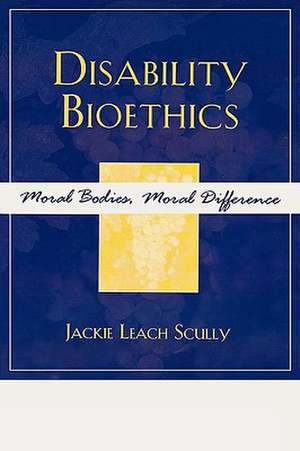
Disability Bioethics: Moral Bodies, Moral Difference: Feminist Constructions
Autor Jackie Leach Scullyen Limba Engleză Hardback – 15 aug 2008
Din seria Feminist Constructions
- 19%
 Preț: 312.75 lei
 - 19%
 Preț: 321.33 lei
 - 20%
 Preț: 320.17 lei
 - 23%
 Preț: 322.16 lei
 - 35%
 Preț: 346.61 lei
 - 19%
 Preț: 317.67 lei
 - 21%
 Preț: 306.46 lei
 - 24%
 Preț: 268.74 lei
 -
 Preț: 358.35 lei
 - 22%
 Preț: 317.88 lei
 - 23%
 Preț: 321.01 lei
 - 24%
 Preț: 351.71 lei
 - 19%
 Preț: 313.80 lei
 - 23%
 Preț: 322.99 lei
 - 22%
 Preț: 364.21 lei
 - 20%
 Preț: 314.50 lei
 - 52%
 Preț: 532.03 lei
Preț: 562.80 lei
Preț vechi: 863.10 lei
-35%
Puncte Express: 844
Carte tipărită la comandă
Livrare economică 18 noiembrie-02 decembrie
Livrare prin curier în România Termenul estimat este afișat lângă disponibilitate.
Transport gratuit pentru acest produs Plată online sau ramburs, în funcție de opțiunile comenzii.
Retur gratuit în 14 zile Comandă securizată și suport în română.
Specificații
ISBN-13: 9780742551220
ISBN-10: 0742551229
Pagini: 203
Dimensiuni: 160 x 232 x 20 mm
Greutate: 0.45 kg
Editura: Bloomsbury Publishing
Colecția Rowman & Littlefield
Seria Feminist Constructions
Locul publicării:New York, United States
ISBN-10: 0742551229
Pagini: 203
Dimensiuni: 160 x 232 x 20 mm
Greutate: 0.45 kg
Editura: Bloomsbury Publishing
Colecția Rowman & Littlefield
Seria Feminist Constructions
Locul publicării:New York, United States
Cuprins
Chapter 1 Chapter One: Bioethics and Embodied Difference
Chapter 2 Chapter Two: Conceptualizing Disability
Chapter 3 Chapter Three: Exploring Moral Understandings
Chapter 4 Chapter Four: Different by Choice?
Chapter 5 Chapter Five: Thinking Through the Variant Body
Chapter 6 Chapter Six: Narratives of Disability: Models and Mentors
Chapter 7 Chapter Seven: Political Recognition and Misrecognition
Chapter 8: All Clues and (some) Solutions
Chapter 2 Chapter Two: Conceptualizing Disability
Chapter 3 Chapter Three: Exploring Moral Understandings
Chapter 4 Chapter Four: Different by Choice?
Chapter 5 Chapter Five: Thinking Through the Variant Body
Chapter 6 Chapter Six: Narratives of Disability: Models and Mentors
Chapter 7 Chapter Seven: Political Recognition and Misrecognition
Chapter 8: All Clues and (some) Solutions
Recenzii
Disability Bioethics brings together important insights from disability studies, feminist theory, and bioethics to create an integrated, original analysis into a range of ethical questions that arise in the context of medical approaches to disabilities. Scully's expertise in diverse approaches to philosophy, biology, and feminist thought ensure careful and critical engagement with multiple approaches to the complex questions that surround the place of disabilities and people who are disabled in society, in medicine, and in science. The book moves questions concerning disabilities from the margins to the center of bioethics and makes clear how important it is that we understand how deeply assumptions about disability run in many current debates. Challenging the superficial treatment of ethical issues concerning disability that is prevalent in bioethics, Scully adopts the perspective of feminist disability ethics to show how important it is to begin bioethics from the reality of disabled lives.
In her wise, clear, and careful book, Jackie Leach Scully takes her place among the leaders of a second wave of disbility theory.
The detailed and reflective description of disability as a factor in shaping moral identity, and the consideration in the concluding chapters of the formation of groups with similar limitations as political or cultural communities, make this a unique and creative contribution to the moral issues of life with disabilities. This book will be valuable to professionals and individuals dealing practically with living in "different bodies." Very thorough bibliography and index. Highly recommended.
This book operates at the intersection of three debates: bioethics; biomedicine; and disability/Deaf studies. It is an excellent introduction for bioethicists and others who are unfamiliar with the challenge posed by disability studies. Not least because she is unafraid to deploy autobiography as part of her intellectual toolbox, Scully's personality comes through the pages of this book: accessible, thoughtful, with a dry wit. Scully is one of the deeper thinkers in contemporary disability studies, eschewing radical rhetoric in favor of detailed readings and carefully constructed arguments.
Both provocative and sound - a thoughtful exploration of the way(s) in which understanding disability illuminates our broad understanding of human biology and its processes, by a scholar with expertise in both fields.
In her wise, clear, and careful book, Jackie Leach Scully takes her place among the leaders of a second wave of disbility theory.
The detailed and reflective description of disability as a factor in shaping moral identity, and the consideration in the concluding chapters of the formation of groups with similar limitations as political or cultural communities, make this a unique and creative contribution to the moral issues of life with disabilities. This book will be valuable to professionals and individuals dealing practically with living in "different bodies." Very thorough bibliography and index. Highly recommended.
This book operates at the intersection of three debates: bioethics; biomedicine; and disability/Deaf studies. It is an excellent introduction for bioethicists and others who are unfamiliar with the challenge posed by disability studies. Not least because she is unafraid to deploy autobiography as part of her intellectual toolbox, Scully's personality comes through the pages of this book: accessible, thoughtful, with a dry wit. Scully is one of the deeper thinkers in contemporary disability studies, eschewing radical rhetoric in favor of detailed readings and carefully constructed arguments.
Both provocative and sound - a thoughtful exploration of the way(s) in which understanding disability illuminates our broad understanding of human biology and its processes, by a scholar with expertise in both fields.