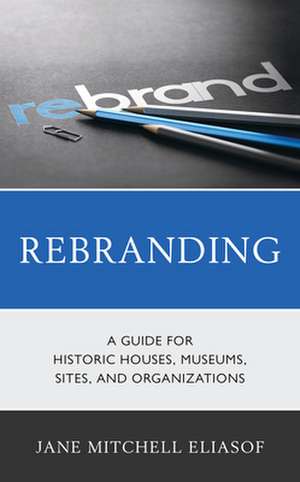
Rebranding: A Guide for Historic Houses, Museums, Sites, and Organizations: American Association for State and Local History
Autor Jane Mitchell Eliasofen Limba Engleză Paperback – 11 mar 2022
If you're part of the leadership team of a historic house museum or historical society, you may have considered rebranding -- either renaming your organization or developing a new look - to be more appealing to a younger, more diverse audience or to reflect changes to your mission, interpretation, site, etc.
Using examples from museums of all sizes across the country, this book helps you decide whether to move forward with a rebranding effort and give you a concrete outline to work from.
The book will help you:
Decide if you should rebrand (and that you're not just putting lipstick on a pig)Nitty-gritty details about how to go about itHow to react when someone says you're making a huge mistakeHow much it will cost and where you can cut corners How to evaluate what you've done.
Rebranding: A Guide forHistoric Houses, Museums, Sites and Organizations is a step-by-step guide that helps Executive Directors, Board members, and staff at history organizations decide if it's time to rebrand and, if so, how to go about it. The book will guide readers through the process of deciding if a rebranding is in order, testing ideas, developing a plan and budget, implementing the launch, and even handling naysayers. It's an essential guide for anyone rebranding a history organization.
Din seria American Association for State and Local History
- 33%
 Preț: 813.15 lei
 - 22%
 Preț: 209.66 lei
 - 22%
 Preț: 317.46 lei
 - 19%
 Preț: 316.09 lei
 - 11%
 Preț: 398.39 lei
 - 30%
 Preț: 355.61 lei
 - 19%
 Preț: 331.43 lei
 - 23%
 Preț: 286.27 lei
 - 24%
 Preț: 255.41 lei
 - 27%
 Preț: 501.00 lei
 - 25%
 Preț: 216.46 lei
 - 24%
 Preț: 254.02 lei
 - 19%
 Preț: 313.39 lei
 - 34%
 Preț: 951.06 lei
 - 19%
 Preț: 322.24 lei
 - 24%
 Preț: 384.05 lei
 - 31%
 Preț: 569.03 lei
 - 18%
 Preț: 334.84 lei
 - 24%
 Preț: 222.59 lei
 - 23%
 Preț: 282.98 lei
 -
 Preț: 421.53 lei
 - 21%
 Preț: 305.14 lei
 - 20%
 Preț: 373.68 lei
 - 30%
 Preț: 576.05 lei
 - 19%
 Preț: 323.58 lei
 - 25%
 Preț: 286.61 lei
 - 21%
 Preț: 365.17 lei
 - 23%
 Preț: 276.66 lei
 - 35%
 Preț: 619.19 lei
 - 31%
 Preț: 534.98 lei
 - 24%
 Preț: 255.02 lei
 - 31%
 Preț: 569.81 lei
 - 29%
 Preț: 522.70 lei
 - 19%
 Preț: 322.03 lei
 - 19%
 Preț: 322.16 lei
Preț: 219.09 lei
Preț vechi: 292.02 lei
-25%
Puncte Express: 329
Carte tipărită la comandă
Livrare economică 27 octombrie-10 noiembrie
Livrare prin curier în România Termenul estimat este afișat lângă disponibilitate.
Transport gratuit de la 400.00 lei Plată online sau ramburs, în funcție de opțiunile comenzii.
Retur gratuit în 14 zile Comandă securizată și suport în română.
Specificații
ISBN-13: 9781538148907
ISBN-10: 1538148900
Pagini: 192
Ilustrații: 52 b/w photos; 3 textboxes
Dimensiuni: 148 x 228 x 12 mm
Greutate: 0.25 kg
Editura: Bloomsbury Publishing
Colecția Rowman & Littlefield
Seria American Association for State and Local History
Locul publicării:New York, United States
ISBN-10: 1538148900
Pagini: 192
Ilustrații: 52 b/w photos; 3 textboxes
Dimensiuni: 148 x 228 x 12 mm
Greutate: 0.25 kg
Editura: Bloomsbury Publishing
Colecția Rowman & Littlefield
Seria American Association for State and Local History
Locul publicării:New York, United States
Cuprins
Preface
Chapter 1: Meet the Thirteen History Organizations
Chapter 2: Why they Rebranded
Chapter 3: Testing the Water
Chapter 4: Making it Legal
Chapter 5: The Design Process
Chapter 6: Implementing the Launch
Chapter 7: How Much will it Cost?
Chapter 8: The Naysayers
Chapter 9: Success
Appendix: Short Summaries of the History Organizations
Chapter 1: Meet the Thirteen History Organizations
Chapter 2: Why they Rebranded
Chapter 3: Testing the Water
Chapter 4: Making it Legal
Chapter 5: The Design Process
Chapter 6: Implementing the Launch
Chapter 7: How Much will it Cost?
Chapter 8: The Naysayers
Chapter 9: Success
Appendix: Short Summaries of the History Organizations
Recenzii
If you are associated with a history organization that chafes against an outdated name, you need this book. The wide range of case studies - statewide organizations, local societies, regional museums - translates to a knowledge base that is relevant to virtual every situation. It will guide you through the exciting, fun, and creative steps at the start of the process right through budgeting and dealing with naysayers.
Eliasof offers relevant case studies and a practical accounting of rebranding processes for museum leaders who may have limited experience with these concepts. In doing so, Eliasof explores the issues many museums are tackling: mission and identity, leadership and governance, sustainability and relevance, inclusive storytelling, and community engagement. This handbook will be useful to anyone involved in rebranding, or those teaching or studying museum theory and practice.
I wish I had this book when I was rebranding the museum I ran! Jane Mitchell Eliasof has created at indispensable guide on how history museums and sites of all sizes can effectively rebrand. What I like so much about this publication is the fact that it is practical, bringing together the cumulative experience of thirteen museum leaders, mainly of smaller history organizations to lay out systematically how museums can successfully rebrand. The author devotes chapters to the why and how of rebranding, the costs associated with it, the design process then, launching the rebrand. One chapter of this very accessible book is on the legal aspects involved. Each ends with a set of questions to help your institution in the process. The author and the leaders she interviewed show there is distinct process to follow but demonstrates how this can be scaled to the size of your institution. The author and those interviewed do not shy away from problems encountered along the way, giving us all lessons to learn.
Eliasof offers relevant case studies and a practical accounting of rebranding processes for museum leaders who may have limited experience with these concepts. In doing so, Eliasof explores the issues many museums are tackling: mission and identity, leadership and governance, sustainability and relevance, inclusive storytelling, and community engagement. This handbook will be useful to anyone involved in rebranding, or those teaching or studying museum theory and practice.
I wish I had this book when I was rebranding the museum I ran! Jane Mitchell Eliasof has created at indispensable guide on how history museums and sites of all sizes can effectively rebrand. What I like so much about this publication is the fact that it is practical, bringing together the cumulative experience of thirteen museum leaders, mainly of smaller history organizations to lay out systematically how museums can successfully rebrand. The author devotes chapters to the why and how of rebranding, the costs associated with it, the design process then, launching the rebrand. One chapter of this very accessible book is on the legal aspects involved. Each ends with a set of questions to help your institution in the process. The author and the leaders she interviewed show there is distinct process to follow but demonstrates how this can be scaled to the size of your institution. The author and those interviewed do not shy away from problems encountered along the way, giving us all lessons to learn.