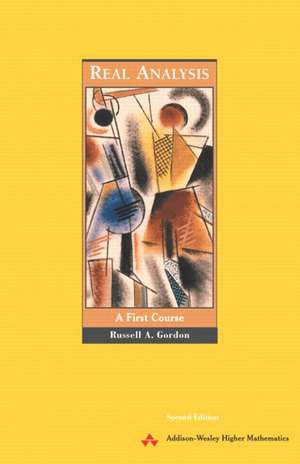
Real Analysis: A First Course: Featured Titles for Real Analysis
Autor Russell A. Gordonen Limba Engleză Paperback – 31 mai 2001
Preț: 923.83 lei
Preț vechi: 1199.78 lei
-23%
Puncte Express: 1386
Carte tipărită la comandă
Livrare economică 17 iunie-01 iulie
Specificații
ISBN-13: 9780201437270
ISBN-10: 0201437279
Pagini: 400
Dimensiuni: 156 x 231 x 20 mm
Greutate: 0.66 kg
Ediția:Nouă
Editura: Pearson
Seria Featured Titles for Real Analysis
Locul publicării:Upper Saddle River, United States
ISBN-10: 0201437279
Pagini: 400
Dimensiuni: 156 x 231 x 20 mm
Greutate: 0.66 kg
Ediția:Nouă
Editura: Pearson
Seria Featured Titles for Real Analysis
Locul publicării:Upper Saddle River, United States
V-ar putea interesa
-
 A Course in Real AnalysisJohn N. McDonald-32%Preț: 422.58 lei621.11 lei
 -
 Products of GroupsBernhard Amberg-34%Preț: 573.18 lei863.12 lei
 -
 How to Think About AnalysisLara Alcock-18%Preț: 151.07 lei184.14 lei
 -
 Introduction to Metric and Topological SpacesWilson A Sutherland-13%Preț: 332.83 lei380.75 lei
 -
 Limits, Limits Everywhere: The Tools of Mathematical AnalysisDavid Applebaum-14%Preț: 265.98 lei311.02 lei
 -
 Real AnalysisN. L. Carothers-19%Preț: 439.30 lei542.35 lei
 -
 DistributionsJ J Duistermaat-15%Preț: 578.42 lei680.50 lei
 -
 Real Analysis Through Modern InfinitesimalsNader Vakil-14%Preț: 1165.63 lei1355.39 lei
 -
 Lectures on Real AnalysisFinnur LárussonPreț: 400.80 lei
 -
 Preț: 408.92 lei
 -
 -11%Preț: 520.65 lei584.99 lei
 -
 A Problem Book in Real AnalysisAsuman G. Aksoy-8%Preț: 465.40 lei505.87 lei
 -
 A First Course in Real AnalysisMurray H. Protter-15%Preț: 441.92 lei519.91 lei
 -
 Elementary AnalysisKenneth A. RossPreț: 375.02 lei
 -
 Real AnalysisJohn M. HowiePreț: 346.04 lei
 -
 Sobolev SpacesVladimir Maz'ya-18%Preț: 1089.74 lei1328.95 lei
Descriere
Real Analysis, 2/e is a carefully worded narrative that presents the ideas of elementary real analysis while keeping the perspective of a student in mind. The order and flow of topics has been preserved, but the sections have been reorganized somewhat so that related ideas are grouped together better. A few additional topics have been added; most notably, functions of bounded variation, convex function, numerical methods of integration, and metric spaces. The biggest change is the number of exercises; there are now more than 1600 exercises in the text.
Cuprins
1. Real Numbers.
What Is a Real Number?Absolute Value, Intervals, and Inequalities.The Completeness Axiom.Countable and Uncountable Sets.Real-Valued Functions.
2. Sequences.
Convergent Sequences.Monotone Sequences and Cauchy Sequences.Subsequences.Supplementary Exercises.
3. Limits and Continuity.
The Limit of a Function.Continuous Functions.Intermediate and Extreme Values.Uniform Continuity.Monotone Functions.Supplementary Exercises.
4. Differentiation.
The Derivative of a Function.The Mean Value Theorem.Further Topics on Differentiation.Supplementary Exercises.
5. Integration.
The Riemann Integral.Conditions for Riemann Integrability.The Fundamental Theorem of Calculus.Further Properties of the Integral.Numerical Integration.Supplementary Exercises.
6. Infinite Series.
Convergence of Infinite Series.The Comparison Tests.Absolute Convergence.Rearrangements and Products.Supplementary Exercises.
7. Sequences and Series of Functions.
Pointwise Convergence.Uniform Convergence.Uniform Convergence and Inherited Properties.Power Series.Taylor's Formula.Several Miscellaneous Results.Supplementary Exercises.
8. Point-Set Topology.
Open and Closed Sets.Compact Sets.Continuous Functions.Miscellaneous Results.Metric Spaces.
Appendix A. Mathematical Logic.
Mathematical Theories.Statements and Connectives.Open Statements and Quantifiers.Conditional Statements and Quantifiers.Negation of Quantified Statements.Sample Proofs.Some Words of Advice.
Appendix B. Sets and Functions.
Sets.Functions.
Appendix C. Mathematical Induction.
Three Equivalent Statements.The Principle of Mathematical Induction.The Principle of Strong Induction.The Well-Ordering Property.Some Comments on Induction Arguments.
Bibliography.
Index.
Caracteristici
- Introductory material, such as the study of sets, functions, relations, and mathematical induction has been kept to a minimum and is presented in context for students to acquire a working knowledge. The three appendices go into more depth with introductory material, without bogging down the course.
- Focus of the text is on the basic notation of real analysis. Peripheral material has been kept to a minimum to avoid overwhelming students with too much information.
- Topological concepts, omitted from the main body of the text, are presented in a separate chapter at the end of the text for the benefit of students going on in mathematics. Although topological concepts are necessary in Rn, Gordon motivates the introduction of topology in R using questions and problems.
- The Riemann approach to the integral is carried out in detail. This approach is used exclusively, as it provides a consistent definition of the integral and is in keeping with the integral as it is usually defined in calculus.
- Gordon carefully words and presents proofs, so they are clear and understandable to the students. Parts of some proofs are left as exercises, so that students must participate in the development of the material.