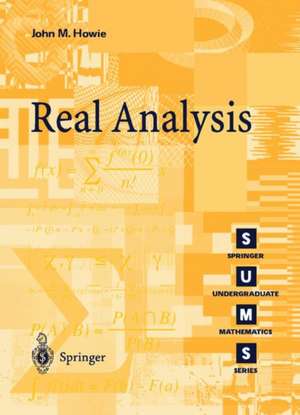
Real Analysis: Springer Undergraduate Mathematics Series
Autor John M. Howieen Limba Engleză Paperback – 28 mar 2001
Găsim în această lucrare, Real Analysis, o abordare pedagogică echilibrată care recunoaște o realitate pragmatică a învățământului universitar: rigoarea analizei matematice este mai ușor de asimilat după ce studentul și-a format deja o intuiție practică prin cursurile de calcul diferențial și integral. Autorul John M. Howie structurează materia începând cu fundamentele necesare — limbajul teoriei mulțimilor și conceptul de număr — oferind astfel cadrul logic pentru temele complexe ce urmează. Cartea parcurge sistematic analiza pe o singură variabilă, de la convergența șirurilor și seriilor (Capitolul 2), la continuitatea funcțiilor și derivabilitate. Un punct central este tratamentul acordat integralei Riemann în Capitolul 5, unde sunt explorate clasele de funcții integrabile și Teorema Fundamentală a Calculului. Această ediție din Springer Undergraduate Mathematics Series extinde cadrul propus de Fundamental Mathematical Analysis de Robert Magnus prin faptul că pune un accent deosebit pe tranziția graduală de la calculul informal la demonstrația riguroasă, fiind adaptată specific studenților care întâlnesc pentru prima dată conceptele de limită sau continuitate uniformă. În contextul operei sale, John M. Howie demonstrează aceeași claritate a expunerii pe care o regăsim și în Complex Analysis. Dacă în lucrările sale despre semigrupuri, precum Fundamentals of Semigroup Theory, abordarea este una extrem de specializată, aici autorul reușește să democratizeze rigoarea matematică. Structura este una clasică, dar progresia este calibrată pentru a evita dificultățile insuportabile de care se lovesc începătorii, oferind o punte solidă între intuiția de liceu și formalismul universitar.
Din seria Springer Undergraduate Mathematics Series
-
 Preț: 333.42 lei
 -
 Preț: 373.88 lei
 -
 Preț: 413.31 lei
 -
 Preț: 366.50 lei
 -
 Preț: 265.98 lei
 -
 Preț: 414.81 lei
 - 13%
 Preț: 403.14 lei
 - 20%
 Preț: 374.59 lei
 -
 Preț: 383.13 lei
 -
 Preț: 422.57 lei
 -
 Preț: 390.50 lei
 -
 Preț: 404.72 lei
 -
 Preț: 400.74 lei
 -
 Preț: 438.54 lei
 -
 Preț: 368.16 lei
 -
 Preț: 282.72 lei
 -
 Preț: 301.31 lei
 -
 Preț: 261.80 lei
 -
 Preț: 269.23 lei
 -
 Preț: 267.01 lei
 -
 Preț: 267.95 lei
 -
 Preț: 362.56 lei
 -
 Preț: 270.56 lei
 -
 Preț: 276.73 lei
 -
 Preț: 278.40 lei
 -
 Preț: 273.62 lei
 -
 Preț: 353.46 lei
 -
 Preț: 271.48 lei
 - 15%
 Preț: 506.44 lei
 -
 Preț: 282.17 lei
 -
 Preț: 265.85 lei
 -
 Preț: 275.65 lei
 -
 Preț: 280.67 lei
 -
 Preț: 259.16 lei
 -
 Preț: 274.44 lei
 -
 Preț: 323.68 lei
 -
 Preț: 281.19 lei
 -
 Preț: 281.87 lei
 -
 Preț: 272.46 lei
 -
 Preț: 265.55 lei
 -
 Preț: 276.32 lei
 -
 Preț: 271.25 lei
 -
 Preț: 254.58 lei
 -
 Preț: 267.93 lei
 -
 Preț: 260.53 lei
 -
 Preț: 356.95 lei
 -
 Preț: 257.69 lei
 -
 Preț: 254.70 lei
 -
 Preț: 270.73 lei
 -
 Preț: 266.17 lei
Preț: 359.53 lei
Carte tipărită la comandă
Livrare economică 25 noiembrie-09 decembrie
Specificații
ISBN-10: 1852333146
Pagini: 288
Ilustrații: X, 276 p. 13 illus.
Dimensiuni: 170 x 244 x 16 mm
Greutate: 0.5 kg
Ediția:2001
Editura: Springer
Colecția Springer Undergraduate Mathematics Series
Seria Springer Undergraduate Mathematics Series
Locul publicării:London, United Kingdom
V-ar putea interesa
-
 Fundamentals of Semigroup TheoryJohn M. Howie-38%Preț: 1109.49 lei1791.12 lei
 -
 Automata and LanguagesJohn M. Howie-35%Preț: 339.47 lei520.04 lei
 -
 Introduction to Metric and Topological SpacesWilson A Sutherland-11%Preț: 374.36 lei420.86 lei
 -
 -16%Preț: 656.32 lei781.33 lei
 -
 -9%Preț: 1109.69 lei1219.43 lei
 -
 Multivariable AnalysisSatish Shirali-15%Preț: 478.68 lei563.15 lei
 -
 Complex AnalysisIan StewartPreț: 334.23 lei
 -
 Fourier Restriction, Decoupling, and ApplicationsCiprian Demeter-11%Preț: 457.44 lei513.99 lei
 -
 -18%Preț: 964.16 lei1175.80 lei
 -
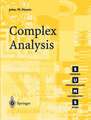
 Complex AnalysisJohn M. HowiePreț: 282.72 lei
 -
 Calculus of One VariableK. E. HirstPreț: 262.55 lei
 -
 Fields and Galois TheoryJohn M HowiePreț: 269.87 lei
 -
 Introduction to Mathematical AnalysisIgor Kriz-15%Preț: 546.00 lei642.35 lei
 -
 Real AnalysisPeter A. LoebPreț: 476.93 lei
 -
 -18%Preț: 1474.35 lei1797.99 lei
 -
 Real Analysis and ApplicationsFabio Silva Botelho-15%Preț: 416.64 lei490.16 lei
 -
 Number Systems: Constructions and PropertiesInder K. Rana-15%Preț: 442.37 lei520.43 lei
 -
 SEMIGROUPS OF MATRICES (V6)Okninski Jan-15%Preț: 559.35 lei658.06 lei
 -
 PARTIALLY ORDERED GROUPS (V7)Glass A M WPreț: 473.67 lei
 -
 INTRODUCTION TO ANALYSIS, ANMikusinski Piotr-15%Preț: 529.24 lei622.63 lei
Public țintă
Lower undergraduateDe ce să citești această carte
Recomandăm această carte studenților la matematică sau informatică aflați în primii ani de studiu. Real Analysis oferă o claritate rară în explicarea conceptelor abstracte, făcând trecerea de la simplul calcul la demonstrația matematică riguroasă. Cititorul câștigă o bază teoretică solidă, necesară pentru orice curs avansat de analiză sau analiză complexă, beneficiind de experiența pedagogică a lui John M. Howie.