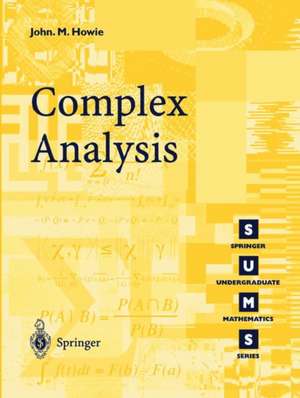
Complex Analysis: Springer Undergraduate Mathematics Series
Autor John M. Howieen Limba Engleză Paperback – 28 mai 2003
În cadrul programului de studiu al matematicii la nivel de licență, analiza complexă reprezintă unul dintre pilonii centrali, făcând trecerea de la calculul elementar la structuri teoretice profunde. Considerăm că volumul Complex Analysis de John M. Howie, publicat de Springer, reușește să echilibreze rigoarea matematică pură cu necesitățile aplicate ale studenților din inginerie și fizică. Această abordare didactică este facilitată de experiența autorului, a cărui lucrare anterioară, Real Analysis, stabilea deja un standard de claritate în expunerea fundamentelor logice ale analizei. Structura cărții este metodică, începând cu o secțiune utilă de recapitulare a cunoștințelor prealabile — de la teoria mulțimilor la calculul de mai multe variabile — asigurând astfel o bază solidă pentru noțiunile noi. Progresia narativă ne poartă prin proprietățile numerelor complexe, diferențiabilitate și integrare complexă, culminând cu Teorema lui Cauchy și consecințele sale. Cititorii familiarizați cu A First Course in Complex Analysis de Allan R. Willms vor aprecia aici includerea unor teme moderne și fascinante în finalul volumului, precum Ipoteza Riemann și o descriere a fractalilor prin mulțimile Julia și Mandelbrot. Subliniem importanța celor peste 100 de exerciții care însoțesc textul; faptul că John M. Howie oferă soluții complete transformă această ediție într-un instrument ideal pentru studiul individual. Stilul scriiturii este precis, evitând jargonul inutil și concentrându-se pe clarificarea punctelor de ramificație și a singularităților, elemente care adesea ridică dificultăți studenților aflați la primul contact cu această disciplină.
Din seria Springer Undergraduate Mathematics Series
-
 Preț: 366.50 lei
 -
 Preț: 400.74 lei
 -
 Preț: 413.31 lei
 -
 Preț: 414.81 lei
 -
 Preț: 422.57 lei
 -
 Preț: 390.50 lei
 -
 Preț: 383.13 lei
 - 20%
 Preț: 374.59 lei
 -
 Preț: 373.88 lei
 -
 Preț: 339.27 lei
 -
 Preț: 465.31 lei
 -
 Preț: 404.72 lei
 -
 Preț: 368.16 lei
 -
 Preț: 306.67 lei
 -
 Preț: 261.80 lei
 -
 Preț: 269.23 lei
 -
 Preț: 267.01 lei
 -
 Preț: 267.95 lei
 -
 Preț: 362.56 lei
 -
 Preț: 270.56 lei
 -
 Preț: 276.73 lei
 -
 Preț: 278.40 lei
 -
 Preț: 273.62 lei
 -
 Preț: 254.58 lei
 -
 Preț: 267.93 lei
 -
 Preț: 260.53 lei
 -
 Preț: 318.36 lei
 -
 Preț: 353.46 lei
 -
 Preț: 271.48 lei
 - 15%
 Preț: 506.44 lei
 -
 Preț: 282.17 lei
 -
 Preț: 265.85 lei
 -
 Preț: 275.65 lei
 -
 Preț: 280.67 lei
 -
 Preț: 272.15 lei
 -
 Preț: 274.44 lei
 -
 Preț: 323.68 lei
 -
 Preț: 281.19 lei
 -
 Preț: 281.87 lei
 -
 Preț: 272.46 lei
 -
 Preț: 270.03 lei
 -
 Preț: 271.25 lei
 -
 Preț: 276.32 lei
 -
 Preț: 257.69 lei
 -
 Preț: 254.70 lei
 -
 Preț: 270.73 lei
 -
 Preț: 270.64 lei
 -
 Preț: 360.36 lei
 -
 Preț: 277.36 lei
Preț: 282.72 lei
Carte tipărită la comandă
Livrare economică 07-21 decembrie
Specificații
ISBN-10: 1852337338
Pagini: 272
Ilustrații: XI, 260 p.
Dimensiuni: 178 x 254 x 15 mm
Greutate: 0.52 kg
Ediția:2003
Editura: Springer
Colecția Springer Undergraduate Mathematics Series
Seria Springer Undergraduate Mathematics Series
Locul publicării:London, United Kingdom
V-ar putea interesa
-
 Fundamentals of Semigroup TheoryJohn M. Howie-38%Preț: 1109.49 lei1791.12 lei
 -
 Riemann SurfacesSimon Donaldson-33%Preț: 820.82 lei1219.67 lei
 -
 Automata and LanguagesJohn M. Howie-35%Preț: 339.47 lei520.04 lei
 -
 Riemann SurfacesSimon Donaldson-21%Preț: 373.46 lei473.87 lei
 -
 Geometry of Complex NumbersHans SchwerdtfegerPreț: 91.15 lei
 -
 Harmonic Analysis of Operators on Hilbert SpaceBéla Sz Nagy-15%Preț: 539.82 lei635.08 lei
 -
 Complex Analysis on Infinite Dimensional SpacesSean DineenPreț: 388.59 lei
 -
 -18%Preț: 773.31 lei943.07 lei
 -
 Real AnalysisJohn M. HowiePreț: 359.53 lei
 -
 Variable Lebesgue SpacesDavid V. Cruz-Uribe-24%Preț: 594.27 lei784.81 lei
 -
 Pseudo-Differential Operators, Generalized Functions and AsymptoticsShahla Molahajloo-15%Preț: 674.21 lei793.19 lei
 -
 Classical and Stochastic Laplacian GrowthBjörn GustafssonPreț: 411.26 lei
 -
 Lectures on Several Complex VariablesPaul M. Gauthier-15%Preț: 542.88 lei638.68 lei
 -
 Preț: 392.46 lei
 -
 Several Complex Variables IIIG. M. KhenkinPreț: 373.77 lei
 -
 Analytische StellenalgebrenHans GrauertPreț: 487.62 lei
 -
 Entire Functions of Several Complex VariablesPierre Lelong-15%Preț: 559.07 lei657.73 lei
 -
 -18%Preț: 766.12 lei934.30 lei
 -
 Harmonic Analysis on Exponential Solvable Lie GroupsHidenori Fujiwara-15%Preț: 679.69 lei799.63 lei
 -
 SEMIGROUPS OF MATRICES (V6)Okninski Jan-15%Preț: 577.63 lei679.56 lei
 -
 PARTIALLY ORDERED GROUPS (V7)Glass A M WPreț: 473.67 lei
 -
 Preț: 404.88 lei
Public țintă
Lower undergraduateDe ce să citești această carte
Recomandăm această carte oricărui student la matematică sau inginerie care caută o introducere clară și bine structurată în analiza complexă. Câștigul principal al cititorului este accesul la explicații pas cu pas și la un set generos de probleme rezolvate, esențiale pentru fixarea conceptelor. Este un ghid de încredere care demistifică teoremele complexe, oferind în același timp o deschidere spre probleme celebre nerezolvate ale matematicii.
Descriere scurtă
Cuprins
Recenzii
Howie's book is a gem. I want to use it the next time I teach complex analysis. Not only do Howie's selection of topics and their sequence correspond perfectly to what I believe to be the ideal approach to this gorgeous subject, the writing style is (again) wonderful...I think this is a terrific book. I'm going to use it the first chance I get. And I recommend it very, very highly.
MAA Online
Howie has written an outstanding book on complex variables...The readability of the book is improved by more than 80 figures and numerous examples. Also included are 140 exercises with complete solutions in an appendix. All this makes the book ideal for self-study. Summing up: Highly recommended.
CHOICE
"This book provides a self-study text for students in mathematics, science and engineering. It covers all the topics likely to feature in a first course in complex analysis up to Laurent series, the residue theorem and conformal mappings. … Many carefully worked examples and more than 100 exercises with solutions make the book a valuable contribution to the extensive literature on complex analysis." (F.Haslinger, Monatshefte für Mathematik, Vol. 143 (2), 2004)
"This is a superbly well-written, balanced introduction to complex analysis that will meet the needs of a wide range of undergraduates. … Here, page after page, I found myself nodding in agreement with the choices that the author has made ... . ‘Of all the many introductions to complex analysis, Howie’s is arguably the most attractive’." (Nick Lord, The Mathematical Gazette, Vol. 88 (512), 2004)
"This book takes account of the varying needs and backgrounds and provides a self-study text for students in mathematics, science and engineering. ... Clear and careful explanations are backed up with worked examples and more than 100 exercises, for which full solutions are provided." (L'ENSEIGNEMENT MATHEMATIQUE, Vol. 49 (3-4),2003)
"Howie … has written an outstanding book on complex variables. … The readability of the book is improved by more than 80 figures and numerous examples. Also included are 140 exercises with complete solutions in an appendix. All this make the book ideal for self-study. Summing Up: Highly recommended." (D.P.Turner, CHOICE, December, 2003)