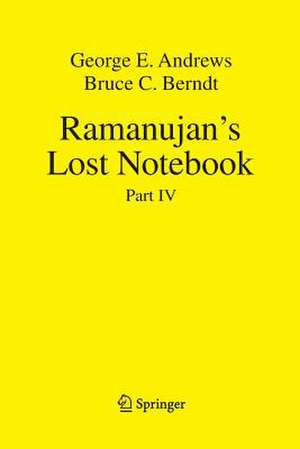
Ramanujan's Lost Notebook
Autor George E. Andrews, Bruce C. Berndten Limba Engleză Paperback – 7 iul 2015
This volume is the fourth of five volumes that the authors plan to write on Ramanujan’s lost notebook. In contrast to the first three books on Ramanujan's Lost Notebook, the fourth book does not focus on q-series. Most of the entries examined in this volume fall under the purviews of number theory and classical analysis. Several incomplete manuscripts of Ramanujan published by Narosa with the lost notebook are discussed. Three of the partial manuscripts are on diophantine approximation, and others are in classical Fourier analysisand prime number theory. Most of the entries in number theory fall under the umbrella of classical analytic number theory. Perhaps the most intriguing entries are connected with the classical, unsolved circle and divisor problems.
Review from the second volume:
"Fans of Ramanujan's mathematics are sure to be delighted by this book. While some of the content is taken directly from published papers, most chapters contain new material and some previously published proofs have been improved. Many entries are just begging for further study and will undoubtedly be inspiring research for decades to come. The next installment in this series is eagerly awaited."
- MathSciNet
Review from the first volume:
"Andrews and Berndt are to be congratulated on the job they are doing. This is the first step...on the way to an understanding of the work of the genius Ramanujan. It should act as an inspiration to future generations of mathematicians to tackle a job that willnever be complete."
- Gazette of the Australian Mathematical Society
Preț: 907.95 lei
Preț vechi: 1107.25 lei
-18%
Puncte Express: 1362
Carte tipărită la comandă
Livrare economică 07-21 decembrie
Livrare prin curier în România Termenul estimat este afișat lângă disponibilitate.
Transport gratuit pentru acest produs Plată online sau ramburs, în funcție de opțiunile comenzii.
Retur gratuit în 14 zile Comandă securizată și suport în română.
Specificații
ISBN-13: 9781489991751
ISBN-10: 1489991751
Pagini: 460
Ilustrații: XVII, 439 p.
Dimensiuni: 155 x 235 x 25 mm
Greutate: 0.69 kg
Ediția:2013
Editura: Springer
Locul publicării:New York, NY, United States
ISBN-10: 1489991751
Pagini: 460
Ilustrații: XVII, 439 p.
Dimensiuni: 155 x 235 x 25 mm
Greutate: 0.69 kg
Ediția:2013
Editura: Springer
Locul publicării:New York, NY, United States
V-ar putea interesa
-
 EASY LEARN MENTAL MAT AGE 7-9Collins Easy LearningPreț: 30.74 lei
 -
 Collins Easy Learning Age 7-11 -- Multiplication and Division Ages 7-9: New EditionCollins Easy LearningPreț: 31.04 lei
 -
 Addition and Subtraction Workbook Ages 5-7Collins Easy LearningPreț: 31.29 lei
 -
 Mental Maths Ages 5-7Collins Easy LearningPreț: 30.64 lei
 -
 Collins Easy Learning Age 5-7 -- Multiplication and Division Ages 5-7: New EditionCollins Easy LearningPreț: 31.20 lei
 -
 Fractions Ages 5-7Collins Easy LearningPreț: 30.88 lei
 -
 Fractions and Decimals Ages 7-9Collins Easy LearningPreț: 30.86 lei
 -
 -32%Preț: 1012.02 lei1482.38 lei
 -
 A First Course in Modular FormsFred Diamond-15%Preț: 408.44 lei480.51 lei
 -
 Modular Forms and Fermat's Last TheoremGary Cornell-15%Preț: 660.14 lei776.63 lei
 -
 Gauss and Jacobi SumsBruce C Berndt-9%Preț: 1328.64 lei1460.04 lei
 -
 Math Workbook for Foodservice / LodgingMilton C McDowell-8%Preț: 433.04 lei470.70 lei
 -
 -14%Preț: 917.81 lei1067.22 lei
 -
 Preț: 434.55 lei
 -
 -23%Preț: 604.86 lei785.54 lei
 -
 Problem-Solving and Selected Topics in Number TheoryMichael Th Rassias-15%Preț: 537.34 lei632.17 lei
 -
 Right-Brained Addition & SubtractionSarah MajorPreț: 291.00 lei
Public țintă
ResearchCuprins
Preface.- 1 Introduction.- 2 Double Series of Bessel Functions and the Circle and Divisor Problems.- 3 Koshliakov's Formula and Guinand's Formula.- 4 Theorems Featuring the Gamma Function.- 5 Hypergeometric Series.- 6 Euler's Constant.- 7 Problems in Diophantine Approximation.- 8 Number Theory.- 9 Divisor Sums.- 10 Identities Related to the Riemann Zeta Function and Periodic Zeta Functions.- 11 Two Partial Unpublished Manuscripts on Sums Involving Primes.- 12 Infinite Series.- 13 A Partial Manuscript on Fourier and Laplace Transforms.- 14 Integral Analogues of Theta Functions adn Gauss Sums.- 15 Functional Equations for Products of Mellin Transforms.- 16 Infinite Products.- 17 A Preliminary Version of Ramanujan's Paper, On the Integral ∫_0^x tan^(-1)t)/t dt.- 18 A Partial Manuscript Connected with Ramanujan's Paper, Some Definite Integrals.- 19 Miscellaneous Results in Analysis.- 20 Elementary Results.- 21 A Strange, Enigmatic Partial Manuscript.- Location Guide.- Provenance.- References.- Index.
Notă biografică
George E. Andrews is currently a professor of mathematics at Pennsylvania State University. Bruce C. Berndt is currently a professor of mathematics at the University of Illinois.
Textul de pe ultima copertă
In the spring of 1976, George Andrews of Pennsylvania State University visited the library at Trinity College, Cambridge, to examine the papers of the late G.N. Watson. Among these papers, Andrews discovered a sheaf of 138 pages in the handwriting of Srinivasa Ramanujan. This manuscript was soon designated, "Ramanujan's lost notebook." Its discovery has frequently been deemed the mathematical equivalent of finding Beethoven's tenth symphony.
This volume is the fourth of five volumes that the authors plan to write on Ramanujan’s lost notebook. In contrast to the first three books on Ramanujan's Lost Notebook, the fourth book does not focus on q-series. Most of the entries examined in this volume fall under the purviews of number theory and classical analysis. Several incomplete manuscripts of Ramanujan published by Narosa with the lost notebook are discussed. Three of the partial manuscripts are on diophantine approximation, and others are in classical Fourier analysisand prime number theory. Most of the entries in number theory fall under the umbrella of classical analytic number theory. Perhaps the most intriguing entries are connected with the classical, unsolved circle and divisor problems.
Review from the second volume:
"Fans of Ramanujan's mathematics are sure to be delighted by this book. While some of the content is taken directly from published papers, most chapters contain new material and some previously published proofs have been improved. Many entries are just begging for further study and will undoubtedly be inspiring research for decades to come. The next installment in this series is eagerly awaited."
- MathSciNet
Review from the first volume:
"Andrews and Berndt are to be congratulated on the job they are doing. This is the first step...on the way to an understanding of the work of the genius Ramanujan. It should act as an inspiration to future generations of mathematicians to tackle a job that willnever be complete."
- Gazette of the Australian Mathematical Society
This volume is the fourth of five volumes that the authors plan to write on Ramanujan’s lost notebook. In contrast to the first three books on Ramanujan's Lost Notebook, the fourth book does not focus on q-series. Most of the entries examined in this volume fall under the purviews of number theory and classical analysis. Several incomplete manuscripts of Ramanujan published by Narosa with the lost notebook are discussed. Three of the partial manuscripts are on diophantine approximation, and others are in classical Fourier analysisand prime number theory. Most of the entries in number theory fall under the umbrella of classical analytic number theory. Perhaps the most intriguing entries are connected with the classical, unsolved circle and divisor problems.
Review from the second volume:
"Fans of Ramanujan's mathematics are sure to be delighted by this book. While some of the content is taken directly from published papers, most chapters contain new material and some previously published proofs have been improved. Many entries are just begging for further study and will undoubtedly be inspiring research for decades to come. The next installment in this series is eagerly awaited."
- MathSciNet
Review from the first volume:
"Andrews and Berndt are to be congratulated on the job they are doing. This is the first step...on the way to an understanding of the work of the genius Ramanujan. It should act as an inspiration to future generations of mathematicians to tackle a job that willnever be complete."
- Gazette of the Australian Mathematical Society
Caracteristici
Fourth volume of a series of five volumes including some of Ramanujan's deepest work in the last year of his life Contains material of which mathematicians currently lack a complete understanding Focuses on claims in classical analysis and classical analytic number theory found in "The Lost Notebook and Other Unpublished Papers" Two key results show that Ramanujan had a strong interest in the classical circle and divisor problems Although Ramanujan never published any papers in diophantine approximation, three of the partial manuscripts are on this subject Includes supplementary material: sn.pub/extras
Descriere
Descriere de la o altă ediție sau format:
This is the second of approximately four volumes that the authors plan to write in their examination of all the claims made by S. Ramanujan in The Lost Notebook and Other Unpublished Papers. This volume, published by Narosa in 1988, contains the “Lost Notebook,” which was discovered by the ?rst author in the spring of 1976 at the library of Trinity College, Cambridge. Also included in this publication are other partial manuscripts, fragments, and letters that Ramanujan wrote to G. H. Hardy from nursing homes during 1917–1919. The authors have attempted to organize this disparate material in chapters. This second volume contains 16 chapters comprising 314 entries, including some duplications and examples, with chapter totals ranging from a high of ?fty-four entries in Chapter 1 to a low of two entries in Chapter 12. Contents Preface . . . . . . . . . . . . . . . . . . . . . . . . . . . . . . . . . . . . . . . . . . . . . . . . . . . . . . . . vii Introduction . . . . . . . . . . . . . . . . . . . . . . . . . . . . . . . . . . . . . . . . . . . . . . . . . . . 1 1 The Heine Transformation . . . . . . . . . . . . . . . . . . . . . . . . . . . . . . . . . 5 1. 1 Introduction . . . . . . . . . . . . . . . . . . . . . . . . . . . . . . . . . . . . . . . . . . . 5 1. 2 Heine’s Method . . . . . . . . . . . . . . . . . . . . . . . . . . . . . . . . . . . . . . . . . 6 1. 3 Ramanujan’s Proof of the q-Gauss Summation Theorem . . . . . 10 1. 4 Corollaries of (1. 2. 1) and (1. 2. 5) . . . . . . . . . . . . . . . . . . . . . . . . . . 14 1. 5 Corollaries of (1. 2. 6) and (1. 2. 7) . . . . . . . . . . . . . . . . . . . . . . . . . . 22 1. 6 Corollaries of (1. 2. 8), (1. 2. 9), and (1. 2. 10) . . . . . . . . . . . . . . . . . . 24 1. 7 Corollaries of Section 1. 2 and Auxiliary Results . . . . . . . . . . . . . 27 2 The Sears–Thomae Transformation . . . . . . . . . . . . . . . . . . . . . . . . 45 2. 1 Introduction . . . . . . . . . . . . . . . . . . . . . . . . . . . . . . . . . . . . . . . . . . . 45 2. 2 Direct Corollaries of (2. 1. 1) and (2. 1. 3) . . . . . . . . . . . . . . . . . . . . 45 2. 3 Extended Corollaries of (2. 1. 1) and (2. 1. 3) . . . . . . . . . . . . . . . . .
This is the second of approximately four volumes that the authors plan to write in their examination of all the claims made by S. Ramanujan in The Lost Notebook and Other Unpublished Papers. This volume, published by Narosa in 1988, contains the “Lost Notebook,” which was discovered by the ?rst author in the spring of 1976 at the library of Trinity College, Cambridge. Also included in this publication are other partial manuscripts, fragments, and letters that Ramanujan wrote to G. H. Hardy from nursing homes during 1917–1919. The authors have attempted to organize this disparate material in chapters. This second volume contains 16 chapters comprising 314 entries, including some duplications and examples, with chapter totals ranging from a high of ?fty-four entries in Chapter 1 to a low of two entries in Chapter 12. Contents Preface . . . . . . . . . . . . . . . . . . . . . . . . . . . . . . . . . . . . . . . . . . . . . . . . . . . . . . . . vii Introduction . . . . . . . . . . . . . . . . . . . . . . . . . . . . . . . . . . . . . . . . . . . . . . . . . . . 1 1 The Heine Transformation . . . . . . . . . . . . . . . . . . . . . . . . . . . . . . . . . 5 1. 1 Introduction . . . . . . . . . . . . . . . . . . . . . . . . . . . . . . . . . . . . . . . . . . . 5 1. 2 Heine’s Method . . . . . . . . . . . . . . . . . . . . . . . . . . . . . . . . . . . . . . . . . 6 1. 3 Ramanujan’s Proof of the q-Gauss Summation Theorem . . . . . 10 1. 4 Corollaries of (1. 2. 1) and (1. 2. 5) . . . . . . . . . . . . . . . . . . . . . . . . . . 14 1. 5 Corollaries of (1. 2. 6) and (1. 2. 7) . . . . . . . . . . . . . . . . . . . . . . . . . . 22 1. 6 Corollaries of (1. 2. 8), (1. 2. 9), and (1. 2. 10) . . . . . . . . . . . . . . . . . . 24 1. 7 Corollaries of Section 1. 2 and Auxiliary Results . . . . . . . . . . . . . 27 2 The Sears–Thomae Transformation . . . . . . . . . . . . . . . . . . . . . . . . 45 2. 1 Introduction . . . . . . . . . . . . . . . . . . . . . . . . . . . . . . . . . . . . . . . . . . . 45 2. 2 Direct Corollaries of (2. 1. 1) and (2. 1. 3) . . . . . . . . . . . . . . . . . . . . 45 2. 3 Extended Corollaries of (2. 1. 1) and (2. 1. 3) . . . . . . . . . . . . . . . . .
Recenzii
From the reviews: “This volume contains 16 chapters comprising 314 entries. The material is arranged thematically with the main topics being some of Ramanujan’s favorites q series theta functions … . the authors treatment is extremely thorough. Each chapter contains an introduction with appropriate background. References to all other known proofs of the entries are provided. … Fans of Ramanujan’s mathematics are sure to be delighted by this book. … Many entries are just begging for further study and will undoubtedly be inspiring research for decades to come.” (Jeremy Lovejoy, Mathematical Reviews, Issue 2010 f)