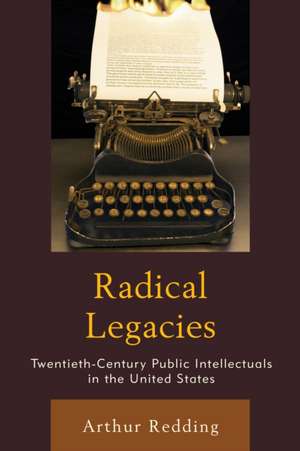
Radical Legacies
Autor Arthur Reddingen Limba Engleză Hardback – 31 dec 2015
| Toate formatele și edițiile | Preț | Express |
|---|---|---|
| Paperback (1) | 305.09 lei 6-8 săpt. | |
| Bloomsbury Publishing – 7 aug 2017 | 305.09 lei 6-8 săpt. | |
| Hardback (1) | 645.09 lei 6-8 săpt. | |
| Rowman & Littlefield – 31 dec 2015 | 645.09 lei 6-8 săpt. |
Preț: 645.09 lei
Preț vechi: 796.40 lei
-19%
Puncte Express: 968
Preț estimativ în valută:
114.10€ • 135.30$ • 99.41£
114.10€ • 135.30$ • 99.41£
Carte tipărită la comandă
Livrare economică 25 martie-08 aprilie
Specificații
ISBN-13: 9781498512664
ISBN-10: 1498512666
Pagini: 170
Dimensiuni: 155 x 231 x 18 mm
Greutate: 0.57 kg
Editura: Rowman & Littlefield
ISBN-10: 1498512666
Pagini: 170
Dimensiuni: 155 x 231 x 18 mm
Greutate: 0.57 kg
Editura: Rowman & Littlefield
V-ar putea interesa
-
 -20%Preț: 76.81 lei96.23 lei
 -
 -17%Preț: 17.88 lei21.50 lei
 -
 Advertisements for MyselfNorman Mailer-19%Preț: 73.40 lei90.62 lei
 -
 Many VoicesAlice Bellis-7%Preț: 358.74 lei384.97 lei
 -
 H.G. Wells ReaderJohn HuntingtonPreț: 161.55 lei
 -
 Folklife and Museums: Twenty-First Century PerspectivesC. Kurt Dewhurst-22%Preț: 379.73 lei486.78 lei
 -
 Disentangling Consciencism: Essays on Kwame Nkrumah's PhilosophyMartin Odei Ajei-18%Preț: 777.10 lei947.68 lei
 -
 -26%Preț: 345.99 lei470.52 lei
 -
 -34%Preț: 677.79 lei1021.97 lei
 -
 Preț: 160.22 lei
 -
 Stories from the City of God: Sketches and Chronicles of RomePier Paolo PasoliniPreț: 104.18 lei
 -
 Jane Austen and the Arts: Elegance, Propriety, and HarmonyNatasha Duquette-25%Preț: 350.86 lei469.39 lei
 -
 -30%Preț: 329.07 lei468.96 lei
 -
 -25%Preț: 142.88 lei190.79 lei
 -
 Preț: 260.15 lei
 -
 Hard to LoveBriallen Hopper-26%Preț: 87.29 lei118.41 lei
 -
 In TruthMatthew FraserPreț: 171.50 lei
 -
 In Praise of Messy LivesKatie RoiphePreț: 89.60 lei
 -
 -22%Preț: 790.88 lei1012.61 lei
 -
 Probe de empatie: EseuriLeslie JamisonPreț: 37.57 lei
Descriere
Descriere de la o altă ediție sau format:
What use is thinking? This study addresses the ways in which modern American thinkers have intervened in the public sphere and attempted to mediate relations between social and political institutions and cultural and intellectual production. Chapters on both well-known (Henry Adams, Langston Hughes, C. Wright Mills, Angela Davis) and neglected (Randolph Bourne, Mary McCarthy, Paul Goodman) public intellectuals considers how these figures have address a range of problems, including the dangers and difficulty of critical dissent thought during wartime, the contemporary crisis of the humanities under neoliberalism, the legacy of American anti-intellectualism, academic professionalism, and the perils of consumer culture and popular tastes. This book reviews in as critically sympathetic a manner as possible a select few of the minor and major currents of twentieth-century American radical thinking in order to see where they might take us, and how they inflect our current social and intellectual predicaments. Arguing that any "use-value" theory of intellectual production is limiting, Radical Legacies endeavors to maintain and expand a space and reassert an argument for the importance of sustained critical reflection on our collective dilemmas today. It assesses a practice of thought that is engaged, committed, involved, and timely, without being necessarily "practical" or even useful.
What use is thinking? This study addresses the ways in which modern American thinkers have intervened in the public sphere and attempted to mediate relations between social and political institutions and cultural and intellectual production. Chapters on both well-known (Henry Adams, Langston Hughes, C. Wright Mills, Angela Davis) and neglected (Randolph Bourne, Mary McCarthy, Paul Goodman) public intellectuals considers how these figures have address a range of problems, including the dangers and difficulty of critical dissent thought during wartime, the contemporary crisis of the humanities under neoliberalism, the legacy of American anti-intellectualism, academic professionalism, and the perils of consumer culture and popular tastes. This book reviews in as critically sympathetic a manner as possible a select few of the minor and major currents of twentieth-century American radical thinking in order to see where they might take us, and how they inflect our current social and intellectual predicaments. Arguing that any "use-value" theory of intellectual production is limiting, Radical Legacies endeavors to maintain and expand a space and reassert an argument for the importance of sustained critical reflection on our collective dilemmas today. It assesses a practice of thought that is engaged, committed, involved, and timely, without being necessarily "practical" or even useful.
Cuprins
Acknowledgments
Introduction: The Uselessness of American Intellectuals.
Chapter One: Be Free!: Globalism and Democratic Pedagogy in Henry James and Henry Adams
Chapter Two: World War I and the Origins of the National Security State: Mary Antin, Randolph Bourne, and Emma Goldman
Chapter Three: Mary McCarthy's Swizzle Sticks: Food, Drink, and Consumerism in the American Depression
Chapter Four: Herman Melville's Cold War: Re-reading C. L. R. James's Mariners, Renegades, and Castaways
Chapter Five: Turning Poetry into Bread: Langston Hughes, Travel-writing, and the Professionalization of African-American Literary Production
Chapter Six: Legacies of the New Left: Paul Goodman, C. Wright Mills, and Angela Davis
Conclusion: Thought during Wartime: American Public Intellectuals in the Twenty-first Century
Notes
Bibliography
Introduction: The Uselessness of American Intellectuals.
Chapter One: Be Free!: Globalism and Democratic Pedagogy in Henry James and Henry Adams
Chapter Two: World War I and the Origins of the National Security State: Mary Antin, Randolph Bourne, and Emma Goldman
Chapter Three: Mary McCarthy's Swizzle Sticks: Food, Drink, and Consumerism in the American Depression
Chapter Four: Herman Melville's Cold War: Re-reading C. L. R. James's Mariners, Renegades, and Castaways
Chapter Five: Turning Poetry into Bread: Langston Hughes, Travel-writing, and the Professionalization of African-American Literary Production
Chapter Six: Legacies of the New Left: Paul Goodman, C. Wright Mills, and Angela Davis
Conclusion: Thought during Wartime: American Public Intellectuals in the Twenty-first Century
Notes
Bibliography
Recenzii
American literary historian Arthur Redding presents six essays on such radical American thinkers as Henry James, Henry Adams, Herman Melville, Langston Hughes, Emma Goldman, Paul Goodman, C. Wright Mills, and Angela Davis (Redding calls Davis 'one of the most compelling activist-philosophers alive'). These public intellectuals have raised deeply disturbing concerns about conservative tendencies in US culture and politics. Redding considers his subjects to be 'radical' in their formulation of hopeless Utopian causes such as prison abolition, pacifism, gender equity, racial equality, and economic justice. The word 'legacies' in the title alludes to the idea that the thinking of these writers is radical rather than reformist. They do not accommodate themselves to any of the conservative policies of the US government. Redding's aim is to keep alive some of this reflective resistance to, as he writes in chapter 1, US 'neo-imperial barbarism.' Redding reminds readers of the fact, so often ignored, that the US has achieved many progressive socialist goals, among them the eight-hour workday, the elimination of child labor, the extension of the vote to women and minorities, recognition of the right to collective bargaining, social security, public education, and Keynesian economics. Summing Up: Highly recommended. All readers.