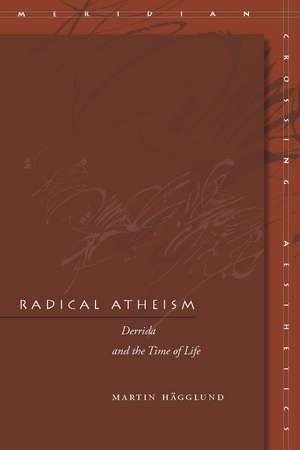
Radical Atheism: Derrida and the Time of Life: Meridian: Crossing Aesthetics
Autor Martin Hägglunden Limba Engleză Paperback – 3 sep 2008
Prin volumul de față, Radical Atheism aduce o perspectivă revizionistă asupra operei lui Jacques Derrida, demontând mitul unei cotituri spre religiozitate în scrierile sale târzii. Notăm cu interes modul în care Martin Hägglund reușește să demonstreze că deconstrucția nu este o deschidere către o transcendență inefabilă, ci o consecință riguroasă a finitudinii temporale. Lucrarea se distinge prin claritatea analitică aplicată unui corpus de texte adesea considerat opac, oferind o logică unitară întregii cariere a filosofului francez.
Putem afirma că acest studiu extinde cadrul propus de Derrida on Time de Joanna Hodge prin faptul că nu se limitează la a cartografia temporalitatea ca temă, ci o transformă în fundamentul unui „ateism radical”. În timp ce Hent de Vries în Philosophy and the Turn to Religion caută puncte de convergență între deconstrucție și experiența religioasă, Hägglund argumentează contrariul: supraviețuirea și dorința sunt posibile doar pentru că suntem muritori și temporali, nu în ciuda acestui fapt. Autorul nu doar explică poziția lui Derrida, ci îi fortifică argumentele în dialog cu marii gânditori ai tradiției occidentale, precum Husserl sau Levinas.
Această abordare este coerentă cu întreaga operă a lui Martin Hägglund. Dacă în Dying for Time – Proust, Woolf, Nabokov analiza se concentra pe teama de moarte ca investiție în viața temporală, aici conceptul este ridicat la rang de principiu ontologic. Radical Atheism servește drept fundament teoretic pentru lucrările sale ulterioare, inclusiv This Life, redefinind mizele democrației și ale eticii dintr-o perspectivă strict seculară și materialistă.
Din seria Meridian: Crossing Aesthetics
-
 Preț: 188.70 lei
 -
 Preț: 148.85 lei
 - 19%
 Preț: 555.52 lei
 - 19%
 Preț: 620.20 lei
 - 23%
 Preț: 842.97 lei
 - 19%
 Preț: 492.92 lei
 - 5%
 Preț: 209.97 lei
 -
 Preț: 230.27 lei
 - 19%
 Preț: 573.68 lei
 -
 Preț: 149.91 lei
 -
 Preț: 150.08 lei
 -
 Preț: 154.68 lei
 -
 Preț: 211.67 lei
 -
 Preț: 170.03 lei
 -
 Preț: 234.28 lei
 -
 Preț: 194.08 lei
 - 19%
 Preț: 718.98 lei
 -
 Preț: 262.25 lei
 -
 Preț: 141.66 lei
 - 15%
 Preț: 543.87 lei
 -
 Preț: 132.00 lei
 -
 Preț: 227.00 lei
 -
 Preț: 206.46 lei
 -
 Preț: 196.56 lei
 -
 Preț: 218.54 lei
 -
 Preț: 148.25 lei
 -
 Preț: 233.17 lei
 - 19%
 Preț: 587.08 lei
 -
 Preț: 264.34 lei
 - 19%
 Preț: 556.39 lei
 -
 Preț: 273.74 lei
 -
 Preț: 140.03 lei
 - 23%
 Preț: 842.67 lei
 -
 Preț: 138.97 lei
 -
 Preț: 234.80 lei
 -
 Preț: 229.45 lei
 -
 Preț: 227.88 lei
 -
 Preț: 170.31 lei
 -
 Preț: 209.97 lei
 -
 Preț: 163.11 lei
 -
 Preț: 316.58 lei
 -
 Preț: 166.91 lei
Preț: 195.23 lei
Carte disponibilă
Livrare economică 31 octombrie-14 noiembrie
Livrare express 17-23 octombrie pentru 56.26 lei
Specificații
ISBN-10: 0804700788
Pagini: 272
Dimensiuni: 152 x 229 x 20 mm
Greutate: 0.36 kg
Editura: Stanford University Press
Colecția Stanford University Press
Seria Meridian: Crossing Aesthetics
V-ar putea interesa
-
 Discourse on Method and the MeditationsRene DescartesPreț: 90.50 lei
 -
 Why is There Something Rather Than Nothing?Leszek Kolakowski-32%Preț: 62.40 lei91.77 lei
 -
 In Search of the MiraculousP. D. OuspenskyPreț: 116.73 lei
 -
 The Philosophy of SchopenhauerBryan Magee-21%Preț: 371.88 lei468.36 lei
 -
 -14%Preț: 295.93 lei343.59 lei
 -
 UtilitarianismJ. S. Mill-13%Preț: 277.58 lei320.06 lei
 -
 The Birth of TragedyFriedrich Nietzsche-50%Preț: 17.46 lei35.16 lei
 -
 A History of Western PhilosophyBertrand RussellPreț: 196.17 lei
 -
 Adieu to Emmanuel LevinasJacques DerridaPreț: 132.00 lei
 -
 Unfashionable Observations: Volume 2Friedrich NietzschePreț: 205.51 lei
 -
 Preț: 169.44 lei
 -
 Preț: 131.87 lei
 -
 Preț: 164.39 lei
 -
 Walter Benjamin: Images, the Creaturely, and the HolySigrid WeigelPreț: 211.58 lei
 -
 Preț: 172.54 lei
 -
 Preț: 101.42 lei
 -
 Meditations, Objections, and RepliesRené Descartes-18%Preț: 100.07 lei121.63 lei
 -
 The Essential Spinoza: Ethics and Related WritingsBaruch Spinoza-16%Preț: 166.56 lei198.90 lei
 -
 Perspectives on Philosophy of CommunicationPat ArnesonPreț: 190.38 lei
 -
 The Essential Rene GuenonJohn HerlihyPreț: 147.29 lei
De ce să citești această carte
O lectură esențială pentru cercetătorii interesați de deconstrucție și filosofia contemporană. Cititorul va câștiga o înțelegere riguroasă a modului în care timpul condiționează orice formă de dorință și responsabilitate politică. Este recomandată celor care doresc o alternativă solidă la interpretările teologice ale lui Derrida, oferind un argument convingător pentru o viață trăită fără promisiunea eternității.
Despre autor
Martin Hägglund este un filosof și critic literar de origine suedeză, cunoscut pentru contribuțiile sale originale în domeniul filosofiei continentale și al teoriei timpului. Opera sa se concentrează pe explorarea finitudinii umane și a implicațiilor acesteia asupra eticii și politicii. Prin lucrări precum Radical Atheism și This Life, Hägglund s-a impus ca o voce majoră în dezbaterea contemporană despre secularism și materialism, primind recunoaștere internațională pentru rigoarea cu care analizează legătura dintre mortalitate și valoarea vieții sociale.
Descriere scurtă
Recenzii
"Like the best of philosophers measured by Nietzschean standards, Hägglund could be characterized as marvelously 'untimely'. [A] superlative conceptual-theoretical analysis."—Adrian Johnston, The New Centennial Review
"What distinguishes Hägglund's book is the philosophical acumen with which he delineates its consequences and the rigour with which he deploys them against the faux amis of deconstruction. Whether or not one finds the philosophy that Hägglund expounds compelling, the rare virtue of his book is that it forces us to assess that philosophy correctly."—Nathan Brown, Radical Philosophy
"Martin Hägglund's Radical Atheism is a tour de force . . . It lives up to [its] bold claim, offering a remarkable tour of Jacques Derrida's diverse and demanding oeuvre via lucid arguments and clear prose. Hägglund demonstrates an impressive command of Derrida's corpus, marshaling these materials skillfully and effectively in rigorous, firmly grounded textual analyses . . . [It is] certainly worthy of the attention it continues to receive, both for its own merits and because any discussion of Derrida and religion will now have to attend to and contend with Hägglund's powerful text."—William Robert, Sophia
"A commanding and refreshing interpretation of Derrida which promises to be a crucial intervention in critical disagreements over Derrida's legacy.Radical Atheism is an important and prescient volume.It re-assesses Derrida's work and its philosophical futures with care, vision, and scholarly rigour, serving to regenerate interest in Derrida for a generation of philosophers for whom his name has fallen out of fashion."—Danielle Sands, Parrhesia
"In this explosive little book on Derrida.Hägglund extracts and explicates what he claims is the core idea of Derrida's work, writing without the piousness, esoterism, or obliqueness that has critically imprisoned his subject. Hägglund's refutation of the idea of an ethical turn in deconstruction is definitive and his association of Derrida's thought with radical atheism is compelling."—Brian Rajski, The Voice Imitator