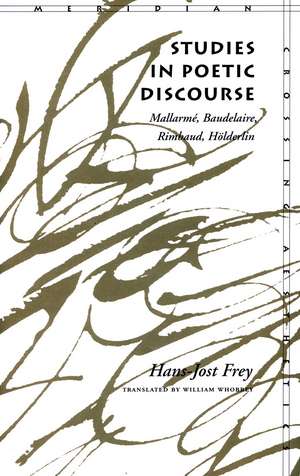
Studies in Poetic Discourse: Mallarmé, Baudelaire, Rimbaud, Hölderlin: Meridian: Crossing Aesthetics
Autor Hans-Jost Frey Traducere de William Whobreyen Limba Engleză Hardback – 1996
This study of four major poets—Mallarmé, Baudelaire, Rimbaud, and Hölderlin—examines the self-reflexivity of modern poetry, exploring questions concerning what it means for a poem to be "about" its own process of saying.
Din seria Meridian: Crossing Aesthetics
-
 Preț: 188.70 lei
 -
 Preț: 148.85 lei
 - 19%
 Preț: 555.52 lei
 - 19%
 Preț: 620.20 lei
 - 23%
 Preț: 842.97 lei
 - 5%
 Preț: 215.57 lei
 -
 Preț: 236.42 lei
 - 19%
 Preț: 573.68 lei
 -
 Preț: 149.91 lei
 -
 Preț: 150.08 lei
 -
 Preț: 154.68 lei
 -
 Preț: 211.67 lei
 -
 Preț: 170.03 lei
 -
 Preț: 234.28 lei
 -
 Preț: 194.08 lei
 - 19%
 Preț: 722.67 lei
 -
 Preț: 262.25 lei
 -
 Preț: 141.66 lei
 - 15%
 Preț: 543.87 lei
 -
 Preț: 132.00 lei
 -
 Preț: 232.09 lei
 -
 Preț: 206.46 lei
 -
 Preț: 196.56 lei
 -
 Preț: 218.54 lei
 -
 Preț: 148.25 lei
 -
 Preț: 233.17 lei
 - 19%
 Preț: 587.08 lei
 -
 Preț: 264.34 lei
 - 19%
 Preț: 556.39 lei
 -
 Preț: 273.74 lei
 -
 Preț: 140.03 lei
 - 23%
 Preț: 842.67 lei
 -
 Preț: 138.97 lei
 -
 Preț: 234.80 lei
 -
 Preț: 237.33 lei
 -
 Preț: 227.88 lei
 -
 Preț: 170.31 lei
 -
 Preț: 215.57 lei
 -
 Preț: 163.11 lei
 -
 Preț: 318.49 lei
 -
 Preț: 166.91 lei
Preț: 492.92 lei
Preț vechi: 608.54 lei
-19%
Puncte Express: 739
Carte tipărită la comandă
Livrare economică 28 noiembrie-12 decembrie
Livrare prin curier în România Termenul estimat este afișat lângă disponibilitate.
Transport gratuit pentru acest produs Plată online sau ramburs, în funcție de opțiunile comenzii.
Retur gratuit în 14 zile Comandă securizată și suport în română.
Specificații
ISBN-13: 9780804724692
ISBN-10: 0804724695
Pagini: 208
Dimensiuni: 152 x 229 x 20 mm
Greutate: 0.49 kg
Ediția:UK edition
Editura: Stanford University Press
Colecția Stanford University Press
Seria Meridian: Crossing Aesthetics
ISBN-10: 0804724695
Pagini: 208
Dimensiuni: 152 x 229 x 20 mm
Greutate: 0.49 kg
Ediția:UK edition
Editura: Stanford University Press
Colecția Stanford University Press
Seria Meridian: Crossing Aesthetics
V-ar putea interesa
-
 The Big SmokeAdrian MatejkaPreț: 104.82 lei
 -
 Black ApertureMatt RasmussenPreț: 103.15 lei
 -
 The Glacier's WakeKaty DiddenPreț: 105.94 lei
 -
 It Becomes YouDobby GibsonPreț: 79.30 lei
 -
 IncarnadineMary SzybistPreț: 91.56 lei
 -
 Collected Haiku of Yosa BusonYosa BusonPreț: 151.75 lei
 -
 The Earth Is Not FlatKatharine ColesPreț: 95.55 lei
 -
 A Wild SurmiseEloise Klein HealyPreț: 110.79 lei
 -
 The Shipwrecked HouseClaire TrevienPreț: 83.66 lei
 -
 Begging for ItAlex DimitrovPreț: 83.71 lei
Recenzii
“This is an exceptional and important volume in which close readings of four major European writers daringly eradicate the border between commentary and literature. In precise analyses of particular texts, Frey works through and elucidates the various theories of writing, reading, representation, and memory. The complex line of argumentation is rendered with remarkable clarity, and one learns a great deal not only about the texts studied but also about literary theory in general.”—Carol Jacobs, State University of New York, Buffalo
Textul de pe ultima copertă
“This is an exceptional and important volume in which close readings of four major European writers daringly eradicate the border between commentary and literature. In precise analyses of particular texts, Frey works through and elucidates the various theories of writing, reading, representation, and memory. The complex line of argumentation is rendered with remarkable clarity, and one learns a great deal not only about the texts studied but also about literary theory in general.”—Carol Jacobs, State University of New York, Buffalo