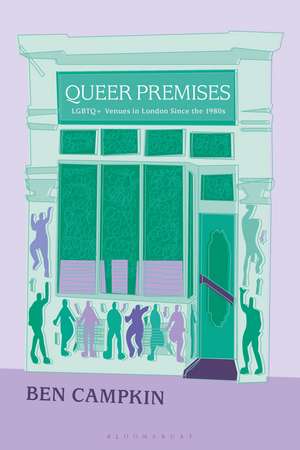
Queer Premises: LGBTQ+ Venues in London Since the 1980s
Autor Prof. Ben Campkinen Limba Engleză Paperback – 29 iun 2023
Queer Premises offers evidence for how London's diverse LGBTQ+ populations have embedded themselves into urban space, systems and resources. It sets out to understand how, across their different material dimensions, bars, cafés, nightclubs, pubs, community centres, and hybrids of these typologies, have been imagined, created and sustained. From the 1980s to the present, Campkin asks how, where, and why these venues have been established, how they operate and the purposes they serve, what challenges they face and why they close down.
Preț: 182.28 lei
Preț vechi: 210.08 lei
-13%
Puncte Express: 273
Carte tipărită la comandă
Livrare economică 27 noiembrie-11 decembrie
Livrare express 23-29 octombrie pentru 61.56 lei
Livrare prin curier în România Termenul estimat este afișat lângă disponibilitate.
Transport gratuit de la 400.00 lei Plată online sau ramburs, în funcție de opțiunile comenzii.
Retur gratuit în 14 zile Comandă securizată și suport în română.
Specificații
ISBN-13: 9781350324855
ISBN-10: 135032485X
Pagini: 296
Dimensiuni: 154 x 232 x 22 mm
Greutate: 0.48 kg
Editura: Bloomsbury Publishing
Colecția Bloomsbury Academic
Locul publicării:London, United Kingdom
ISBN-10: 135032485X
Pagini: 296
Dimensiuni: 154 x 232 x 22 mm
Greutate: 0.48 kg
Editura: Bloomsbury Publishing
Colecția Bloomsbury Academic
Locul publicării:London, United Kingdom
V-ar putea interesa
-
 Preț: 430.28 lei
 -
 -15%Preț: 423.65 lei498.41 lei
 -
 Beyond Bad Girls: Gender, Violence and HypeMeda Chesney-LindPreț: 406.36 lei
 -
 Preț: 286.44 lei
 -
 -23%Preț: 335.60 lei435.26 lei
 -
 -29%Preț: 343.67 lei482.99 lei
 -
 -31%Preț: 603.68 lei870.45 lei
 -
 Rhetorical DragCarrollPreț: 166.42 lei
 -
 Preț: 368.59 lei
 -
 Preț: 382.76 lei
 -
 Class, Gender and the Family BusinessK. Mulholland-15%Preț: 628.33 lei739.20 lei
 -
 Feminist ErasuresK. SilvaPreț: 400.08 lei
 -
 Psychoanalysis,Psychiatry and Modernist LiteratureK. ValentinePreț: 368.79 lei
 -
 Women's AutobiographyV. StewartPreț: 369.00 lei
 -
 -15%Preț: 658.70 lei774.94 lei
 -
 Surviving Domestic ViolencePaula WilcoxPreț: 369.55 lei
 -
 Identity TroubleC. Caldas-CoulthardPreț: 401.88 lei
 -
 Preț: 442.18 lei
 -
 -18%Preț: 1118.04 lei1363.46 lei
 -
 Manning the NationKizito Z. MuchemwaPreț: 288.37 lei
 -
 Remaking London: Decline and Regeneration in Urban CultureProf. Ben Campkin-21%Preț: 187.80 lei237.42 lei
 -
 Dirt: New Geographies of Cleanliness and ContaminationProf. Ben Campkin-19%Preț: 236.49 lei290.93 lei
 -
 Engaged Urbanism: Cities and MethodologiesProf. Ben Campkin-23%Preț: 234.50 lei304.42 lei
 -
 Gender and the Southern Body PoliticNancy BercawPreț: 262.93 lei
Cuprins
Table of contents
List of figures
List of abbreviations
Queer Premises
Chapter 1 Queer infrastructure
Chapter 2 Perverted purposes
Chapter 3 Mainstreaming pride
Chapter 4 Rupture and repair
Chapter 5 Seeking closure
Chapter 6 Sui generis
Chapter 7 Macho city
Chapter 8 Pandemic premises
About the author
Acknowledgments
List of figures
List of abbreviations
Queer Premises
Chapter 1 Queer infrastructure
Chapter 2 Perverted purposes
Chapter 3 Mainstreaming pride
Chapter 4 Rupture and repair
Chapter 5 Seeking closure
Chapter 6 Sui generis
Chapter 7 Macho city
Chapter 8 Pandemic premises
About the author
Acknowledgments
Recenzii
Queer Premises provides a valuable account of London's commercial venues, which will be of interest to both scholars and practitioners of LGBTQ+ placemaking.
This terrific book deftly unpicks the shifting and unequal forces - from LGBTQ+ activism to clunky planning processes and neo-liberal urban redevelopment - that have affected the survival or closure of London's queer venues since the 1980s. Professor Campkin's fine-grained and authoritative analysis illuminates our understanding of London's queer nightlife and will reshape queer urban studies.
In these pages lives a network of places that scale up into structures of urban governance, planning, and "queer infrastructure" in London. The clever move to examine the heritage values of these LGBTQ+ venues enables Campkin to show the collectivist project of placemaking initiatives. An absolute tour de force.
Queer Premises is thus an ethnography of not only club life and the intimacy sought there, but also the adjustments municipal government made to queer culture in London after 1980. Performance styles, music genres, and most importantly new community emerged. The interaction between the new identity cultures, and the conservative government is what makes Campkin's book significant to a broader audience.
This terrific book deftly unpicks the shifting and unequal forces - from LGBTQ+ activism to clunky planning processes and neo-liberal urban redevelopment - that have affected the survival or closure of London's queer venues since the 1980s. Professor Campkin's fine-grained and authoritative analysis illuminates our understanding of London's queer nightlife and will reshape queer urban studies.
In these pages lives a network of places that scale up into structures of urban governance, planning, and "queer infrastructure" in London. The clever move to examine the heritage values of these LGBTQ+ venues enables Campkin to show the collectivist project of placemaking initiatives. An absolute tour de force.
Queer Premises is thus an ethnography of not only club life and the intimacy sought there, but also the adjustments municipal government made to queer culture in London after 1980. Performance styles, music genres, and most importantly new community emerged. The interaction between the new identity cultures, and the conservative government is what makes Campkin's book significant to a broader audience.