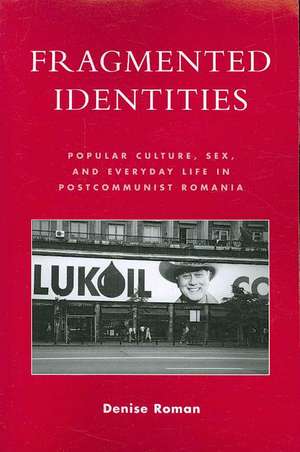
Fragmented Identities: Popular Culture, Sex, and Everyday Life in Postcommunist Romania
Autor Denise Romanen Limba Engleză Paperback – 16 apr 2007
Preț: 335.60 lei
Preț vechi: 435.26 lei
-23%
Puncte Express: 503
Carte tipărită la comandă
Livrare economică 10-24 noiembrie
Livrare prin curier în România Termenul estimat este afișat lângă disponibilitate.
Transport gratuit de la 400.00 lei Plată online sau ramburs, în funcție de opțiunile comenzii.
Retur gratuit în 14 zile Comandă securizată și suport în română.
Specificații
ISBN-13: 9780739121184
ISBN-10: 0739121189
Pagini: 187
Dimensiuni: 154 x 232 x 15 mm
Greutate: 0.31 kg
Editura: Bloomsbury Publishing
Colecția Lexington Books
Locul publicării:New York, United States
ISBN-10: 0739121189
Pagini: 187
Dimensiuni: 154 x 232 x 15 mm
Greutate: 0.31 kg
Editura: Bloomsbury Publishing
Colecția Lexington Books
Locul publicării:New York, United States
V-ar putea interesa
-
 Vulnerability: New Essays in Ethics and Feminist PhilosophyCatriona Mackenzie-21%Preț: 373.03 lei474.08 lei
 -
 Trans Bodies, Trans Selves: A Resource for the Transgender CommunityLaura Erickson-Schroth-6%Preț: 401.27 lei428.12 lei
 -
 Gender and the EnvironmentNicole DetrazPreț: 186.97 lei
 -
 Preț: 240.39 lei
 -
 Normal LifeDean SpadePreț: 143.96 lei
 -
 Unspeakable Things: Sex, Lies and RevolutionLaurie Penny-26%Preț: 52.74 lei71.47 lei
 -
 The Tattooed LadyAmelia Klem OsterudPreț: 124.78 lei
 -
 -23%Preț: 199.26 lei258.95 lei
 -
 Realizing Hope: Life Beyond CapitalismMichael Albert-22%Preț: 111.47 lei142.96 lei
 -
 Male Daughters, Female HusbandsIfi Amadiume-10%Preț: 116.94 lei130.52 lei
 -
 -27%Preț: 67.28 lei91.99 lei
 -
 Anxiety Disorders and GenderDan J. Stein-5%Preț: 712.71 lei750.22 lei
Cuprins
Part 1 Everyday Life
Chapter 2 A Flâneur through Bucharest at the End of the Twentieth Century
Chapter 3 Discourses, Identities, and Practices of Everyday Life
Part 4 Popular Culture
Chapter 5 Aesthetics and Politics: From "Socialist Realism" to "Postcommunist Carnivalesque"
Chapter 6 "Blue Jeans Generation" and "Generation PRO": Youth, Pop Culture, and Politics
Chapter 7 Popular Culture and the Discourse of Hate: The Case of Anti-Semitism
Part 8 Gender and Sexuality
Chapter 9 The Postcommunist Feminine Mystique: Women as Subjects, Women and Politics
Chapter 10 Between Ars Erotica and Scientia Sexualis: Queer Subjectivity and the Discourse of Sex
Chapter 2 A Flâneur through Bucharest at the End of the Twentieth Century
Chapter 3 Discourses, Identities, and Practices of Everyday Life
Part 4 Popular Culture
Chapter 5 Aesthetics and Politics: From "Socialist Realism" to "Postcommunist Carnivalesque"
Chapter 6 "Blue Jeans Generation" and "Generation PRO": Youth, Pop Culture, and Politics
Chapter 7 Popular Culture and the Discourse of Hate: The Case of Anti-Semitism
Part 8 Gender and Sexuality
Chapter 9 The Postcommunist Feminine Mystique: Women as Subjects, Women and Politics
Chapter 10 Between Ars Erotica and Scientia Sexualis: Queer Subjectivity and the Discourse of Sex
Recenzii
Ms. Roman is anything but a detached traveler, although she does bring to her writing a most insightful and often amusing account of the state of politics and identity in Bucharest. But this is politics and identity in no common understanding of those terms. Skillfully teasing her own innovative interpretations from the insights of historians, sociologists, political, feminist, and cultural theorists, Ms. Roman . . . dismantle[s] old conceptions and convincingly reconstruct[s] new ones about the 'politics of life' in Eastern Europe today. By brilliantly bringing together disparate strands of thought in truly innovative, provocative, and sometimes even sly ways, she has written not only an outstanding piece of academic scholarship, but a real 'page turner.'
In this important book Denise Roman takes us to an exciting journey through 1980s and 1990s Bucharest. Her analysis of experiences and practices of the everyday life of women, youth, and queers leaves the reader with a deeper understanding of the complexity of the economic, political, and social changes the Eastern European societies underwent as they emerged from Communism.
Roman has managed to do what only a handful of scholars have even attempted: to bring the study of Romania squarely within the field of cultural studies. Rather than treat Romania as an exotic exception, Roman shows how constructed social identities-of gender, sexual orientation, generation, and even aesthetic taste-exhibit recognizable patterns. Her walk through the complicated landscape of Bucharest and the country at large is not only a nuanced and readable work on one country's postcommunist experience; it is also a smart and often funny example of cultural theory in action.
This book is recommended for those who are interested in transnational, feminist and queer studies, identity politics, and subject formation as well as for those interested specifically in post-communist studies, particularly Romanian....An enjoyable read, Roman's book interweaves her theorizations with vivid descriptions and colorful anecdotes to make the tensions, negotiations, and struggles for identity visceral for the reader and thought-provoking for a wide audience.
The subsequent chapters, dedicated in turn to each of these topics, provide useful, theoretically informed, and, largely accurate accounts of the empirical reality a flaneur, or flaneuse, might encounter.
A good introduction to aspects of postcommunist culture in Romania.... The author, both an insider (as a native of Bucharest) and an outsider (as an American academic) has a special perspective...that gives her special insight into not only Romanian culture, but also Western European and American academic practices vis-a-vis Eastern European issues, especially the gender problematic.
Denise Roman's fine book should be read as a kind of 'flânerie', expressing the feel of everyday personal life in post-1989 Romania, but it also displays solid methodological reflection and scholarly culture. The way in which it moves between these two dimensions, between theory and lived experience, is what gives the study its special charm-even for a non-specialist reader. Denise Roman places post-1989 Romania on view for us, a society taken apart, a society resisting without any object of resistance, attached to a golden age without a golden age that can be located anywhere, clinging to a dream of the West while at the same time rejecting that West. Romania experiences itself as ringed with shadows: there is the figure of the Jew who embodies Evil, the Other as Evil. Women are lost between the imagined calm of a return to the home and a militant feminism of the Anglo-American kind. These women speak a great deal through the author's pen: they speak humor, self-hatred, a need to leave-to leave for somewhere else. They are real women, and the author has been able to hear what they say from within their private lives. Denise Roman's extreme talent is what is needed to infuse knowledge with feeling, as she puts her heart into studying the course of a country with seemingly no clearly defined plans for the future, carried along by a hybrid identity. This book is an indispensable means of illuminating the complex tensions of a Romanian identity driven both to banalize and to reject integration. The author has been able to set before us the East European combination of dynamism and conservatism: she is the guide who walks with serious mien and poses questions, at the bends in the road.
In this important book Denise Roman takes us to an exciting journey through 1980s and 1990s Bucharest. Her analysis of experiences and practices of the everyday life of women, youth, and queers leaves the reader with a deeper understanding of the complexity of the economic, political, and social changes the Eastern European societies underwent as they emerged from Communism.
Roman has managed to do what only a handful of scholars have even attempted: to bring the study of Romania squarely within the field of cultural studies. Rather than treat Romania as an exotic exception, Roman shows how constructed social identities-of gender, sexual orientation, generation, and even aesthetic taste-exhibit recognizable patterns. Her walk through the complicated landscape of Bucharest and the country at large is not only a nuanced and readable work on one country's postcommunist experience; it is also a smart and often funny example of cultural theory in action.
This book is recommended for those who are interested in transnational, feminist and queer studies, identity politics, and subject formation as well as for those interested specifically in post-communist studies, particularly Romanian....An enjoyable read, Roman's book interweaves her theorizations with vivid descriptions and colorful anecdotes to make the tensions, negotiations, and struggles for identity visceral for the reader and thought-provoking for a wide audience.
The subsequent chapters, dedicated in turn to each of these topics, provide useful, theoretically informed, and, largely accurate accounts of the empirical reality a flaneur, or flaneuse, might encounter.
A good introduction to aspects of postcommunist culture in Romania.... The author, both an insider (as a native of Bucharest) and an outsider (as an American academic) has a special perspective...that gives her special insight into not only Romanian culture, but also Western European and American academic practices vis-a-vis Eastern European issues, especially the gender problematic.
Denise Roman's fine book should be read as a kind of 'flânerie', expressing the feel of everyday personal life in post-1989 Romania, but it also displays solid methodological reflection and scholarly culture. The way in which it moves between these two dimensions, between theory and lived experience, is what gives the study its special charm-even for a non-specialist reader. Denise Roman places post-1989 Romania on view for us, a society taken apart, a society resisting without any object of resistance, attached to a golden age without a golden age that can be located anywhere, clinging to a dream of the West while at the same time rejecting that West. Romania experiences itself as ringed with shadows: there is the figure of the Jew who embodies Evil, the Other as Evil. Women are lost between the imagined calm of a return to the home and a militant feminism of the Anglo-American kind. These women speak a great deal through the author's pen: they speak humor, self-hatred, a need to leave-to leave for somewhere else. They are real women, and the author has been able to hear what they say from within their private lives. Denise Roman's extreme talent is what is needed to infuse knowledge with feeling, as she puts her heart into studying the course of a country with seemingly no clearly defined plans for the future, carried along by a hybrid identity. This book is an indispensable means of illuminating the complex tensions of a Romanian identity driven both to banalize and to reject integration. The author has been able to set before us the East European combination of dynamism and conservatism: she is the guide who walks with serious mien and poses questions, at the bends in the road.