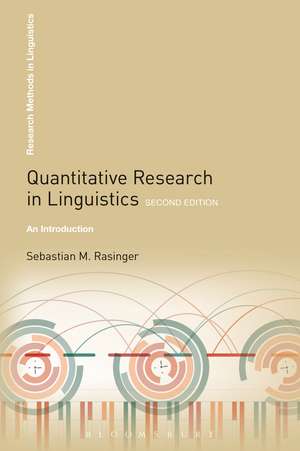
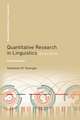
Quantitative Research in Linguistics: An Introduction: Research Methods in Linguistics
Autor Professor Sebastian M. Rasingeren Limba Engleză Hardback – 5 dec 2013
Evoluția recentă a lingvisticii indică o tranziție clară către rigoarea empirică, unde analiza cantitativă nu mai este doar un instrument opțional, ci o competență fundamentală pentru cercetarea modernă. În acest context, Quantitative Research in Linguistics de Professor Sebastian M. Rasinger devine o resursă esențială pentru studenții și cercetătorii care navighează între datele calitative și cele numerice. Subliniem faptul că această a doua ediție extinde semnificativ cadrul teoretic, introducând concepte avansate precum ANOVA, MANOVA și o introducere în meta-analiza statistică, elemente care reflectă complexitatea actuală a studiilor de limbaj.
Remarcăm o structură logică și pedagogică, organizată pentru a ghida cititorul de la fundamentele designului de cercetare și eșantionare, către codificarea chestionarelor și, în final, spre analiza datelor „atipice” (dodgy data). Comparabil cu Quantitative Research Methods for Linguists de Tim Grant în rigurozitate, volumul lui Professor Sebastian M. Rasinger se distinge prin actualizarea tehnicilor pentru noile standarde academice și prin accentul pus pe utilizarea practică a instrumentelor digitale. Descoperim aici o abordare aplicată, unde fiecare capitol este susținut de grafice, exemple rezolvate și exerciții care facilitează înțelegerea teoriei statistice fără a intimida novicele.
Un aspect distinctiv al acestei ediții, publicată de Bloomsbury Publishing, este includerea resurselor de pe site-ul acompaniator, care oferă șabloane Excel și fișe de sinteză. Această integrare între suportul tipărit și cel digital transformă lucrarea dintr-un simplu manual într-un ghid de lucru interactiv, esențial pentru proiectele de licență sau cercetarea postuniversitară în lingvistică aplicată.




Preț: 1057.19 lei
Preț vechi: 1383.18 lei
-24%
Carte tipărită la comandă
Livrare economică 04-18 decembrie
Specificații
ISBN-10: 1441117229
Pagini: 304
Dimensiuni: 156 x 234 x 21 mm
Greutate: 0.57 kg
Ediția:2. Auflage
Editura: Bloomsbury Publishing
Colecția Bloomsbury Academic
Seria Research Methods in Linguistics
Locul publicării:London, United Kingdom
V-ar putea interesa
-
 Preț: 218.53 lei
 -
 Preț: 435.30 lei
 -
 -11%Preț: 363.09 lei406.47 lei
 -
 Sonderegger, M: Regression Modeling for Linguistic DataMorgan SondereggerPreț: 484.64 lei
 -
 Preț: 419.08 lei
 -
 Research Methods and Statistics in PsychologyHugh Coolican-8%Preț: 466.30 lei506.85 lei
 -
 Preț: 382.00 leiRecomandat
 -
 An Introduction to Applied Statistics: With Step-By-Step SPSS InstructionsJr. Edward T. Vieira-9%Preț: 669.64 lei735.86 lei
 -
 Preț: 430.81 lei
 -
 -22%Preț: 894.87 lei1147.27 lei
 -
 R-ticulateMartin Bader-23%Preț: 655.33 lei851.08 lei
 -
 How to Analyze DataCatrin Radcliffe-20%Preț: 58.95 lei73.77 lei
 -
 Preț: 423.09 lei
 -
 Research Methods in LinguisticsDr. Lia Litosseliti-15%Preț: 219.32 lei257.45 lei
 -
 Statistical Analysis with Python For DummiesJoseph SchmullerPreț: 197.44 lei
 -
 -26%Preț: 652.72 lei882.06 lei
 -
 -22%Preț: 875.15 lei1121.98 lei
 -
 Research Methods in InformationAlison Jane Pickard-19%Preț: 558.33 lei689.30 lei
 -
 Statistics for Psychology Research: A Short Guide Using ExcelAdam Tyler HutchesonPreț: 286.80 lei
 -
 Statistics for ScientistsUmberto Michelucci-20%Preț: 279.62 lei349.53 lei
De ce să citești această carte
Această carte se adresează studenților și cercetătorilor din domeniul științelor limbajului care doresc să stăpânească metodele cantitative. Cititorul câștigă o bază solidă în statistica aplicată, învățând cum să transforme date brute în concluzii validate științific. Este un ghid practic care elimină anxietatea față de cifre prin exemple clare și resurse Excel gata de utilizat în propriile proiecte de cercetare.
Descriere
Starting with an definition of quantitative data, and how it differs from qualitative data, Seb Rasinger examines what the student linguist is trying to find out through analysing data, and how quantitative techniques can help arrive at meaningful and accurate conclusions. This expanded, 2nd edition now also includes a discussion of Analysis of Variance (ANOVA) and MANOVA, and provides a brief introduction to statistical meta-analysis. A companion website allows readers to download crib sheets and Excel templates for the main statistical tools.
The book introduces:
-using statistics
-variables
-reliability of data
-describing data
-analysing data
-testing hypotheses
-dealing with problematic data.
Each chapter includes graphs and figures explaining theory through worked examples, chapter summaries, and exercises to aid student understanding. An appendix containing a summary of statistical formulae, excel commands and statistical tables is included and is an invaluable resource.
Presenting a down-to-earth and readable introduction to quantitative research, this book is a useful how-to guide for students encountering quantitative data for the first time, or for postgraduates embarking on linguistic research projects.
Cuprins
2. Quantitative Research: some basic issues
3. Research Design and Sampling
4. Questionnaire Design and Coding
5. A First Glimpse at Data
6. Describing Data Properly: central location and dispersion
7. Analysing Data: a few steps further
8. Testing Hypotheses
9. Analysing Dodgy Data: when things are not quite normal
10. Appendices and Solutions
Bibliography
Recenzii
Intended for both undergraduate and graduate students, this textbook presents a concise, clear and well-illustrated introduction to the quantitative analysis of language. It is comprehensive and example-based, and it covers the basics of quantitative analysis of linguistic data and explores how this differs from qualitative approaches. At the same time, the book is also practical, helping the reader understand how to conceptualize, construct, and implement a quantitative investigation in linguistics.
Rasinger's new book provides a comprehensive and accessible introduction to quantitative research methods in linguistics. Aimed at an advanced undergraduate and early postgraduate audience, the book addresses a longstanding need in the field for a textbook specifically geared toward students who may have already developed a nuanced understanding of language and linguistics but who have had little to no exposure to statistical methods. As such, the book stands to make an important contribution to the teaching of linguistics, whether as a classroom resource for teachers or as a guide to individual students as they undertake their own research projects.
Presenting a down-to-earth and readable introduction to quantitative research, this book is a useful how-to guide for students encountering quantitative data for the first time, or for postgraduates embarking on linguistic research projects.
For the maths-shy linguistics student with no statistics training, this long-needed, reader-friendly book demystifies what quantitative research is and how it's done. Assuming no prior knowledge, students are introduced to various research methods and shown the steps to designing, analysing and interpreting data. Statistical analyses are brilliantly explained and illustrated with examples from published research with which students will already be familiar.
Reviewed in Times Higher Education Supplement, 28 May 2009
Rasinger's book remains a comprehensive and accessible introduction to quantitative research methods in linguistics. Rasinger covers all the bases, including everything from research design through to implementation and analysis, and makes good use of examples drawn from real linguistics research to illustrate important concepts. The inclusion of new sections on ANOVAs and MANOVAs, the addition of brief introductions to doing statistics in SPSS and R, and the updated suggestions for further reading all make the revised edition the ideal choice for students who wish to learn the basics of quantitative linguistics.
Highly relevant publication for languages and linguistics students who normally prefer qualitative research methods and are apprehensive about application or use of quantitative methods.