
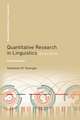
Quantitative Research in Linguistics: An Introduction: Research Methods in Linguistics
Autor Professor Sebastian M. Rasingeren Limba Engleză Paperback – 18 feb 2027
Evoluția recentă a lingvisticii indică o tranziție clară către rigoarea empirică, unde analiza cantitativă nu mai este doar un instrument opțional, ci o competență fundamentală pentru cercetarea modernă. În acest context, Quantitative Research in Linguistics de Professor Sebastian M. Rasinger devine o resursă esențială pentru studenții și cercetătorii care navighează între datele calitative și cele numerice. Subliniem faptul că această a doua ediție extinde semnificativ cadrul teoretic, introducând concepte avansate precum ANOVA, MANOVA și o introducere în meta-analiza statistică, elemente care reflectă complexitatea actuală a studiilor de limbaj.
Remarcăm o structură logică și pedagogică, organizată pentru a ghida cititorul de la fundamentele designului de cercetare și eșantionare, către codificarea chestionarelor și, în final, spre analiza datelor „atipice” (dodgy data). Comparabil cu Quantitative Research Methods for Linguists de Tim Grant în rigurozitate, volumul lui Professor Sebastian M. Rasinger se distinge prin actualizarea tehnicilor pentru noile standarde academice și prin accentul pus pe utilizarea practică a instrumentelor digitale. Descoperim aici o abordare aplicată, unde fiecare capitol este susținut de grafice, exemple rezolvate și exerciții care facilitează înțelegerea teoriei statistice fără a intimida novicele.
Un aspect distinctiv al acestei ediții, publicată de Bloomsbury Publishing, este includerea resurselor de pe site-ul acompaniator, care oferă șabloane Excel și fișe de sinteză. Această integrare între suportul tipărit și cel digital transformă lucrarea dintr-un simplu manual într-un ghid de lucru interactiv, esențial pentru proiectele de licență sau cercetarea postuniversitară în lingvistică aplicată.




Preț: 250.46 lei
Preț vechi: 274.24 lei
-9% Precomandă
Carte nepublicată încă
Specificații
ISBN-10: 1350496480
Pagini: 304
Dimensiuni: 156 x 232 x 26 mm
Greutate: 0.45 kg
Ediția:3rd edition
Editura: Bloomsbury Publishing
Colecția Bloomsbury Academic
Seria Research Methods in Linguistics
Locul publicării:London, United Kingdom
V-ar putea interesa
-
 Preț: 218.53 lei
 -
 Preț: 435.30 lei
 -
 -11%Preț: 363.09 lei406.47 lei
 -
 Sonderegger, M: Regression Modeling for Linguistic DataMorgan SondereggerPreț: 484.64 lei
 -
 Preț: 419.08 lei
 -
 Research Methods and Statistics in PsychologyHugh Coolican-8%Preț: 466.30 lei506.85 lei
 -
 Preț: 382.00 leiRecomandat
 -
 An Introduction to Applied Statistics: With Step-By-Step SPSS InstructionsJr. Edward T. Vieira-9%Preț: 669.64 lei735.86 lei
 -
 Preț: 430.81 lei
 -
 -22%Preț: 894.87 lei1147.27 lei
 -
 R-ticulateMartin Bader-23%Preț: 653.46 lei848.65 lei
 -
 How to Analyze DataCatrin Radcliffe-20%Preț: 58.95 lei73.77 lei
 -
 Preț: 423.09 lei
 -
 Research Methods in LinguisticsDr. Lia Litosseliti-15%Preț: 219.32 lei257.45 lei
 -
 Statistical Analysis with Python For DummiesJoseph SchmullerPreț: 197.44 lei
 -
 -26%Preț: 652.72 lei882.06 lei
 -
 -22%Preț: 875.15 lei1121.98 lei
 -
 Research Methods in InformationAlison Jane Pickard-19%Preț: 558.33 lei689.30 lei
 -
 Statistics for Psychology Research: A Short Guide Using ExcelAdam Tyler HutchesonPreț: 286.80 lei
 -
 Statistics for ScientistsUmberto Michelucci-20%Preț: 279.62 lei349.53 lei
De ce să citești această carte
Această carte se adresează studenților și cercetătorilor din domeniul științelor limbajului care doresc să stăpânească metodele cantitative. Cititorul câștigă o bază solidă în statistica aplicată, învățând cum să transforme date brute în concluzii validate științific. Este un ghid practic care elimină anxietatea față de cifre prin exemple clare și resurse Excel gata de utilizat în propriile proiecte de cercetare.
Descriere
The author examines what the student linguist is trying to find out through analysing data, and how quantitative techniques can help arrive at meaningful and accurate conclusions. Now fully updated and revised, the third edition includes more complex examples in the form of case studies allowing for a more in-depth exploration of the concepts and tools discussed and a glossary of key terms and concepts. A companion website allows readers to download crib sheets and Excel templates for the main statistical tools.
The book focuses on introducing readers to the fundamentals of quantitative research and systematic approaches to data analysis and covers:
- using statistics
- variables
- reliability of data
- describing data
- analysing data
- testing hypotheses
- dealing with problematic data.
Using robust pedagogic scaffolding, the tasks and discussion questions increase in complexity and nuance as each chapter unfolds. Each chapter includes graphs and figures explaining theory through worked examples, chapter summaries, and exercises to aid student understanding, as well as suggestions for further reading to enable students to explore the topics in more depth. An appendix containing a summary of statistical formulae, excel commands and statistical tables is included.
Presenting a down-to-earth and readable introduction to quantitative research, this book is an essential how-to guide for students encountering quantitative data for the first time, or for postgraduates embarking on linguistic research projects.
Cuprins
2. Quantitative Research: Some Basic Issues
3. Get the Structure Right: Research Design and Sampling
4. Questionnaire Design and Coding
5. A First Glimpse at Data
6. Beyond Counting: Describing Data Properly
7. Analysing Data: A Few Steps Further
8. Is A Really Better than B? Testing Hypotheses
9. Analysing Non-Parametric Data
10. Appendices and Solutions
Bibliography