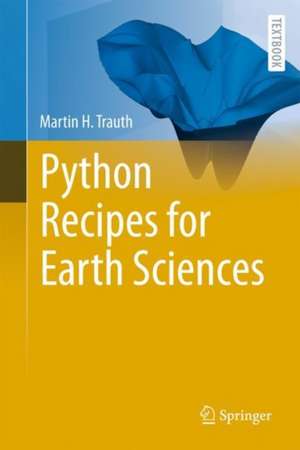
Python Recipes for Earth Sciences: Springer Textbooks in Earth Sciences, Geography and Environment
Autor Martin H. Trauthen Limba Engleză Hardback – 30 sep 2022
Python is used in a wide range of geoscientific applications, such as in processing images for remote sensing, in generating and processing digital elevation models, and in analyzing time series. This book introduces methods of data analysis in the geosciences using Python that include basic statistics for univariate, bivariate, and multivariate data sets, time series analysis, and signal processing; the analysis of spatial and directional data; and image analysis. The text includes numerous examples that demonstrate how Python can be used on data sets from the earth sciences. The supplementary electronic material (available online through Springer Link) contains the example data as well as recipes that include all the Python commands featured in the book.
| Toate formatele și edițiile | Preț | Express |
|---|---|---|
| Paperback (1) | 394.56 lei 22-36 zile | +36.95 lei 5-11 zile |
| Springer International Publishing – 2 oct 2023 | 394.56 lei 22-36 zile | +36.95 lei 5-11 zile |
| Hardback (2) | 579.83 lei 22-36 zile | |
| Springer – 30 sep 2022 | 579.83 lei 22-36 zile | |
| Springer Nature Switzerland – 15 sep 2024 | 713.87 lei 43-57 zile |
Din seria Springer Textbooks in Earth Sciences, Geography and Environment
-
 Preț: 492.80 lei
 - 15%
 Preț: 567.45 lei
 - 15%
 Preț: 394.56 lei
 - 17%
 Preț: 465.19 lei
 - 15%
 Preț: 577.08 lei
 -
 Preț: 387.88 lei
 - 15%
 Preț: 611.42 lei
 - 17%
 Preț: 575.71 lei
 -
 Preț: 411.41 lei
 - 15%
 Preț: 499.48 lei
 - 18%
 Preț: 721.17 lei
 - 15%
 Preț: 574.50 lei
 - 15%
 Preț: 505.97 lei
 - 19%
 Preț: 675.25 lei
 -
 Preț: 416.45 lei
 - 15%
 Preț: 673.98 lei
 - 18%
 Preț: 615.93 lei
 -
 Preț: 474.13 lei
 -
 Preț: 492.15 lei
 - 24%
 Preț: 740.30 lei
 -
 Preț: 429.18 lei
 - 15%
 Preț: 621.03 lei
 -
 Preț: 432.12 lei
 -
 Preț: 469.11 lei
 -
 Preț: 520.47 lei
 - 15%
 Preț: 509.25 lei
 -
 Preț: 406.69 lei
 -
 Preț: 373.76 lei
 - 15%
 Preț: 389.64 lei
 - 15%
 Preț: 688.48 lei
 -
 Preț: 480.08 lei
 - 15%
 Preț: 632.02 lei
 - 15%
 Preț: 597.75 lei
 -
 Preț: 392.86 lei
 -
 Preț: 446.45 lei
 - 15%
 Preț: 694.43 lei
 -
 Preț: 457.75 lei
Preț: 579.83 lei
Preț vechi: 682.15 lei
-15%
Puncte Express: 870
Preț estimativ în valută:
102.53€ • 117.57$ • 88.61£
102.53€ • 117.57$ • 88.61£
Carte disponibilă
Livrare economică 06-20 aprilie
Specificații
ISBN-13: 9783031077180
ISBN-10: 3031077180
Pagini: 468
Ilustrații: XII, 453 p. 200 illus., 110 illus. in color.
Dimensiuni: 160 x 241 x 29 mm
Greutate: 0.95 kg
Ediția:1st ed. 2022
Editura: Springer
Seria Springer Textbooks in Earth Sciences, Geography and Environment
Locul publicării:Cham, Switzerland
ISBN-10: 3031077180
Pagini: 468
Ilustrații: XII, 453 p. 200 illus., 110 illus. in color.
Dimensiuni: 160 x 241 x 29 mm
Greutate: 0.95 kg
Ediția:1st ed. 2022
Editura: Springer
Seria Springer Textbooks in Earth Sciences, Geography and Environment
Locul publicării:Cham, Switzerland
Cuprins
Data Analysis in the Earth Sciences.- Introduction to Python.- Univariate Statistics.- Bivariate Statistics.- Time Series Analysis.- Signal Processing.- Spatial Data.- Image Processing.- Multivariate Statistics.- Directional Data.
Notă biografică
Martin H. Trauth studied geophysics and geology at the University of Karlsruhe. He obtained a doctoral degree from the University of Kiel in 1995 and subsequently became a permanent member of the scientific staff at the University of Potsdam. Following his habilitation in 2003, he became a lecturer, and in 2011, he was granted a titular professorship at the University of Potsdam. Since 1990, Martin H. Trauth has worked on various aspects of past changes in the climates of eastern Africa and South America. His projects have aimed to provide a better understanding of (1) the role that the tropics play in terminating ice ages, (2) the relationship between climatic changes and human evolution, and (3) the influence that climate anomalies have had on mass movements in the central Andes. Each of these projects has involved numerical and statistical methods (e.g., time series analysis and signal processing) with paleoclimate time series, lake balance modeling, stochastic modeling of bioturbation, age-depth modeling of sedimentary sequences, or satellite- and microscopic image processing. Martin H. Trauth has taught a variety of courses on data analysis in the earth sciences for more than 25 years both at the University of Potsdam and at other universities around the world.
Textul de pe ultima copertă
Python is used in a wide range of geoscientific applications, such as in processing images for remote sensing, in generating and processing digital elevation models, and in analyzing time series. This book introduces methods of data analysis in the geosciences using Python that include basic statistics for univariate, bivariate, and multivariate data sets, time series analysis, and signal processing; the analysis of spatial and directional data; and image analysis. The text includes numerous examples that demonstrate how Python can be used on data sets from the earth sciences. The supplementary electronic material (available online through Springer Link) contains the example data as well as recipes that include all the Python commands featured in the book.
Martin H. Trauth studied geophysics and geology at the University of Karlsruhe. He obtained a doctoral degree from the University of Kiel in 1995 and subsequently became a permanent member of the scientific staff at the University of Potsdam. Following his habilitation in 2003, he became a lecturer, and in 2011, he was granted a titular professorship at the University of Potsdam. Since 1990, Martin H. Trauth has worked on various aspects of past changes in the climates of eastern Africa and South America. His projects have aimed to provide a better understanding of (1) the role that the tropics play in terminating ice ages, (2) the relationship between climatic changes and human evolution, and (3) the influence that climate anomalies have had on mass movements in the central Andes. Each of these projects has involved numerical and statistical methods (e.g., time series analysis and signal processing) with paleoclimate time series, lake balance modeling, stochastic modeling of bioturbation, age-depth modeling of sedimentary sequences, or satellite- and microscopic image processing. Martin H. Trauth has taught a variety of courses on data analysisin the earth sciences for more than 25 years both at the University of Potsdam and at other universities around the world.
Caracteristici
Introduces methods of data analysis in geosciences using Python Contains a complete collection of computer codes and sample data, as well as an accompanying blog Written by an expert for geoscientific modeling programs