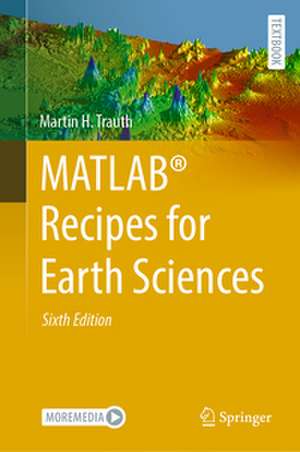
MATLAB® Recipes for Earth Sciences
Autor Martin H. Trauthen Limba Engleză Hardback – 18 mar 2025
Preț: 777.74 lei
Preț vechi: 948.47 lei
-18%
Puncte Express: 1167
Carte disponibilă
Livrare economică 30 noiembrie-14 decembrie
Livrare prin curier în România Termenul estimat este afișat lângă disponibilitate.
Transport gratuit pentru acest produs Plată online sau ramburs, în funcție de opțiunile comenzii.
Retur gratuit în 14 zile Comandă securizată și suport în română.
Specificații
ISBN-13: 9783031579486
ISBN-10: 3031579488
Pagini: 580
Ilustrații: Approx. 500 p. 350 illus., 250 illus. in color.
Dimensiuni: 160 x 241 x 35 mm
Greutate: 1.08 kg
Ediția:Sixth Edition 2025
Editura: Springer
Locul publicării:Cham, Switzerland
ISBN-10: 3031579488
Pagini: 580
Ilustrații: Approx. 500 p. 350 illus., 250 illus. in color.
Dimensiuni: 160 x 241 x 35 mm
Greutate: 1.08 kg
Ediția:Sixth Edition 2025
Editura: Springer
Locul publicării:Cham, Switzerland
Cuprins
Data Analysis in the Earth Sciences.- Introduction to MATLAB.- Univariate Statistics.- Bivariate Statistics.- Time Series Analysis.- Signal Processing.- Spatial Data.- Image Processing.- Multivariate Statistics.- Directional Data.
Notă biografică
Martin H. Trauth studierte Geophysik und Geologie an der Universität Karlsruhe. Er promovierte 1995 an der Universität Kiel und wurde anschließend ständiger wissenschaftlicher Mitarbeiter an der Universität Potsdam. Nach seiner Habilitation im Jahr 2003 wurde er Privatdozent, 2011 erhielt er eine außerplanmäßige Professur an der Universität Potsdam. Seit 1990 beschäftigt sich Martin H. Trauth mit verschiedenen Aspekten vergangener Klimaveränderungen im östlichen Afrika und in Südamerika. Seine Projekte zielten auf ein besseres Verständnis (1) der Rolle der Tropen bei der Beendigung von Eiszeiten, (2) der Beziehung zwischen klimatischen Veränderungen und der menschlichen Evolution und (3) des Einflusses von Klimaanomalien auf Massenbewegungen in den zentralen Anden. In jedem dieser Projekte wurden numerische und statistische Methoden (z.B. Zeitreihenanalyse und Signalverarbeitung) mit Paläoklima-Zeitreihen, Seebilanzmodellierung, stochastische Modellierung von Bioturbation, Alterstiefenmodellierung von Sedimentabfolgen oder Satelliten- und mikroskopische Bildverarbeitung eingesetzt. Martin H. Trauth lehrt seit mehr als 25 Jahren an der Universität Potsdam und an anderen Universitäten weltweit eine Vielzahl von Kursen zur Datenanalyse in den Geowissenschaften.
Textul de pe ultima copertă
MATLAB® is used in a wide range of geoscientific applications, such as for image processing in remote sensing, for generating and processing digital elevation models, and for analyzing time series. This book introduces methods of data analysis in the earth sciences using MATLAB, such as basic statistics for univariate, bivariate, and multivariate data sets, time series analysis, signal processing, spatial and directional data analysis, and image analysis. The text includes numerous examples demonstrating how MATLAB can be used on data sets from the earth sciences. The supplementary electronic material (available online through Springer Link) contains recipes that include all the MATLAB commands featured in the book and example data.
The Author:
Martin H. Trauth studied geophysics and geology at the University of Karlsruhe. He obtained a doctoral degree from the University of Kiel in 1995 and was subsequently appointed a permanent member of the scientific staff at the University of Potsdam. He became a lecturer following his habilitation in 2003 and was granted a titular professorship at the University of Potsdam in 2011. Since 1990, he has worked on various aspects of past changes in the climates of eastern Africa and South America. Martin H. Trauth has taught a variety of courses on data analysis in the earth sciences with MATLAB for more than 30 years both at the University of Potsdam and at other universities around the world.
Caracteristici
Introduces methods of data analysis in geosciences using MATLAB Contains numerous examples on how to process geoscientific information Written by an expert for geoscientific modeling programs