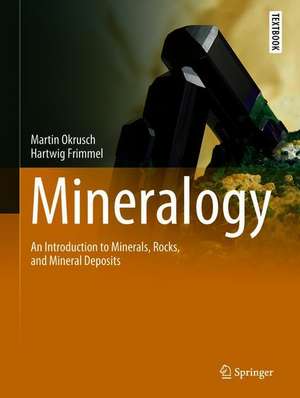
Mineralogy: An Introduction to Minerals, Rocks, and Mineral Deposits: Springer Textbooks in Earth Sciences, Geography and Environment
Autor Martin Okrusch, Hartwig E. Frimmelen Limba Engleză Hardback – 18 sep 2020
Capitolul dedicat cristalografiei, care deschide volumul, stabilește rigoarea științifică a acestei lucrări, abordând de la operații de simetrie și rețele Bravais până la determinarea structurilor prin difracție cu raze X. Putem afirma că Mineralogy reprezintă un efort de actualizare esențial, fiind prima traducere în limba engleză a unui text fundamental german care a servit drept referință în universități timp de decenii. Această ediție din 2020, semnată de Martin Okrusch și Hartwig E. Frimmel, păstrează structura didactică a originalului, dar integrează progresele recente din geochimie și studiul zăcămintelor.
Ne-a atras atenția modul în care autorii echilibrează descrierea teoretică a proprietăților fizice — conductivitate termică, proprietăți magnetice și electrice — cu aplicațiile practice în microscopia cu lumină transmisă și reflectată. Merită menționat că, spre deosebire de Minerals de Hans-Rudolf Wenk, care este conceput pentru cursuri de unul sau două semestre cu un accent mai pronunțat pe fotografiile color, lucrarea de față oferă o profunzime tehnică sporită în zona de cristalochimie și geneză a resurselor. Ea completează perspectiva oferită de Introduction to Mineralogy and Petrology, adăugând un fundament teoretic mai solid în zona simetriei și a legilor indicilor raționali, elemente cruciale pentru studenții avansați.
În contextul operei lui Martin Okrusch, acest titlu este succesorul direct al celebrului manual Mineralogie, rafinând conceptele introduse inițial de Siegfried Matthes. Structura este logică și progresivă: începe cu bazele cristalografiei (Partea I), trece prin definirea riguroasă a mineralelor și culminează cu procesele de formare a rocilor și depozitelor minerale. Este un instrument de lucru dens, cu 700 de pagini, susținut de numeroase figuri și tabele care facilitează înțelegerea fenomenelor complexe.
Preț: 613.80 lei
Preț vechi: 722.11 lei
-15%
Carte disponibilă
Livrare economică 30 octombrie-13 noiembrie
Specificații
ISBN-10: 3662573148
Pagini: 700
Ilustrații: XI, 719 p. 522 illus., 414 illus. in color.
Dimensiuni: 210 x 279 x 36 mm
Greutate: 1.86 kg
Ediția:1st ed. 2020
Editura: Springer Berlin, Heidelberg
Colecția Springer
Seria Springer Textbooks in Earth Sciences, Geography and Environment
Locul publicării:Berlin, Heidelberg, Germany
De ce să citești această carte
Această lucrare este esențială pentru studenții și specialiștii în geosciințe care caută o bază teoretică solidă, dincolo de simplele descrieri de minerale. Cititorul câștigă o înțelegere profundă a legăturii dintre structura atomică a cristalelor și proprietățile lor macroscopice. Este un manual de referință care face trecerea de la mineralogia descriptivă la cea analitică, fiind ideal pentru pregătirea examenelor universitare și pentru activitatea de cercetare în laborator.
Despre autor
Martin Okrusch este profesor emerit la Universitatea din Würzburg, fiind o figură de referință în petrologia și mineralogia germană. Experiența sa de decenii în cercetare și predare este sintetizată în acest manual, pe care l-a preluat și dezvoltat de la mentorul său, Siegfried Matthes. Hartwig E. Frimmel, co-autor al acestei ediții, este profesor de geologie economică, aducând o expertiză valoroasă în domeniul resurselor minerale și al geochimiei, elemente care întregesc viziunea modernă a acestui tratat academic publicat sub egida Springer.
Cuprins
1 Crystals
1.1 Crystal morphology
1.1.1 Symmetry operations and symmetry elements
1.1.2 Crystal systems and classes
1.1.3 The Law of rational indices
1.2 Crystal structure
1.2.1 Bravais lattices
2.2.2 Space groups
2.2.3 Determination of crystal structures by X-ray diffraction
1.3 Crystal chemistry
1.3.1 Basic concepts
1.3.2 Types of chemical bonds
1.3.3 Some important terms of crystal chemistry
1.4. Physical properties of crystals
1.4.1 Hardness and cohesion
1.4.2 Thermal conductivity
1.4.3 Electric properties
1.4.4 Magnetic properties
1.5 Optical crystallography
1.5.1 Basic bonds
1.5.2 Basic principles of microscopy in transmitted light
1.5.3 Basic principles of microscopy reflected light
References
2 Minerals
2.1 Definition of the term mineral
2.2 Identification and classification of minerals
2.3 Mode of occurrence
2.4 Rock-forming and economic minerals
2.4.1 Rock-forming minerals
2.4.2 Economic minerals
2.4.3 Gemstones
2.5 Biomineralisation and medical mineralogy
2.5.1 Biogenic mineral formation
2.5.2 Medical mineralogy
References
3 Rocks
3.1 Mineralogical composition of rocks
3.2 Relationships between lithogeochemistry and mineralogy
3.3 Rock fabric
3.3.1 Texture (microstructure)
3.3.2 Structure
3.4 Field relationships
3.5 Principal rock-forming processes
3.6 Mineral deposits
References
Part II
Systematic mineralogy – a selection of important minerals
4. Elements
4.1 Metals
4.2 Metalloids (semi-metals)
4.3 Non-metals
References
5 Sulfides, arsenides and complex sulfides (sulfosalts)
5.1 Metal su^ 1:1 (generally 2:1)
5.2 Metal sulfides and arsenites with M:S = 1:1
5.3 Metal sulfides, sulfarsenides and arsenites with M:S ≤ 1:2
5.4 Arsenic sulfides
5.5 Complex metal sulfides (sulfosalts)
References
6 Halides
References
7 Oxides and hydroxides
7.1 M2O compounds
7.2 M3O4 compounds
7.3 M2O3 compounds
7.4 MO2 compounds
7.5 Hydroxides
References
8 Carbonates, nitrates, borates
8.1 Calcite group 32/m
8.2 Aragonite group 2/m2/m2/m
8.3 Dolomite group
8.4 Azurite–malachite group
8.5 Nitrates
8.6 Borates
References
9 Sulfates, chromates, molybdates, wolframates
9.1 Sulfates
9.2 Chromates
9.3 Molybdates and wolframates
References
10 Phosphates, arsenates, vanadates
References
11 Silicates
11.1 Orthosilicates (nesosilicates)
11.2 Disilicates (sorosilicates)
11.3 Ring silicates (cyclosilicates)
11.4 Chain silicates (inosilicates)
11.4.1 Pyroxenes
11.4.2 Pyroxenoids 11.4.3 Amphiboles
11.5 Sheet silicates (phyllosilicates)
11.5.1 Pyrophyllite–talc group
11.5.2 Mica group
11.5.3 Hydro-mica group
11.5.4 Brittle mica group
11.5.5 Chlorite series
11.5.6 Serpentine group
11.5.7 Clay minerals
11.5.8 Apophyllite group
11.6 Framework silicates
11.6.1 SiO2 minerals
11.6.2 Feldspar family
11.6.3 Feldspathoids
11.6.4 Cancrinite group
11.6.5 Scapolite group
11.6.6 Zeolite family
References
12 Fluid inclusions in minerals
References
Part III
Petrology and metallogenesis
13. Igneous rocks
13.1. Classification of igneous rocks
13.1.1 Principal classification based on geological position and fabric
13.1.2 Classification based on mineralogy
13.1.3 Classification based on bulk chemical composition
13.2 Petrography of igneous rocks
13.2.1 Subalkaline magmatic rocks
13.2.2 Alkaline magmatic rocks
13.2.3 Carbonatite, kimberlite and lamproite
References
14 Volcanism
14.1 Effusive volcanism: lava flows
14.2 Extrusive volcanism
14.3 Explosive volcanism
14.4 Mixed volcanic activity: stratovolcanoes
14.5 Volcanic exhalations
References
15 Plutonism
15.1 Volcanic roots and magma chambers
15.2 Shapes of plutonic and subvolcanic intrusive bodies 15.3 Internal structure and emplacement of intrusive bodies
15.3.1 Internal structure of plutons
15.3.2 Emplacement mechanisms
15.3.3 Layered intrusions
References
16 Magma and lava
16.1 Chemical composition and structure of magma 16.2 Volcanic gases
16.3 Temperatures of magmat
16.3.1 Direct measurement by pyrometry
16.3.2 Melting experiments on natural rocks
16.4 Viscosity of magmas and lavas
16.5 Solubility of volatiles in magma
References
17 Formation and evolution of magmas
17.1 Magma series
17.2 Primary and parental melts
17.2.1 Primary basaltic melts
17.2.2 Granitic melts
17.3 Magma mixing
17.4 Magmatic differentiation
17.4.1 Fractional crystallisation
17.4.2 Liquid immiscibility
17.5 Assimilation
References
18 Experiments in simplified model systems
18.1 The Gibbs’ Phase Rule
18.2 Experiments in binary and ternary systems
18.2.1 Experiments modelling the fractional crystallisation of basaltic magmas
18.2.2 Experiments modelling the formation of SiO2-oversaturated and undersaturated
magmas
18.2.3 Experiments on the phase relations of mafic minerals in basaltic melts
18.3 Bowens’s Reaction Series
18.4 The basalt tetrahedron of Yoder and Tilley (1962)
18.5 Equilibrium melting and fractionated melting
References
19 The origin of basalt
19.1 Basalt types and plate tectonics
19.2 Formation of basaltic melts by partial melting of peridotite in Earth’s upper mantle
19.2.1 The pyrolite model
19.2.2 Partial melting of H2O-free pyrolite
19.2.3 Partial melting of H2O-bearing pyrolite
References
20 The origin of granite
20.1 Petrogenetic classification of granitoids based on their chemical composition
20.2 Experiments on the petrogenesis of granite
20.2.1 Introduction
20.2.2 Crystallisation sequence in granitic melts: Experiments on the H2O-saturated
model system Qz–Ab–Or–H2O
20.3.3 Experimental anatexis: Experiments under H2O saturated and H2O-
undersaturated conditions in the model system Qz–Ab–Or–H2O(–CO2)
20.2.4 The model system Qz–Ab–An–Or–H2O
20.2.5 The model system Qz–Ab–An–H2O
20.2.6 The natural granite system References
21 Orthomagmatic mineral deposits
21.1 Introduction
21.2 Mineralisation due to fractional crystallisation
21.2.1 Chromite and chromite–PGE deposits
21.2.2 Fe-Ti oxide deposits
21.3 Mineralisation due to liquid immiscibility
21.3.1 pyrrhotite–pentlandite–chalcopyrite–PGE deposits in norites and pyroxenites
21.3.2 pyrrhotite– pentlandite–chalcopyrite deposits in komatiites
21.3.3 Magnetite–apatite deposits
21.4 Carbonatite- and alkaline-magmatic rock-hosted mineralisations
References
22 Pegmatites
22.1 Theoretical considerations
22.2 Field relations, petrography and petrogenesis of pegmatites
22.3 Pegmatites as sources of economic minerals
22.4 Geochemical classification of granitic pegmatites
23 Hydrothermal mineral deposits
23.1 Basic principles
23.2 Hydrothermal impregnation deposits
23.2.1 Granite-related Sn-W deposits
23.3.2 Porphyry Cu- (Mo-, Au-) deposits
23.3.3 Impregnations with native copper (Lake Superior type)
23.3 Hydrothermal replacement deposits
23.3.1 Skarn deposits
23.3.2 Mesothermal Cu–As replacement deposits
23.3.3 Hydrothermal Pb–Ag–Zn replacement deposits
23.3.4 Hyrothermal gold–pyrite replacement deposits (Carlin type)
23.3.5 Metasomatic siderite deposits
23.4 Hydrothermal vein-type deposits
23.4.1 Orogenic gold–quartz veins
23.4.2 Epithermal Au- and Au–Ag veins (subvolcanic)
23.4.3 Mesothermal Cu ore veins
23.4.4 Pb–Ag–Zn ore veins
23.4.5 Sn–Ag–Bi ore veins in the Bolivian tin belt
23.4.6 Veins of Bi–Co–Ni–Ag–U ore
23.4.7 Telethermal stibnite–quartz veins
23.4.8 Hydrothermal siderite and haematite veins
23.4.9 Non-metallic hydrothermal veins
23.4.10 Quartz veins
23.4.11 Mineralisation in late-orogenic tension joints
23.5 Volcanogenic-sedimentary ore deposits
23.5.1 Ore formation by hydrothermal activity in the deep sea: Black smokers
23.5.2 Volcanic hosted massive sulfide-ore deposits (VMS deposits)
23.5.3 Volcanogenic massive Hg deposits
23.5.4 Magmatogenic oxide-ore deposits
23.6 Non-magmatic stratabound hydrothermal deposits
23.6.1 Sedimentary exhalative Pb–Zn deposits (SEDEX deposits)
23.6.2 Carbonate-hosted ore deposits (MVT)
23.7 Unconformity-related uranium deposits
References
24. Weathering and mineral formation in soils
24.1 Mechanical weathering
24.2 Chemical weathering
24.2.1 Highly soluble minerals
24.2.2 Silicate weathering
24.3 Subaerial weathering and climate zones
24.4 On the definition of the term soil
24.5 Weathering of silicate rocks and related deposits
24.5.1 Residual clay and other kaolin deposits
24.5.2 Bentonite
24.5.3 Bauxite
24.5.4 Fe-, Mn- and Co-rich laterite 24.5.5 Ni- and Co-rich laterite
24.5.6 Other residual deposits
24.6 Weathering of sulfidic ore bodies 24.6.1 Oxidation zone
24.6.2 Cementation zone
24.6.3 Stability of important secondary copper minerals
25. Sediments and sedimentary rocks
25.1 Basic principles
25.1.1 Classification of sediments and sedimentary rocks 25.1.2 Structures of sediments and sedimentary rocks
25.2 Clastic sediments and sedimentary rocks
25.2.1 Transport and deposition of clastic materials 25.2.2 Chemical alteration during sediment transport
25.2.3 Grain-size distribution of clastic sediments
25.3.4 Diagenesis of clastic sediments 25.2.5 Classification of rudites and arenites
25.2.6 Heavy minerals in arenites
25.2.7 Fluvial and marine placer deposits 25.2.8 Red bed deposits
25.2.9 Classification of argillites
25.2.10 Diagenesis of argillites 25.2.11 Base-metal deposits in black shales
25.2.12 Transition from diagenesis to low-grade metamorphism
25.3 Chemical and biochemical sediments and sedimentary rocks 25.3.1 Classification of sedimentary carbonate rocks
25.3.2 Solubility and precipitation conditions of carbonates
25.3.3 Anorganic and biochemical carbonate precipitation in sea water 25.3.4 Formation of terrestrial carbonate rocks
25.3.5 Diagenesis of limestone
25.3.6 Diagenetic magnesite deposits
25.4 Iron- and manganese-rich sediments and sedimentary rocks
25.4.1 Stability field of Fe-minerals
25.4.2 Sedimentary iron ores
25.4.3 Sedimentary manganese ores
25.4.4 Metal concentrations on the ocean floor
25.5 Siliceous sediments and sedimentary rocks
25.6 Sedimentary phosphate rocks 25.7 Evaporites
25.7.1 Continental (terrestrial) evaporites
25.7.2 Marine evaporites
26. Metamorphic rocks
26.1 Basic principles
26.1.1 Metamorphic processes
26.1.2 Protoliths of metamorphic rocks 26.1.3 Lower and upper temperature boundaries of metamorphism
26.1.4 The driving forces of metamorphism
26.2 Metamorphism as a geological process
26.2.1 Contact metamorphism
26.2.2 Cataclastic metamorphism and mylonitisation
26.2.3 Impact or shock metamorphism 26.2.4 Hydrothermal metamorphism
26.2.5 Regional metamorphism in orogens
26.2.6 Burial metamorphism 26.2.7 Ocean-floor metamorphism
26.3 Nomenclature of regional and contact metamorphic rocks
26.3.1 Regional metamorphic rocks 26.3.2 Contact metamorphic rocks
26.4 Structure and texture of metamorphic rocks
26.4.1 Remnants of protolith-structures 26.4.2 Metamorphic textures
26.4.3 Strain-induced preferred orientation of metamorphic minerals
26.5. Formation of migmatites by anatexis 26.5.1 Definition of the term migmatite
26.5.2 Experimental evidence of migmatite formation by partial melting
26.5.3 Mass balance in migmatites 26.5.4 The global geodynamic relevance of anatexis
26.6 Metasomatism
26.6.1 Contact metasomatism
26.6.2 Autometasomatism
26.2.3 Spilites as product of hydrothermal metamorphism and sodium metasomatism
References
27. Phase relations and mineral reactions in metamorphic rocks
27.1 Mineral equilibria in metamorphic rocks
27.1.1 Assessment of chemical equilibrium
27.1.2 Application of the Gibbs Phase Rule 27.1.3 Gibbs free energy: stable and metastable equilibria
27.2 Metamorphic mineral reactions
27.2.1 Polymorphic transformations and solid-solid reactions 27.2.2 Dehydration reactions
27.2.3 Decarbonation reactions
27.2.4 Reactions involving both H2O and CO2 27.2.5 Redox reactions
27.2.6 Petrogenetic grids
27.3 Geothermometry and geobarometry 27.4 Pressure-temperature evolution of metamorphic complexes
27.4.1 Pressure-temperature paths
27.4.2 Pressure-temperature-time paths
27.5 Graphical presentation of metamorphic mineral assemblages
27.5.1 ACF and A’KF diagrams
27.5.2 AFM projections
References
28 Metamorphic facies and facies series
28.1 Principles of metamorphic facies
28.2 Metamorphic facies series
28.3 Mineralogical characteristics of individual metamorphic facies
28.3.1 Zeolite and prehnite–pumpellyite facies
28.3.2 Greenschist facies
28.3.3 Epidote-amphibolite facies
28.3.4 Amphibolite facies
28.3.5 Granulite facies
28.3.6 Hornfels facies
28.3.7 Sanidinite facies 28.3.8 Blueschist facies
28.3.9 Eclogite facies
References
Part IV
Our planetary system
29 Earth's interior
29.1 Seismic evidence of the whole-Earth structure 29.1.1 Physical background
29.1.2 Propagation of seismic waves through Earth's interior
29.1.3 Velocity distribution of seismic waves in Earth's interior
29.2 The crust
29.2.1 Oceanic crust
29.2.2 Continental crust
29.2.3 The crust in orogenic belts
29.3 The mantle
29.3.1 The uppermost lithospheric mantle and the nature of the Moho
29.3.2 The asthenosphere as conveyor belt of lithosperic plates
29.3.3 The transitional zone between upper and lower mantle 29.3.4 The lower mantle
29.4 The core
29.4.1 Seismic evidence
29.4.2 Chemical composition of the core
References
30. Lunar rocks and the Moon's interior
30.1 The lunar crust 30.1.1 Lunar highlands
30.1.2 Maria
30.1.3 Minerals in lunar rocks
30.1.4 Lunar regolith 30.1.5 Relics of water in the lunar regolith
30.2 Moon's internal layering
30.2.1 Lunar crust
30.2.2 Lunar mantle
30.2.3 Lunar core
30.3 Geological history of the Moon
References
31. Meteorites
31.1 Fall phenomena
31.2 Frequency of falls and finds
31.3 Classification of meteorites derived from the asteroid belt
31.3.1 Undifferentiated stony meteorites: Chondrites
31.3.2 Achondrites derived from the asteroid belt
31.3.3 Stony iron meteorites (differentiated)
31.3.4 Iron meteorites (differentiated) 31.4 Planetary meteorites
31.4.1 Martian meteorites: The SNC group of achondrites
31.4.2 Lunar meteorites: Lunaites
31.5 Tektites
References
32 The planets, their satellites and smaller planetary bodies
32.1 The terrestrial planets
32.1.1 Mercury
32.1.2 Venus
32.1.3 Mars
32.2 Asteroids
32.3 The giant planets and their satellites
32.3.1 Astronomical exploration
32.3.2 Atmosphere and interior of the giant planets
32.3.3 The moons of Jupiter
32.3.4 The icy moons of Saturn, Uranus and Neptune
32.3.5 The ring systems of the giant planets
32.4 The trans-Neptun objects (TNO) in the Kuiper belt
32.5 The dwarf planet Pluto and its moon Charon: A double planet References
33. Introduction to geochemistry
33.1 Geochemical classification of the elements
33.2 Chemical composition of the bulk Earth
33.3 Chemical composition of the Earth's crust
33.3.1 Calculation of the mean crustal composition: Clarke values
33.3.2 Rare elements and their Clarke values
33.4. Trace-element partitioning and magmatic processes
33.4.1 Basic concepts
33.4.2 Trace-element fractionation during formation and differentiation of magmas
33.4.3 Trace elements as indicators of the geotectonic setting of magmatic processes 33.5 Isotope geochemistry
33.5.1 Introduction
33.5.2 Stable isotopes
33.5.3 Radiogenic isotopes in geochronology
33.6 The formation of the chemical elements
References
34. The genesis of our solar system
34.1 Earlier theories
34.2 Formation of stars
34.3 Composition of the solar nebula
34.4 Formation of planets
References
A Appendix
A.1 Important ionic radii and the coordination of cations against O2-
A.2 Calculation of mineral formulae
I Index
Subject index
Geographical index
Notă biografică
Hartwig Frimmel, born in 1960 in Linz, Austria, received his PhD in Geology and Petrology from the University of Vienna in 1987. Since 2004 he has been a full professor at the University of Würzburg, Bavaria, where he holds the Chair in Geodynamics and Geomaterials Research. He is an honorary research associate at the University of Cape Town, South Africa, where he rose from lecturer to associate professor between 1989 and 2004. From 1998 to 2004 he was the leader of the Earth Science subprogramme of the South African National Antarctic Programme. He is a former president of the Society for Geology Applied to Mineral Deposits (SGA) and advisor at the national and European level on matters concerning mineral deposits. His main research interests range from economic geology, metamorphic petrology, Precambrian palaeoclimate and palaeogeography, to sedimentary geochemistry and the role of early life in metallogenesis.
Textul de pe ultima copertă
Caracteristici
Serves as didactic guide to the principles of mineralogical processes
Includes numerous figures and tables
Provides a detailed description of the genesis of mineral resources