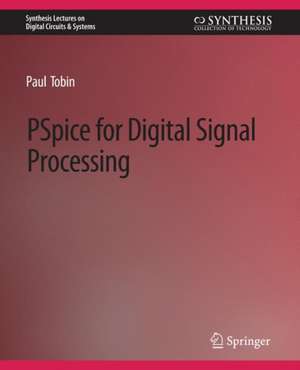
PSpice for Digital Signal Processing: Synthesis Lectures on Digital Circuits & Systems
Autor Paul Tobinen Limba Engleză Paperback – 31 dec 2007
Ne-a atras atenția modul în care acest volum, bazat pe resurse precum Cadence Orcad PSpice versiunea 10.5 și utilitarul Wav2Ascii, propune o alternativă tehnică la abordarea clasică bazată pe Matlab. Considerăm că forța acestui text rezidă în capacitatea de a „deschide cutia neagră” a procesării semnalelor digitale (DSP), oferind o vizibilitate directă asupra comportamentului circuitelor, spre deosebire de natura abstractă a pachetelor software matematice. Pe linia practică a lucrării Conceptual Digital Signal Processing with MATLAB, dar cu focus pe simularea la nivel de circuit și componente, volumul ghidează cititorul prin mecanismele intime ale filtrelor FIR și IIR. Structura este riguros organizată în șase capitole ce reflectă o progresie logică: de la bazele semnalelor eșantionate și ecuații cu diferențe, la designul filtrelor prin transformată biliniară și tehnici de ferestruire. Recomandăm atenția asupra capitolului dedicat convoluției, unde autorul utilizează ingenios comanda 'log' din Probe pentru a demonstra metoda grafică a eșantioanelor. În contextul operei sale tehnice, PSpice for Digital Signal Processing reprezintă punctul culminant al seriei Synthesis Lectures on Digital Circuits & Systems, continuând rigoarea metodologică din PSpice for Digital Communications Engineering și extinzând-o către aplicații complexe precum modulația SSB și decimarea semnalelor. Finalul volumului aduce o notă practică distinctă, explorând aplicații muzicale (ecou, reverberație) și egalizarea semnalelor în receptoare, demonstrând că mediul PSpice este capabil să gestioneze scenarii de utilizare din lumea reală prin conversia fișierelor audio în formate compatibile de date.
Din seria Synthesis Lectures on Digital Circuits & Systems
-
 Preț: 394.07 lei
 - 18%
 Preț: 912.46 lei
 - 20%
 Preț: 325.01 lei
 -
 Preț: 295.42 lei
 -
 Preț: 404.25 lei
 -
 Preț: 383.35 lei
 -
 Preț: 450.83 lei
 -
 Preț: 295.13 lei
 -
 Preț: 271.12 lei
 -
 Preț: 312.47 lei
 -
 Preț: 305.34 lei
 - 19%
 Preț: 505.44 lei
 -
 Preț: 317.88 lei
 -
 Preț: 440.48 lei
 -
 Preț: 257.00 lei
 -
 Preț: 254.22 lei
 -
 Preț: 253.04 lei
 -
 Preț: 212.49 lei
 -
 Preț: 249.79 lei
 -
 Preț: 269.29 lei
 -
 Preț: 199.08 lei
 -
 Preț: 306.46 lei
 -
 Preț: 255.39 lei
 - 15%
 Preț: 532.06 lei
 -
 Preț: 402.03 lei
 -
 Preț: 446.62 lei
 -
 Preț: 232.45 lei
 -
 Preț: 253.12 lei
 -
 Preț: 262.78 lei
 -
 Preț: 400.30 lei
 -
 Preț: 258.95 lei
 -
 Preț: 471.39 lei
 -
 Preț: 258.35 lei
 -
 Preț: 245.79 lei
 -
 Preț: 263.36 lei
 -
 Preț: 401.98 lei
 -
 Preț: 433.54 lei
 -
 Preț: 397.84 lei
 -
 Preț: 433.99 lei
 -
 Preț: 199.71 lei
 -
 Preț: 433.13 lei
 -
 Preț: 199.71 lei
 -
 Preț: 203.88 lei
 -
 Preț: 254.22 lei
 -
 Preț: 201.37 lei
Preț: 295.13 lei
Carte disponibilă
Livrare economică 28 octombrie-11 noiembrie
Livrare express 13-17 octombrie pentru 30.04 lei
Specificații
ISBN-10: 3031797663
Pagini: 156
Ilustrații: XI, 141 p.
Dimensiuni: 191 x 235 x 9 mm
Greutate: 0.31 kg
Editura: Springer
Colecția Synthesis Lectures on Digital Circuits & Systems
Seria Synthesis Lectures on Digital Circuits & Systems
Locul publicării:Cham, Switzerland
V-ar putea interesa
-
 DSP FirstJames H. McClellan-23%Preț: 1526.36 lei1982.28 lei
 -
 Signal Processing and Linear SystemsB. P. Lathi-24%Preț: 1592.65 lei2085.53 lei
 -
 Digital Signal ProcessingEmmanuel Ifeachor-20%Preț: 572.74 lei715.93 lei
 -
 Signals and Systems Using MATLAB®Aydin Akan-32%Preț: 654.18 lei964.49 lei
 -
 -32%Preț: 454.59 lei667.43 lei
 -
 -40%Preț: 618.11 lei1027.76 lei
 -
 -24%Preț: 143.13 lei189.40 lei
 -
 Digital Signal ProcessingThomas Holton-23%Preț: 912.20 lei1184.67 lei
 -
 -9%Preț: 125.42 lei138.36 lei
 -
 Digital Signal Processing First, Global EditionJames Mcclellan-20%Preț: 655.49 lei819.36 lei
 -
 ElectronicsNeil Storey-9%Preț: 553.60 lei608.36 lei
 -
 Signals, Systems and Inference, Global EditionAlan Oppenheim-15%Preț: 655.58 lei771.26 lei
 -
 Digital Image Processing, Global EditionRafael Gonzalez-11%Preț: 654.09 lei734.93 lei
 -
 Signals and SystemsChi-Tsong ChenPreț: 156.42 lei
 -
 -18%Preț: 948.18 lei1156.32 lei
 -
 Signals and Systems with MATLAB® and Simulink®Farzin AsadiPreț: 431.01 lei
 -
 PSpice for Filters and Transmission LinesPaul TobinPreț: 295.42 lei
De ce să citești această carte
Recomandăm această carte inginerilor și studenților care doresc să înțeleagă DSP dincolo de formule abstracte. Cititorul câștigă o metodă de vizualizare a semnalelor în timp real folosind PSpice, un instrument standard în industrie. Este un ghid esențial pentru cei care vor să vadă cum teoriile matematice, precum transformata z sau convoluția, se traduc direct în comportament hardware și circuite funcționale, oferind o perspectivă aplicată rar întâlnită în manualele teoretice.
Despre autor
Paul Tobin este un autor prolific, a cărui activitate acoperă domenii surprinzător de diverse. Deși în spațiul public este recunoscut pentru contribuțiile sale majore în universul benzilor desenate, scriind pentru Marvel Comics și adaptând serii celebre precum The Witcher Omnibus sau Plants vs. Zombies Volume 16: The Garden Path, Tobin deține o expertiză tehnică solidă în ingineria electronică. Această dualitate îi permite să redacteze manuale tehnice pentru Springer cu o claritate didactică deosebită, reușind să explice concepte matematice complexe prin simulări practice accesibile, transformând seria sa despre PSpice într-o resursă de referință pentru comunitatea academică.