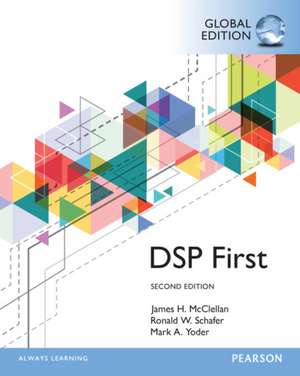
Digital Signal Processing First, Global Edition
Autor James Mcclellan, James H. McClellan, Ronald W. Schafer, Mark Yoderen Limba Engleză Paperback – 5 aug 2016
Ecosistemul educațional propus de Digital Signal Processing First, Global Edition se bazează pe integrarea mediului de programare MATLAB ca limbaj fundamental pentru rezolvarea problemelor de inginerie. Subliniem faptul că acest volum reprezintă o evoluție a metodei pedagogice dezvoltate de James H. McClellan și echipa sa, prioritizând procesarea semnalelor în fața studiului clasic al circuitelor. Față de alte lucrări ale autorului, precum Science Reorganized, care explorează perspective istorice și instituționale asupra științei, lucrarea de față este un instrument tehnic aplicat, riguros structurat pentru mediul universitar. Considerăm că progresia materialului este logică și orientată spre practică, începând cu reprezentarea matematică a semnalelor și sistemelor, trecând prin studiul sinusoidelor și ajungând la conceptele fundamentale de fazori. Ediția a doua extinde considerabil acoperirea teoretică prin adăugarea a trei capitole esențiale: Seriile Fourier, Transformata Fourier în timp discret (DTFT) și Transformata Fourier Discretă (DFT). Această structură indică o trecere graduală de la experimentul fizic, precum cel cu diapazonul descris în capitolul 2, către algoritmi complecși de procesare. Abordarea diferă de cea din Digital Signal Processing de Samir I. Abood prin faptul că este mai puțin abstractă și mult mai aplicabilă; în timp ce Abood se concentrează pe o prezentare logică pas-cu-pas a principiilor, Digital Signal Processing First, Global Edition forțează interacțiunea directă cu semnalele prin sute de probleme noi și demonstrații vizuale. Experiența de lectură este definită de un ritm alert, susținut de necesitatea implementării constante în MATLAB, ceea ce transformă teoria în abilități tehnice concrete.
Preț: 655.49 lei
Preț vechi: 819.36 lei
-20%
Carte disponibilă
Livrare economică 16-30 noiembrie
Livrare express 31 octombrie-06 noiembrie pentru 60.67 lei
Specificații
ISBN-10: 1292113863
Pagini: 592
Dimensiuni: 203 x 254 x 32 mm
Greutate: 1.25 kg
Ediția:2. Auflage
Editura: Pearson
V-ar putea interesa
-
 On the Foundations of ComputingGiuseppe Primiero-17%Preț: 401.43 lei481.14 lei
 -
 Computational Intelligence in Healthcare ApplicationsRajeev Agrawal-28%Preț: 839.26 lei1161.12 lei
 -
 -20%Preț: 211.41 lei264.26 lei
 -
 Blockchain Chicken FarmXiaowei WangPreț: 93.56 lei
 -
 Possible Minds: Twenty-Five Ways of Looking at AIJohn Brockman-36%Preț: 83.27 lei129.23 lei
 -
 -7%Preț: 93.82 lei101.31 lei
 -
 Algorithms Illuminated (Part 2)Tim Roughgarden-20%Preț: 89.06 lei111.32 lei
 -
 Database SystemsRamez Elmasri-20%Preț: 552.09 lei690.12 lei
 -
 The Political Principles of Robert A. TaftRussell KirkPreț: 483.87 lei
 -
 Beaglebone CookbookMark A Yoder-20%Preț: 202.58 lei253.22 lei
 -
 Life Along the Apalachicola RiverJim McclellanPreț: 119.31 lei
 -
 Tmux 2Brian Hogan-20%Preț: 129.90 lei162.38 lei
 -
 The Revolutionary PhenotypeJean-François GariépyPreț: 122.50 lei
 -
 AdventureJamie LendinoPreț: 117.78 lei
 -
 Preț: 438.57 lei
 -
 Earthquakes and Multi-hazards Around the Pacific Rim, Vol. IYongxian ZhangPreț: 432.41 lei
 -
 JAVA PROGRAMMING (22412)Mahesh Gurunani-20%Preț: 202.00 lei252.49 lei
 -
 COMPUTER ORGANIZATIONMeghana Tikhe-Palkar-20%Preț: 138.73 lei173.42 lei
 -
 COMPILER DESIGNRajeshs. Prasad-20%Preț: 110.93 lei138.67 lei
 -
 WEB TECHNOLOGY (HTML--JSS--CSS)Bhupesh Taunk-20%Preț: 138.38 lei172.98 lei
 -
 RELATIONAL DATABASEMs. MANISHA Bharambe-20%Preț: 164.70 lei205.88 lei
 -
 DATA WAREHOUSING WITH MINING TECHNIQUES (22621)MeenakshiA. Thalor-20%Preț: 97.41 lei121.77 lei
 -
 CLOUD COMPUTING (22624)KishorS. Wagh-20%Preț: 144.54 lei180.67 lei
 -
 NETWORK AND INFORMATION SECURITY (22620)MrunalP. FatangarePreț: 145.28 lei
De ce să citești această carte
Recomandăm această carte studenților și inginerilor aflați la început de drum care doresc o bază solidă în procesarea semnalelor fără a depinde de cunoștințe prealabile despre circuite. Cititorul câștigă o înțelegere intuitivă a matematicii aplicate prin exerciții practice în MATLAB. Este un manual esențial pentru cei care preferă învățarea prin experimentare și vizualizare în detrimentul teoriei pur abstracte.
Descriere scurtă
DSP First and its accompanying digital assets are the result of more than 20 years of work that originated from, and was guided by, the premise that signal processing is the best starting point for the study of electrical and computer engineering. The "DSP First" approach introduces the use of mathematics as the language for thinking about engineering problems, lays the groundwork for subsequent courses, and gives students hands-on experiences with MATLAB.
The Second Edition features three new chapters on the Fourier Series, Discrete-Time Fourier Transform, and the The Discrete Fourier Transform as well as updated labs, visual demos, an update to the existing chapters, and hundreds of new homework problems and solutions.
Cuprins
1-1 Mathematical Representation of Signals
1-2 Mathematical Representation of Systems
1-3 Systems as Building Blocks
1-4 The Next Step
Sinusoids
2-1 Tuning Fork Experiment
2-2 Review of Sine and Cosine Functions
2-3 Sinusoidal Signals
2-3.1 Relation of Frequency to Period
2-3.2 Phase and Time Shift
2-4 Sampling and Plotting Sinusoids
2-5 Complex Exponentials and Phasors
2-5.1 Review of Complex Numbers
2-5.2 Complex Exponential Signals
2-5.3 The Rotating Phasor Interpretation
2-5.4 Inverse Euler Formulas Phasor Addition
2-6 Phasor Addition
2-6.1 Addition of Complex Numbers
2-6.2 Phasor Addition Rule
2-6.3 Phasor Addition Rule: Example
2-6.4 MATLAB Demo of Phasors
2-6.5 Summary of the Phasor Addition Rule Physics of the Tuning Fork
2-7.1 Equations from Laws of Physics
2-7.2 General Solution to the Differential Equation
2-7.3 Listening to Tones
2-8 Time Signals: More Than Formulas
Summary and Links
Problems
Spectrum Representation
3-1 The Spectrum of a Sum of Sinusoids
3-1.1 Notation Change
3-1.2 Graphical Plot of the Spectrum
3-1.3 Analysis vs. Synthesis
Sinusoidal Amplitude Modulation
3-2.1 Multiplication of Sinusoids
3-2.2 Beat Note Waveform
3-2.3 Amplitude Modulation
3-2.4 AM Spectrum
3-2.5 The Concept of Bandwidth
Operations on the Spectrum
3-3.1 Scaling or Adding a Constant
3-3.2 Adding Signals
3-3.3 Time-Shifting x.t/ Multiplies ak by a Complex Exponential
3-3.4 Differentiating x.t/ Multiplies ak by .j 2nfk/
3-3.5 Frequency Shifting
Periodic Waveforms
3-4.1 Synthetic Vowel
3-4.3 Example of a Non-periodic Signal
Fourier Series
3-5.1 Fourier Series: Analysis
3-5.2 Analysis of a Full-Wave Rectified Sine Wave
3-5.3 Spectrum of the FWRS Fourier Series
3-5.3.1 DC Value of Fourier Series
3-5.3.2 Finite Synthesis of a Full-Wave Rectified Sine
Time-Frequency Spectrum
3-6.1 Stepped Frequency
3-6.2 Spectrogram Analysis
Frequency Modulation: Chirp Signals
3-7.1 Chirp or Linearly Swept Frequency
3-7.2 A Closer Look at Instantaneous Frequency
Summary and Links
Problems
Fourier Series
Fourier Series Derivation
4-1.1 Fourier Integral Derivation
Examples of Fourier Analysis
4-2.1 The Pulse Wave
4-2.1.1 Spectrum of a Pulse Wave
4-2.1.2 Finite Synthesis of a Pulse Wave
4-2.2 Triangle Wave
4-2.2.1 Spectrum of a Triangle Wave
4-2.2.2 Finite Synthesis of a Triangle Wave
4-2.3 Half-Wave Rectified Sine
4-2.3.1 Finite Synthesis of a Half-Wave Rectified Sine
Operations on Fourier Series
4-3.1 Scaling or Adding a Constant
4-3.2 Adding Signals
4-3.3 Time-Scaling
4-3.4 Time-Shifting x.t/ Multiplies ak by a Complex Exponential
4-3.5 Differentiating x.t/ Multiplies ak by .j!0k/
4-3.6 Multiply x.t/ by Sinusoid
Average Power, Convergence, and Optimality
4-4.1 Derivation of Parseval's Theorem
4-4.2 Convergence of Fourier Synthesis
4-4.3 Minimum Mean-Square Approximation
Pulsed-Doppler Radar Waveform
4-5.1 Measuring Range and Velocity
Problems