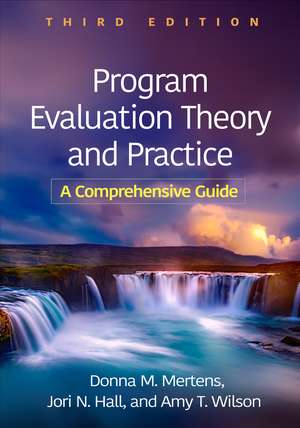
Program Evaluation Theory and Practice, Third Edition: A Comprehensive Guide
Autor Donna M. Mertens, Amy T. Wilson, Jori N. Hallen Limba Engleză Paperback – 11 mar 2025
Observăm în ultimii ani o evoluție semnificativă în domeniul evaluării programelor, care a trecut de la o simplă măsurare a rezultatelor la un instrument complex de justiție socială și analiză a sistemelor. Program Evaluation Theory and Practice, Third Edition reflectă această transformare, oferind un cadru care îmbină rigoarea metodologică cu sensibilitatea culturală. Notăm cu interes modul în care autorii Donna M. Mertens, Amy T. Wilson și Jori N. Hall au reușit să actualizeze acest text fundamental pentru a include paradigme emergente, precum cea Indigenă, oferind o voce grupurilor marginalizate în procesul de cercetare.
Această ediție extinde cadrul propus de Evaluation Roots, Third Edition de Marvin C. Alkin prin faptul că nu se limitează la ierarhizarea teoriilor, ci oferă instrumente practice pentru aplicarea acestora în contexte diverse, de la proiecte locale la evaluări multi-site complexe. Considerăm că forța acestei lucrări rezidă în structura sa progresivă: începe cu fundamentele etice și istorice (Partea I), trece prin ramurile teoretice majore — postpozitivism, constructivism, pragmatism și transformare (Partea II) — și culminează cu planificarea detaliată și utilizarea rezultatelor (Părțile III și IV).
În contextul operei sale, Donna M. Mertens continuă aici direcția începută în Transformative Research and Evaluation, rafinând abordarea sa centrată pe drepturile omului. Față de Program Evaluation Theory and Practice, Second Edition, noua ediție aduce o perspectivă tehnologică necesară, discutând deschis despre avantajele și riscurile utilizării inteligenței artificiale și despre noile metode de codare calitativă. Textul rămâne un ghid echilibrat între teorie și practică, esențial pentru navigarea într-un peisaj profesional tot mai digitalizat și globalizat.
Preț: 566.85 lei
Preț vechi: 666.89 lei
-15%
Carte disponibilă
Livrare economică 09-23 noiembrie
Livrare express 24-30 octombrie pentru 100.72 lei
Specificații
ISBN-10: 146255590X
Pagini: 631
Dimensiuni: 178 x 254 x 34 mm
Greutate: 1.1 kg
Ediția:3. Auflage
Editura: Guilford Publications
Colecția Guilford Press
De ce să citești această carte
Recomandăm această lucrare studenților și profesioniștilor care doresc o înțelegere profundă a metodologiilor de evaluare moderne. Veți câștiga nu doar competențe tehnice în design mixed-methods și analiză de date, ci și capacitatea de a integra perspective diverse (feministe, LGBTQ+, indigene) în proiectele dumneavoastră. Este un instrument indispensabil pentru cei care vor să utilizeze evaluarea ca motor al schimbării sociale și al eficienței organizaționale.
Despre autor
Donna M. Mertens este profesor emerit la Universitatea Gallaudet, fiind o autoritate recunoscută internațional în metodologii de cercetare și evaluare transformativă. Expertiza sa este profund ancorată în lucrul cu comunități diverse, predând metode de cercetare studenților cu deficiențe de auz la nivel de masterat și doctorat. Cariera sa este dedicată utilizării evaluării pentru a promova justiția socială și drepturile persoanelor cu dizabilități. Alături de co-autorii Amy T. Wilson și Jori N. Hall, Mertens aduce în această ediție o vastă experiență practică în evaluări internaționale și servicii de educație specială.
Recenzii
"This text does a great job of providing a wide overview of program evaluation and an initial knowledge base about the most relevant topics in theory and practice. Readers who take a deep dive into this text will be ready to venture into the field under the guidance of a senior evaluator."--Dorothy Skierkowski-Foster, PhD, Department of Psychology, University of Rhode Island
"The pedagogical features support student learning. The 'Preparing to Read' and 'Moving On' elements that bookend each chapter help to guide students through the material. My students are especially interested in the numerous and varied evaluation examples, including examples from international programs. I have not found another program evaluation text that offers this quality and diversity of international examples."--Adriana Cimetta, PhD, MPH, Director, Center for Educational Assessment, Research, and Evaluation, University of Arizona College of Education
"I chose this book because of the strong, detailed chapters on paradigms and theories. The text truly helps students identify their theoretical frames for their pending research. The examples are critically important in bringing the theories and methods to life."--Juan C. Gonzales, PhD, Department of Educational Leadership and Policy, The University of Texas at Austin
"The strengths of this text include its readability and pedagogical features. The presentation of concepts and practices is just as comprehensive as in other evaluation texts, but the pedagogical features highlight the main concepts and move the reader along. Case study applications provide sufficient detail for integration into course activities and assignments. The book is well balanced in laying a theoretical foundation and guiding the user through the evaluation cycle with diverse applications. Students will continue to reference the resources in this text when they become practicing evaluators."--Kristin Koskey, PhD, Research Professor and Co-Director, The Methods Lab, Drexel University School of Education
"This book offers a theoretically grounded introduction to program evaluation, along with practical examples. It provides insightful guidance to help prepare the reader for professional practice."--Christopher Gareis, EdD, William & Mary School of Education-
Cuprins
I. The Landscape of Evaluation
1. Introduction to Evaluation: Defining Terms and Ethical Considerations
2. History of Evaluation and Philosophical Frameworks
II. Evaluation Paradigms, Branches, Theories, and Approaches
3. The Postpositivist Paradigm and the Methods Branch
4. The Pragmatic Paradigm and the Use Branch
5. The Constructivist Paradigm and the Values Branch
6. The Transformative Paradigm and the Social Justice Branch
7. The Indigenous Paradigm and the Needs and Context Branch
III. Planning Evaluations
8. Working with Stakeholders: Establishing the Context and the Evaluand
9. Evaluation Purposes, Types, and Questions
10. Evaluation Designs
11. Data Collection Strategies and Indicators
12. Stakeholders, Participants, and Sampling
13. Data Analysis and Interpretation
IV. Implementation in Evaluation: Communication and Utilization of Findings, Management, Meta-Evaluation, and Challenges
14. Communication and Utilization of Findings
15. Meta-Evaluation and Project Management
16. Perennial and Emerging Challenges in Evaluation
Glossary
References
Author Index
Subject Index
About the Authors
Descriere scurtă
New to This Edition
- Restructured section on philosophical frameworks, with a new chapter on the Indigenous paradigm and expanded coverage of disability, feminist, and LGBTQ+ theories.
- Additional sample studies, including multi-site and systems- and complexity-informed evaluations.
- Expanded coverage of logic models, cost–benefit evaluations, and mixed methods designs.
- New and updated coverage of data collection technologies, qualitative coding methods, Sustainable Development Goals, and uses and pitfalls of artificial intelligence.
- Reflection questions that prepare students to read each chapter.
- "Extending Your Thinking" questions and learning activities.
- New within-chapter maps to aid in navigating chapter sections.
- Boxes offering sample evaluations and closer looks at key concepts.
- Helpful checklists and tables, bolded key terms, and an end-of-book Glossary.
- Companion website with links to recommended online resources and tools.
Notă biografică
Jori N. Hall, PhD, is President's Distinguished Professor of Educational Psychology at the University of Illinois at Chicago. She is an award-winning author and multidisciplinary researcher. Dr. Hall has conducted evaluations in various fields with historically minoritized communities, and has taught graduate-level courses on culturally responsive evaluation, evaluation theory, and mixed methods. Guided by her extensive training and collaborative experiences, she brings a values-engaged, culture-oriented lens that contributes to responsive, rigorous, and innovative evaluation theory and practice.
Amy T. Wilson, PhD, is former Director of Mill Neck International at the Mill Neck Family of Organizations, where she led a team of deaf education specialists sharing their expertise, knowledge, and technical skills with parents, educators, and professionals in economically poor countries. Previously, she was Program Director of the International Development Programs at Gallaudet University. For 20 years, Dr. Wilson engaged in international program development, conducting evaluations in various venues around the world, teaching graduate students, and training people from underserved communities.