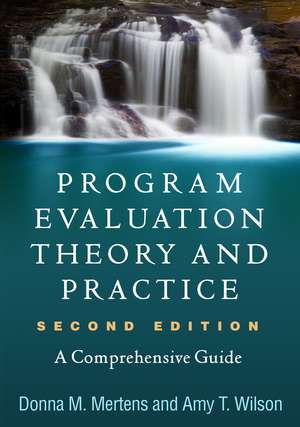
Program Evaluation Theory and Practice, Second Edition: A Comprehensive Guide
Autor Donna M. Mertens, Amy T. Wilsonen Limba Engleză Paperback – 7 dec 2018
Ceea ce aduce nou această a doua ediție a volumului Program Evaluation Theory and Practice este o actualizare metodologică substanțială, adaptată peisajului tehnologic actual și diversității nevoilor sociale. Remarcăm introducerea unor abordări esențiale precum evaluarea bazată pe principii și evaluarea colaborativă, alături de o extindere necesară a discuțiilor despre modelele logice și analizele cost-beneficiu. Lucrarea reușește să pună în echilibru rigoarea academică și pragmatismul cerut de practică, oferind un ghid complet pentru navigarea între teorie și aplicabilitate. Structura cărții urmărește o progresie logică: primele două părți stabilesc contextul etic și paradigmele teoretice (postpozitivistă, pragmatică, constructivistă și transformativă), în timp ce părțile a treia și a patra se concentrează pe execuția tehnică — de la lucrul cu stakeholderii și designul cercetării, până la analiza datelor și managementul proiectelor de meta-evaluare. Suntem de părere că această ediție completează perspectiva oferită de Evaluation Roots, Third Edition de Marvin C. Alkin; în timp ce Alkin se concentrează pe filiația teoriilor („copacul teoretic”), Mertens și Wilson oferă o metodologie aplicată mult mai granulară, incluzând tehnici de codificare calitativă și utilizarea noilor tehnologii în colectarea datelor. În contextul operei sale, Donna M. Mertens rafinează aici conceptele din Transformative Research and Evaluation, consolidând legătura dintre rigoarea cercetării și impactul asupra justiției sociale. Tonul este precis, orientat spre dezvoltarea competențelor, făcând din acest volum un instrument indispensabil pentru curriculumul de metodologie și evaluare a programelor.
Preț: 590.44 lei
Preț vechi: 641.79 lei
-8%
Carte disponibilă
Livrare economică 17 noiembrie-01 decembrie
Livrare express 31 octombrie-06 noiembrie pentru 58.20 lei
Specificații
ISBN-10: 1462532756
Pagini: 620
Dimensiuni: 178 x 254 x 27 mm
Greutate: 1.09 kg
Ediția:2. Auflage
Editura: Guilford Publications
Colecția Guilford Press
Public țintă
Professional Practice & DevelopmentDe ce să citești această carte
Recomandăm această lucrare profesioniștilor și studenților care au nevoie de un cadru teoretic solid dublat de instrumente practice imediate. Cititorul câștigă acces la studii de caz actualizate, liste de verificare (checklists) și activități de învățare care transformă conceptele abstracte în competențe de evaluare. Este resursa ideală pentru cei care doresc să stăpânească metodele mixte și să integreze etica și diversitatea în designul evaluărilor de impact.
Despre autor
Donna M. Mertens este profesor emerit la Universitatea Gallaudet, fiind o figură centrală în domeniul metodologiei cercetării și evaluării programelor. Expertiza sa se concentrează pe includerea persoanelor cu dizabilități și pe promovarea justiției sociale prin evaluare, teme reflectate în lucrări de referință precum Research and Evaluation Methods in Special Education. Amy T. Wilson completează această viziune cu o perspectivă practică vastă. Împreună, autorii au creat un standard academic care este utilizat la nivel internațional în programele de masterat și doctorat pentru pregătirea viitorilor evaluatori.
Cuprins
1. Introduction to Evaluation: Defining Terms and Ethical Considerations
2. Framing Evaluation: Paradigms, Branches, and Theories
II. Historical and Contemporary Evaluation Paradigms, Branches, Theories, and Approaches
3. The Postpositivist Paradigm and the Methods Branch
4. The Pragmatic Paradigm and the Use Branch
5. The Constructivist Paradigm and the Values Branch
6. The Transformative Paradigm and the Social Justice Branch
III. Planning Evaluations
7. Working with Stakeholders: Establishing the Context and the Evaluand
8. Evaluation Purposes, Types, and Questions
9. Evaluation Designs
10. Data Collection Strategies and Indicators
11. Stakeholders, Participants, and Sampling
12. Data Analysis and Interpretation
IV. Implementation in Evaluation: Communication and Utilization of Findings, Management, Meta-Evaluation, and Challenges
13. Communication and Utilization of Findings
14. Meta-Evaluation and Project Management
15. Perennial and Emerging Issues in Evaluation
Abbreviation Dictionary
Glossary
References
Descriere scurtă
New to This Edition
*Additional evaluation approaches: collaborative evaluation, principles-focused evaluation, and desk reviews.
*Coverage of new data collection technologies and methods of qualitative coding.
*Expanded discussions of logic models, cost–benefit analysis, and mixed methods designs.
*Many new and updated sample studies.
Pedagogical Features
*Reflection questions that prepare students to read each chapter.
*"Extending Your Thinking" questions and practical activities.
*Boxes delving into key concepts and example studies.
*End-of-book Glossary, and highlighted key terms throughout.
*Companion website with links to helpful resources on all aspects of evaluation.
Notă biografică
Amy T. Wilson, PhD, is Director of Mill Neck International at the Mill Neck Family of Organizations, where she leads a team of deaf education specialists who share their expertise, knowledge, and technical skills with parents, educators, and professionals in economically poor countries. Dr. Wilson was a professor in the Department of Educational Foundations and Research at Gallaudet University for 14 years. After living in developing countries and noting the poor assistance people with disabilities were receiving from U.S. development organizations, she developed Gallaudet’s MA degree in International Development. The degree, which is the only one of its kind in the United States, focuses on the inclusion of people with disabilities in development assistance programs and in nongovernmental, federal, and faith-based development organizations both in the United States and overseas. Dr. Wilson was Program Director of the International Development Program; she also taught deaf and hearing students research and evaluation, theory and practice of international development, micropolitics, community development with people with disabilities, multicultural education, and gender, disability, and development. Dr. Wilson evaluates and advises development organizations and agencies (e.g., U.S. Agency for International Development, the InterAmerican Development Bank, the World Bank, and the Peace Corps) about the inclusiveness of their programs, as well as their effectiveness with various disability communities.
Recenzii
"If I were permitted only one text to introduce students to the breadth of evaluation theory, methods, and practice, this would sit at the top of the list. The updated second edition offers the beginner an accessible, lively treatment of the distinctive approaches and techniques that make evaluation a uniquely exciting enterprise. Each chapter richly illustrates how an evaluator’s most basic assumptions inform choices in the field and distinguish evaluation from other applied forms of inquiry. Contemporary examples are drawn from diverse problem areas and settings, providing a window into the dilemmas, issues, and challenges confronting evaluators. Readers will discover a wide array of ideas and resources to support their successful design and execution of evaluation projects."--Robin Lin Miller, PhD, Department of Psychology, Michigan State University
"One of the reasons I selected this text for my course is its strong coverage of evaluation with marginalized and vulnerable populations, a topic that has been getting increasing attention in the field. Issues of social justice, power and privilege, and cultural competence are woven throughout.”--Colleen Fisher, PhD, Department of Social Work, University of Alabama at Birmingham
"The primary strength of this book is its grounding in principles of cultural responsiveness, social justice, and the transformative power of evaluation. It occupies a unique space in a sea of 'value-neutral' evaluation textbooks. I also appreciate the real-life evaluation examples. It is rare to find such well-chosen, carefully summarized, and annotated examples to use in a course. I have yet to see a better example of a text that combines the theory and practice of evaluation in one volume.”--Lauren P. Saenz, PhD, Department of Education, Bowdoin College
“The authors’ discussion of paradigms opens up interesting discussions of the ethical elements in program evaluation and the role of the evaluator. This is an excellent introduction to social science theory, models of program evaluation, and the process of research design, for instructors looking for a text that minimizes purely statistical topics.”--Gerasimos "Jerry" A. Gianakis, PhD, Institute for Public Service (retired), Suffolk University